
General Information
University Mission Statement
As a public research university, Texas Tech advances knowledge through innovative and creative teaching, research, and scholarship. The university is dedicated to student success by preparing learners to be ethical leaders for a diverse and globally competitive workforce. The university is committed to enhancing the cultural and economic development of the state, nation, and world.
Campuses
Texas Tech University is the largest institution in the Texas Tech University System, with an enrollment of more than 41,000 students. Its main campus is located in Lubbock, Texas, and the university operates several other locations throughout the state, including Dallas-Fort Worth, Waco, El Paso, Junction, Fredericksburg, Marble Falls, and Amarillo. Texas Tech University also has a campus in San Jose, Costa Rica.
With a population of more than 260,000, Lubbock is in the heart of the South Plains of West Texas. The city is a major regional hub for many industries with year-round dynamic events and attractions, including a celebrated music scene, vibrant arts community, and eclectic food.
History
Texas Tech University was created by legislative action in 1923 and has the distinction of being the largest comprehensive higher education institution in the western two-thirds of Texas.
Originally named Texas Technological College, Texas Tech opened in 1925 with six buildings and an enrollment of 914 students. Graduate instruction began in 1927 in the School of Liberal Arts. A Division of Graduate Studies was established in 1935, which became known as the Graduate School in 1954.
By action of the Texas State Legislature, Texas Technological College formally became Texas Tech University on September 1, 1969. At that time, the schools of Agricultural Sciences, Arts and Sciences, Business Administration, Education, Engineering, and Home Economics also became known as “colleges.” Architecture became a college in 1986. Two colleges changed their names in 1993 to reflect the broadening fields each serves: the College of Agricultural Sciences became the College of Agricultural Sciences & Natural Resources, and the College of Home Economics became the College of Human Sciences. The Honors College was established in 1998, and the J.T. & Margaret Talkington College of Visual & Performing Arts opened in 2002. Media & Communication became a college in 2004.
The legislature authorized funds in 1965 to establish the Texas Tech University School of Law. The first class of 72 students enrolled in 1967. The Law School was approved by the American Bar Association in 1970 and is fully accredited by the Supreme Court of Texas (1968) and the Association of American Law Schools (1969).
In 2019, the Texas Legislature appropriated $17.35 million to Texas Tech University and directed the institution to undertake the steps necessary to open the School of Veterinary Medicine (SVM). Located in Amarillo, the SVM welcomed its inaugural class in the Fall of 2021.
As a member of the National Collegiate Athletic Association, Texas Tech began competing in the Big 12 Conference in 1996 after a 35-year membership in the Southwest Conference.
Texas Tech was first accredited by the Southern Association of Colleges and Schools in 1928 and has been accredited continuously since that time.
The following have been presidents of Texas Tech: Paul Whitfield Horn (1925-1932), Bradford Knapp (1932-1938), Clifford Bartlett Jones (1938-1944), William Marvin Whyburn (1944-1948), Dossie Marion Wiggins (1948-1952), Edward Newlon Jones (1952-1959), Robert Cabaniss Goodwin (1960-1966), Grover Elmer Murray (1966-1976), Maurice Cecil Mackey Jr., (1976-1979), Lauro Fred Cavazos (1980-1988), Robert W. Lawless (1989-1996), Donald R. Haragan (1996-2000), David J. Schmidly (2000-2002), Jon Whitmore (2003-2008), Guy Bailey (2008-2012), M. Duane Nellis (2013-2016), and Lawrence E. Schovanec (2016-present).
Organizational Structure
A nine-member Board of Regents governs Texas Tech University, Angelo State University, Midwestern State University, and the Texas Tech University Health Sciences Centers in Lubbock and El Paso. The Governor of the State of Texas appoints the Regents to six-year terms. The terms of office of three Regents expire every two years. The university’s governance, control, and direction are vested in the Regents, who appoint a Chancellor to carry out the System’s policies as determined by the Regents. The Chancellor appoints a president for each institution in the System. The presidents are chief executive officers of their respective institutions and are responsible for the strategic operation of each institution.
Texas Tech University is home to the Graduate School; School of Law; School of Veterinary Medicine; Professional Studies; Honors College; Davis College of Agricultural Sciences & Natural Resources; Huckabee College of Architecture; Rawls College of Business; Whitacre College of Engineering; Talkington College of Visual & Performing Arts; and the Colleges of Arts & Sciences, Education, Health and Human Sciences, and Media & Communication. Each college is administered by a dean and consists of many instructional departments or areas.
Office of the President

Lawrence E. Schovanec, Ph.D.
President
Ronald Hendrick, Ph.D.
Provost and Senior Vice President
Jamie Hansard
Vice President for Enrollment Management
Joseph Heppert, Ph.D.
Vice President for Research & Innovation
Grace Hernandez
Vice President for Administration and Chief of Staff
Kirby Hocutt
Director of Athletics
Byron Kennedy, J.D., CFP
Vice President for Advancement
Noel Sloan, J.D., CPA
Senior Vice President for Administration & Finance and Chief Financial Officer
Matthew Dewey
Vice President for Marketing & Communications
Lin Zhou, Ph.D.
Vice President for Information Technology, Chief Information Officer, and Executive
Director of AI and Quantum Computing
Stephen Bayne, Ph.D., P.E.
Vice President for National Security
Texas Tech University System Chancellor / Board of Regents
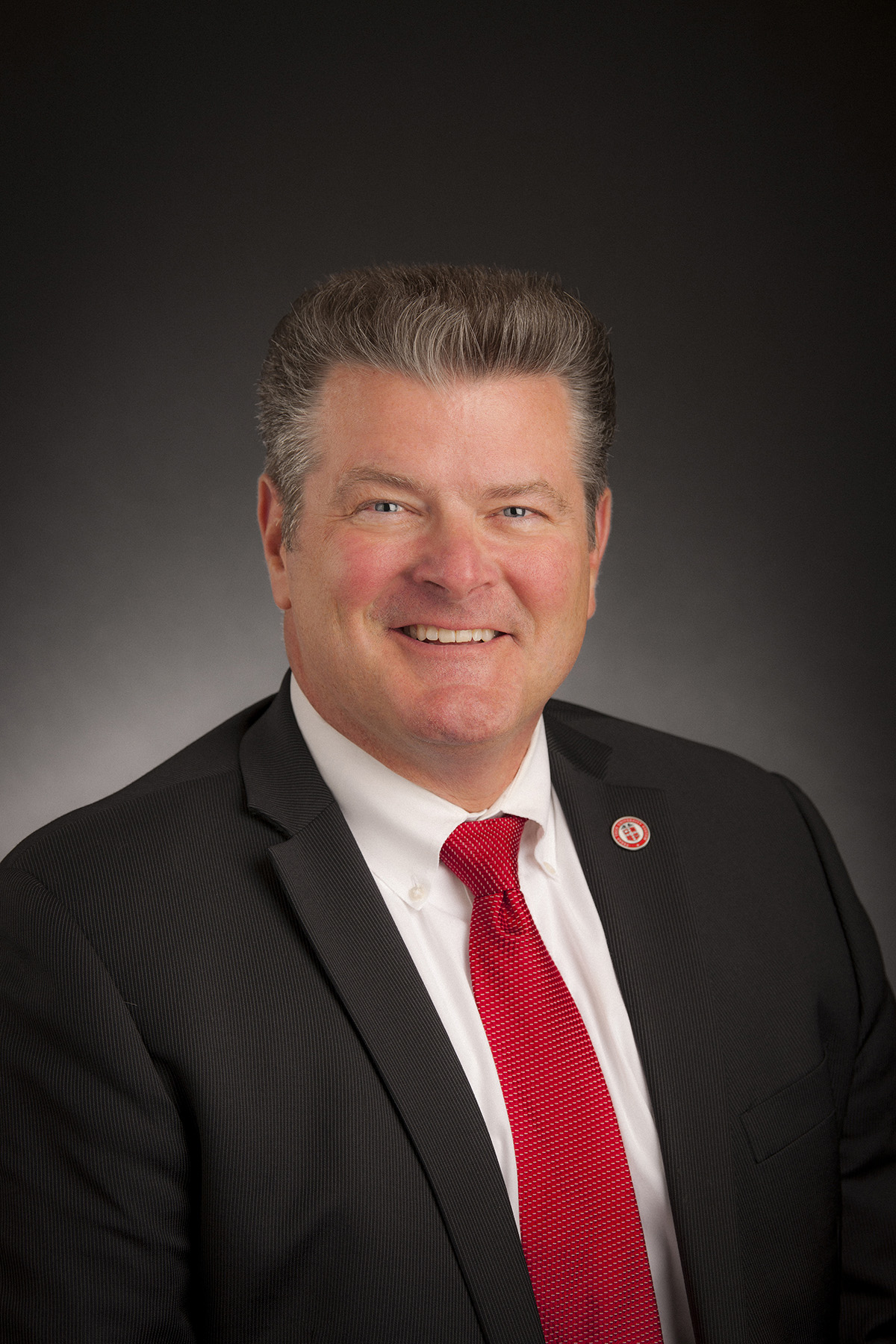
Tedd L. Mitchell, M.D.
System Chancellor
Board of Regents
Term Expires January 31, 2027
Arcilia Acosta....................................Dallas
Cody Campbell, Chair.......................Fort Worth
Pat Gordon.......................................El Paso
Term Expires January 31, 2029
Clay Cash...........................................Lubbock
Tim Culp............................................Midland
Shelley Sweatt...................................Wichita Falls
Term Expires January 31, 2031
Doug McReaken................................Pearland
Don Sinclair........................................Houston
Dustin R. Womble, Vice Chair............Lubbock
Student Regent
Term Expires May 31, 2026
Eli Heath...........................................Flower Mound
Texas Tech University Academic Officers
Mark Sheridan, Ph.D.
Vice Provost for Graduate and Postdoctoral Affairs;
Dean, Graduate School
Jack Nowlin, Ph.D., J.D.
Dean, School of Law
Guy Loneragan, B.V.Sc., Ph.D.
Dean, School of Veterinary Medicine
Clint Krehbiel, Ph.D.
Dean, Davis College of Agricultural Sciences & Natural Resources
Urs Peter Flueckiger, M.Arch.
Dean, Huckabee College of Architecture
Tosha Dupras, Ph.D.
Dean, College of Arts & Sciences
Margaret L. Williams, Ph.D.
Dean, Rawls College of Business
Kamau Oginga Siwatu, Ph.D.
Dean, College of Education
Roland Faller, Ph.D.
Dean, Whitacre College of Engineering
Jill Hernandez, Ph.D.
Dean, Honors College
Tim Dodd, Ph.D.
Dean, College of Health and Human Sciences
Bey-Ling Sha, Ph.D., APR, Fellow PRSA
Dean, College of Media & Communication
Martin Camacho, D.M.A., M.B.A.
Dean, Talkington College of Visual & Performing Arts
Patrick C. Hughes, Ph.D.
Dean, Professional Studies
Earnstein Dukes, M.L.S.
Dean of Libraries
Jeffrey Belnap, Ph.D.
Dean, TTU-Costa Rica
Official Publications
-
Address
Texas Tech Downtown Center Room 218 -
Email
officialpublications@ttu.edu