
Why We're Important
Significance of the Site
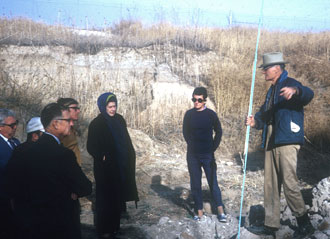
Lubbock Lake Landmark offers a window into the cultural and natural heritage of the Llano Estacado and how people adapted to environmental change through time.
Because Yellowhouse Draw offered a reliable water source, animals frequented this area for about two million years. Humans continuously used this water source as far back as 12,000 radiocarbon years ago (about 13,850 calendar years ago).
While some New World sites may contain evidence of earlier humans, the Landmark is unique because its record of human activity is unbroken.
Many archaeological sites have only one or two cultural levels. Their sediment layers are often mixed and difficult to define. At the Landmark, cultural occupations are more clearly separated by sterile sediment layers where no artifacts are present.
Using an interdisciplinary approach, researchers study artifacts, plants, animal remains, and geologic layers to better understand how people and animals lived within changing landscapes.
Cultural Sequence
The time of people in North America is divided into cultural periods, all represented at the Lubbock Lake Landmark.
The Paleoindian Period is divided into:
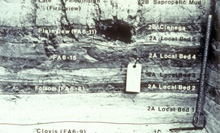
- Clovis (11,500-12,800 radiocarbon years / 13,350-12,675 calendar years ago)
- Folsom (10,800-10,300 radiocarbon years / 12,675-12,100 calendar years ago)
- Plainview (10,000 radiocarbon years / 11,475 calendar years ago)
- Firstview (8,600 radiocarbon years / 9,560 calendar years ago)
Then follows the:
- Archaic Period (8,500-2,000 radiocarbon years / 9,500-1,950 calendar years ago)
- Ceramic (2,000-500 radiocarbon years / 1,950-530 calendar years ago)
- Protohistoric (500-300 radiocarbon years / 530-380 calendar years ago)
- Historic (300 radiocarbon years / 380 calendar years ago to modern times)
Paleoindian
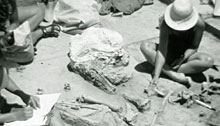
Material from the Clovis Period has been found on a gravel bar of the once-active stream in the ancient river valley. Excavations have uncovered remains of several extinct animals including mammoth, two types of horse, camel, ancient bison, giant short-faced bear, and giant pampathere (an armadillo-like animal).
This material has been recovered from an area where secondary butchering took place, and mammoth bones were broken to secure usable tool material. Folsom and later Paleoindian peoples hunted and killed ancient bison around ponds and marshes in the draw. Locations where bison were both killed and butchered are called kill/butchering locales.
Archaic
The Archaic Period of the Southern High Plains is less understood than other periods. Several bone beds containing bison and pronghorn remains have been found in windblown and stream deposits at the Landmark. A bison kill dating to the Early Archaic and a baking "oven" dating to the Middle Archaic have been discovered.
The oven was a large oval pit containing burned rock and ash. The absence of bone suggests it was used for processing plant matter. Radiocarbon dating places the oven at about 5,000 years old. Several Late Archaic camps have also been uncovered, represented by hearths, scattered hearthstones, discarded tools, and remains of small animals consumed as food.
Ceramic
Broken Puebloan and Mogollon trade-ware pottery has been found in Ceramic levels. Archaeological features include campsites with scattered stone tools, flakes (small stone segments from toolmaking), broken bones, and hearths. Excavation of processing stations from this period has produced remains of modern bison, coyote, wolf, and pronghorn antelope.
Protohistoric
The Protohistoric Period is transitional, extending from just before contact through first contact with Europeans. Spanish explorers were in the area during the later Protohistoric Period, but their presence had no detectable influence on native cultures or archaeological remains. The Apache are known to have been in the area from at least 1400 to the mid-1700s.
Historic
The Historic Period represents full contact with, and influence by, Europeans. Excavated Historic deposits indicate modern horses, metal, and glass. The Apache were displaced from the area by the Comanche, who roamed the Southern High Plains from the mid-1700s to the 1870s. Information from sites of these periods can be compared to historical records to better understand lifeways and population movement.
Evidence of Anglo-American habitation has been found in the most recent archaeological deposits. Artifacts such as rifle cartridges, metal hardware, square nails, buttons, and a ginger beer bottle represent George Singer's store and home of the early 1880s.
The Singer Store was the first commercial business in the area. Located at the edge of what was then called Long Lake at the crossing of two military trails, the store was built near springs as a trading post for early settlers and cattle ranchers. It operated from 1881 to 1886 when it burned down; the store was rebuilt farther downstream. The Singer Store represents the founding of the Lubbock community.
Stratigraphy
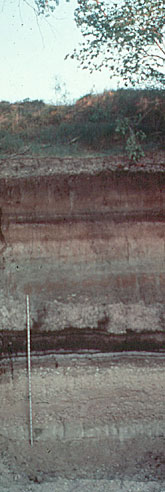
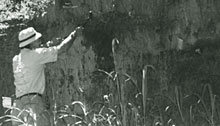
In addition to the cultural record, a geologic history is represented at the Landmark. Different sediments and buried soils indicate local environments at different periods. Soils represent repeated periods when the landscape was stable and neither eroding nor accumulating sediment.
The bedrock at Lubbock Lake is the Blanco Formation, an extensive lake-sediment deposit about 2 million years old. Above it is the Blackwater Draw Formation, a wind-deposited sheet covering much of the region that accumulated between about 1 million and 50,000 years ago. The Dune in the northeastern section of Lubbock Lake contains sediments and buried soils from at least 36,000 radiocarbon years ago. Yellowhouse Draw began developing about 17,700 radiocarbon years ago (about 21,175 calendar years ago), cutting through the Blackwater Draw and into the Blanco Formation. By about 12,000 radiocarbon years ago, the draw had cut a meander about 50 feet deep in the area of the Landmark.
Evidence points to a drying trend at Lubbock Lake over the last 11,000 radiocarbon years (about 12,865 calendar years). The geologic record begins with stream deposits, followed by lake sedimentation, and culminates between 6,500 and 4,500 radiocarbon years ago (about 7,400 to 5,100 calendar years ago) with windblown sediments deposited during severe drought. After 4,500 radiocarbon years ago (about 5,160 calendar years ago), climate was broadly similar to today, with minor changes during the last 2,000 radiocarbon years (about 1,950 calendar years).