
CIO appointed by Gov. Greg Abbot to a two-year term on the Quantum Initiative Advisory Committee
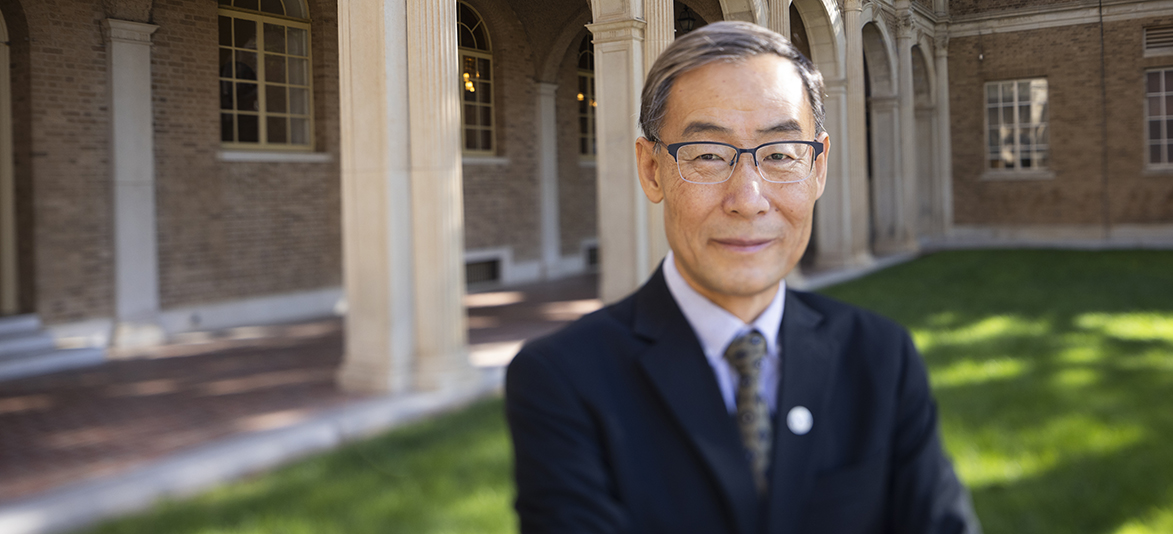
Information Technology is excited to announce that our CIO, Dr. Lin Zhou, has been appointed by Governor Greg Abbott to the Quantum Initiative Advisory Committee. The initiative will develop a strategic plan to advance the quantum economy in Texas.
“Through my work in quantum research and education, I’ve witnessed how quickly this field is moving from theory to impact, and I’m honored to help position our state at the forefront of innovation and societal impact on a global scale.”
Why is Quantum Computing Important?
Quantum computing helps solve problems that exceed the capabilities of traditional computing by leveraging the laws of quantum mechanics. This technology enables us to solve problems that are extremely difficult using today’s traditional computing.
Dr. Zhou’s experience with Quantum Computing
Dr. Zhou received a Bachelor of Science in Physics from Nanjing University and a Doctor of Philosophy in Physics from the University of Glasgow. He is currently a faculty member for the Edward E. Whitacre Jr. College of Engineering and teaches a course on quantum computing.
Before joining TTU, Dr. Zhou served as Senior Vice President and Chief Information Officer at The New School in New York City. There, he spearheaded the institution's quantum initiative, launched the first Quantum Design Jam and Quantum exhibition, and founded the university’s Innovation Center. His groundbreaking work has earned him prestigious accolades, including the CIO100 Award, IDG/CIO FutureEdge50 Award, and the Gold Prize from the Wharton-QS Reimagine Education International Competition.
Currently, Dr. Zhou leads a team of students exploring how quantum computing principles can strengthen deep learning models used in medical imaging, such as breast cancer detection. In a field where even small gains in detection accuracy can significantly impact patient outcomes, their early results demonstrate promising improvements over traditional methods.
What is Quantum Computing?
Traditional computing stores information as bits, which are either 0 or 1. Quantum computing uses qubits, which can exist in combinations of 0 and 1 simultaneously. Qubits can also be linked through entanglement, allowing quantum computers to solve certain problems much more efficiently than traditional computers.
Not only do we have a recognized expert leading our IT initiatives, but TTU will also have representation at the state level helping shape the future of Texas’s quantum economy.
Information Technology
-
Address
Texas Tech University, Office of the CIO, Box 42008, Lubbock, TX 79409 -
Phone
806-742-5151 -
Email
ithelpcentral@ttu.edu