
Coronelli Globe
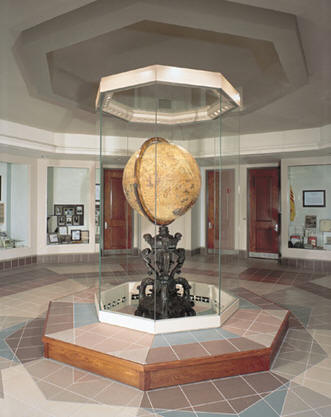
Coronelli Globe and Rotunda. Image courtesy Helmut Guenschel, Inc.
Located in the Coronelli Rotunda within the Southwest Collection/Special Collections Library stands one of Texas Tech University's treasures: Coronelli's 1688 Terrestrial Globe. One of only three in North America, the globe was designed and constructed in the Venetian workshop of the Franciscan Father Vincenzo Coronelli. It is likely that the 1.07 meter (3.5 ft.) globe was paired with a celestial counterpart illustrating the night sky, but its whereabouts are currently unknown. In addition, Texas Tech's globe most likely had a stand similar to the one in this engraving.

Both the celestial and terrestrial globes were based on the two 3.84 meter (12.5 ft.) diameter globes Coronelli presented to King Louis XIV in 1683. Shrewdly capitalizing on his connection to the French throne, Coronelli was able to secure additional financial and political backing from the Roman Catholic Church and the Venetian government. This support enabled Coronelli to establish his workshop and to aggressively elicit geographical and astronomical information from some of Europe's leading scientists and explorers. The result was not only the creation of the largest printed globes of its time, but a whole series of maps, atlases, star charts and even the first alphabetically-arranged dictionary.
Coronelli's 1688 globe illustrates the extent of late 17th century European exploration. For example, the Eastern shore line of Australia, here named "New Holland", is not drawn in. In fact, it would be almost 90 years until James Cook would survey and map the region.

Much closer to the globe's present home, the Mississippi River is located far to the west of its actual route, although the French explorer Robert de La Salle had navigated down the Mississippi in 1682.

The Recent History of Texas Tech University's Coronelli Globe
Little is known of Texas Tech's Coronelli Globe from the time of its construction in 1688 until 1930. It was then that the American newspaper magnate and tireless art collector William Randolph Hearst purchased it for $3,250 from Arnold Seligmann, a Paris antiques dealer. Seligmann probably mated the globe with its present base, which, although approximately the same age as the globe, may originally have supported a flag pole.

Photo of globe from Hearst's album documenting his art and antiquities collection.
Hearst never uncrated the globe, storing it instead in one of his massive warehouses until it was sold at his historic auction in 1941. The globe's scant catalog description, squeezed between everything from suits of armor to complete medieval rooms, incorrectly dated it as being from the 1500's. The purchaser was Texas businessman Harry E. Stewart, whose winning bid of $750 was less than a quarter of what Hearst had originally paid.
In 1963 the Dallas oilman Robert B. Moody purchased the globe from Stewart's estate.

Moody examining the globe ca. 1967.
In 1968 the Texas Tech Friends of the Library bought the globe from Moody for $7,500 as the Library's one millionth acquisition. The globe's meridian arrived at Tech in several pieces, and had to be reconstructed and strengthened with a brass hoop. Displayed until 1984 in the Library's foyer, the globe was removed from public display due to its deteriorating condition.

Realizing the globe's historic and aesthetic significance, Texas Tech Regent James E. Sowell provided funding for an extensive conservation treatment, which was undertaken by Doug Stone of Fulkerstone Fine Arts Conservation located in Milwaukee, Wisconsin.
 Damaged southern polar region
 The base pre repair
 The same region after repair
 The base now
In May of 1997, the globe was rededicated in honor of Texas' First Lady, Laura Bush, shown below with Dr. E. Dale Cluff, Dean of Libraries of Texas Tech University.
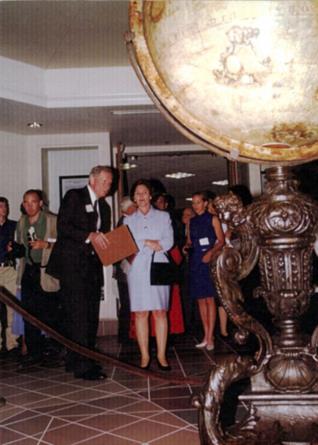
On Ms. Bush's left in the photo below is James E. Sowell. To her right is Grover E. Murray, President of Texas Tech at the time of the globe's original acquisition.

In order to provide a secure environment for the Coronelli globe, a custom exhibit case was constructed by Helmut Guenschel. Positioned in the center of a rotunda built especially for the globe, the case features optical grade glass with seamless joints and fiber optic lighting. Around its base is a step, designed both to facilitate viewing of the globe and to contain trays of silica gel that stabilize the enclosure's relative humidity.
 Helmut Guenschel installing the exhibit case.
For additional information, please contact:
Rob E. King
rob.e.king@ttu.edu
(806) 834-0397
Southwest Collection/Special Collections Library
-
Address
2805 15th St., Box 41041, Lubbock, TX 79409-1041 -
Phone
806.742.3749 -
Email
swco.it@ttu.edu