
It is a warm August night in Lubbock, Texas. Over 60,000 fans have piled into Jones
AT&T Stadium for the first game of the 2025 Texas Tech University football season,
anticipating the 70-year-old tradition that marks the beginning of every game.
In moments, the fans will be on their feet, roaring as the famous Masked Rider streaks across the field with her guns held high atop the horse.
On the field, Sam Jackson, Ph.D., is met with anxiety. The longtime animal science faculty member oversees all things horse-related to Texas Tech’s Masked Rider program. Ahead of each football season, Jackson spends four months preparing both the horse and rider for their ceremonial ride down the field.
“There’s not a moment before I send him that I don’t get nervous,” Jackson said. “I still get chill bumps.”
Jackson, an associate professor in the Department of Animal and Food Sciences at Texas Tech University and member of the Masked Rider Program Advisory Committee, serves in a support role for the program.
As the pregame timer ticks down, Jackson checks the bridle, saddle, rider and horse. Stone-faced, he gives one last nod, the final go-ahead for the Masked Rider and her horse to prepare for their first run together. As the stadium announcer declares the entrance of the team and the gun goes off, Jackson takes a deep breath, and time seems to be at a standstill.
The horse pivots into a tight circle, gathers itself and fires like a bullet shot out of a cannon. Only then does Jackson exhale, watching 60,000 Red Raiders unify around the unique and symbolic tradition of the Masked Rider running.
The Davis College's Role
The Masked Rider is the oldest and most popular mascot at Texas Tech. While not becoming an official mascot until 1954, the roots of the tradition can be dated back to 1936. What began as a dare, the formerly called “Ghost Riders” would circle the field during home games before mysteriously disappearing.
This began a tradition of Masked Riders donning the cape as they led the team out of the tunnel for generations. Since then, there have been 65 Masked Riders chosen to carry on the prestigious tradition, former Masked Rider and author Stacy Stockard Caliva said.
Jackson said the Masked Rider is a notable icon for Texas Tech.
“There are two things that people associate [with Texas Tech] from a mascot standpoint - Raider Red and then the Masked Rider," Jackson said. “The Masked Rider is a little bit more awe-inspiring. The image of that horse running down the field draws people in, makes people have chills.”
Jackson’s role is especially unique because of the Davis College of Agricultural Sciences
and Natural Resources’ direct involvement with the horse and rider.

With a tradition rooted deeply in agriculture, it is no surprise the Davis College coincides deeply with the Masked Rider tradition. In fact, a large majority of Masked Riders have been majors within the college. Whether it be housing and taking care of the horse, providing financial assistance for the members of the program, or providing faculty and staff for the program, the Davis College is essential for the success of the Masked Rider program.
Jackson said the college provides valuable support to navigate the difficulties that come with having a live animal mascot.
“While there are other schools that have live mascots,” Jackson said, “what makes Texas Tech unique is that we are one of the few that has a college of agriculture that supports and takes care of the mascot.”
Other universities with live horse mascots often contract both the horse and rider, Jackson said. The available expertise, facilities and students with horse knowledge within the Davis College allows the university to own the horse and have a qualified student rider.
In fact, Jackson said the college has had a hand in supporting the Masked Rider since the mascot’s origins.
“From day one, when we started having the Masked Rider, it was a university-owned horse, and that student was from the Davis College,” Jackson said.
Jackson said the Davis College supports the Masked Rider financially through a large scholarship for the program.
“A lot of our scholarships for the Masked Rider come through the college,” Jackson said. “It’s a Masked Rider Scholarship, but it’s delivered as a Davis College Scholarship for the Masked Rider.”
Rose Rosas, the 64th Masked Rider at Texas Tech and a first-generation student, said if it were not for this scholarship, she would not be able to attend Texas Tech.
“Without the scholarship, I wouldn’t have even been able to be a student at Texas Tech, let alone be in the position of Masked Rider,” Rosas said. “It definitely helps with the financial stress of holding the position because with the schedule it's definitely hard to hold a job.”
While Masked Riders are not required to be Davis College students, Jackson said many selected for the role come from the college because of the skills its students already possess.
“There are some common themes [among Davis College students] that instill a stronger work ethic, sense of responsibility,” Jackson said. “That’s not to say that there aren’t any students across campus that have those qualities, but when you get in the Davis College, there’s more of those kids that have had experiences that shaped them.”
Davis College Dean, Clint Krehbiel, Ph.D., said being a Masked Rider takes specific character qualities that are common among students from the college.
“It takes a true West Texas spirit,” Krehbiel said. “It takes a lot of grittiness, passion and love for Texas Tech University and our Red Raiders.”
“The image of that horse running down the field draws people in, makes people have chills.”
Stacy Stockard Caliva, the 43rd Masked Rider and author of Long Live the Matadors: The Fearless History of Texas Tech Masked Rider, said Davis College students' experiences in organizations like FFA and taking care of animals tend to draw them to wanting to take care of the horse as the Masked Rider.
“There is something special about being responsible for an animal and knowing that their welfare resides in you,” said Caliva, who received both her bachelor’s and master’s degrees in agriculture communications in [years]. “When I look at our Masked Riders, that’s what I see, so many of our students grew up in that environment from the Davis College, and that’s a path they want to continue.”
Jackson said the Davis College not only supports the Masked Rider, but it takes ownership in its role with the mascot.
“We see it as our responsibility,” Jackson said. “We not only want to support the Masked Rider Program, but we have an obligation to. There’s a sense of pride. That’s our horse. That’s our rider.”
Jackson said the Davis College is committed to doing their part for the Masked Rider program.
“Never do I question, ‘Is the Davis College committed to this program?’” Jackson said. “They are 100% committed. That’s a good feeling because not all universities have that support.”
The Role of The Masked Rider
The Masked Rider holds a prominent place in Texas Tech tradition and is a highly sought after role with significant time commitments.
“The Masked Rider will do over 400 appearances in a year,” said Stephanie Rhode, spirit program director. “You’re also having to ride the horse, feed the horse, muck the stalls.”
The role plays a large part in the gameday tradition of the Texas Tech football team, and Joey McGuire, head coach for the Red Raiders, said gamedays would not be the same without it.
“The Masked Rider is a tradition that is near and dear for every Red Raider out there and really just resonates with the culture of the university,” McGuire said. “The Masked Rider has the ability to impact future generations of Red Raiders.”
Masked Rider appearances can range from community outreach events at a local elementary school or charity, university recruitment events, or appearances at Texas Tech sports.
Whether it be event appearances, caring for the horse, or catching up on missed schoolwork, Masked Riders are left with very little free time.
“I think back to when I was a student, and I often have thought, ‘Why would you want to take that on?’” Rhode said. “It’s so much work.”
64th Masked Rider, Rosas knows all too well about the work that goes into keeping the tradition alive. She said most of her free time is devoted to taking care of the horse or making appearances at events.
“Being the Masked Rider is a daily commitment, not just something that happens on
gamedays,” Rosas said. “A lot of my responsibilities happen behind the scenes. I am
caring for the horse every day, making sure he is worked, fed and kept in top condition.
Balancing academics, personal life, and the responsibilities of the Masked Rider has
definitely pushed me to grow.”

Choosing the Rider
The Davis College plays a key role in the Masked Rider program’s selection of both the rider and the horse. Jackson said a great deal of thought goes into selecting the horse.
“[The horse] has to tolerate so much,” Jackson said. “They have to stay so even. They can’t be temperamental. These horses have to be kind, willing, accepting and trusting. To get that horse that can be all those things and look good – it’s hard to find.”
Jackson said strong horsemanship skills are essential for candidates.
“Obviously, one of the main criteria is their horse-related abilities,” Jackson said. “I don’t care who you are or how much you have ridden horses, you have never been on a horse in the environment of a football game.”
Jackson said because the student will be required to miss classes, it is imperative the Masked Rider has strong study habits.
“Academically, we have a certain GPA requirement to try out,” Jackson said. “That is to protect the students. Typically, our applicants are great students. They learn great time management. Academically, [being a Masked Rider] magnifies their abilities.”
More Than a Mask
The Masked Rider represents what it means to be a Red Raider. Caliva said without it, the university would not be the same.
“It is such a valuable part of our university, and it's a symbol of it,” Caliva said. “It is Texas Tech.”
Rosas says when she puts on the mask, she feels a responsibility to honor the tradition.
“The Masked Rider represents tradition, history and the legacy of every rider who has come before me,” Rosas said. “It is a role that carries decades of meaning at Texas Tech, and when I wear the mask, I am very aware that I am representing not just the university, but also the riders who helped build tradition over time.”
From the Ghost Riders of 1936 to the Masked Rider that is seen today, the tradition has remained rooted in the values and symbols of the university.
Through changing times and changing of the reigns, the Masked Rider has remained the same.
“It harkens back to what we are all so proud about living in [West Texas],” Caliva said. “It’s that dramatic, symbolic thing that stirs our heart when we see it.”
Capturing The Tradition
By: Coleman Mitchell, Carly Watson, Clara Mechem, Carley Smith
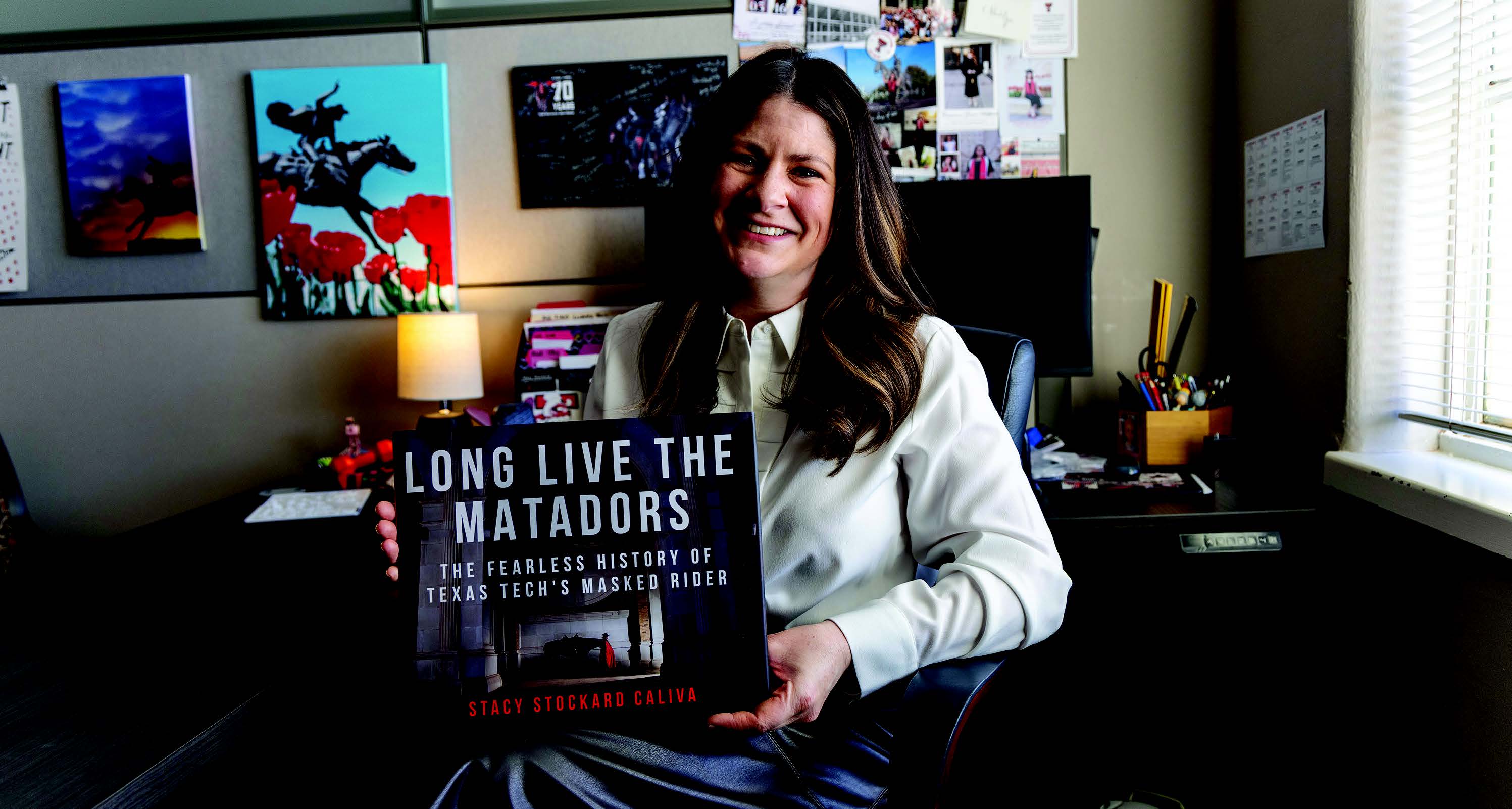
Stacy Stockard Caliva understands what it is like to ride horseback, at full speed, down the field at Jones AT&T Stadium. As Texas Tech University’s 43rd Masked Rider in 2004-2005, Caliva said the experience shaped her life in many ways.
“[Being a Masked Rider] made me love the university even more than I already did,” Caliva said. “It only makes you stronger and more confident in your skills.”
In the nearly two decades since serving as the Masked Rider, Caliva has remained engaged with the spirit program, serving on the Masked Rider Program Advisory Committee. Now, the agricultural communications alum (B.S. ’05, M.S. ’06) is the director of communications and marketing for Texas Tech University’s Office of Advancement. It was in this role that she and a coworker were tasked with speaking about one of the traditions surrounding the Masked Rider.
She started doing research on the stories around the program, which inspired her to dig deeper into the history of the Masked Rider, and ultimately write a book.
“I started from the very beginning because that’s where I had the most questions,” Caliva said, “and I just started looking up things.”
Caliva said she felt a responsibility to the tradition to publish the book and preserve the history of the Masked Rider.
“As I was reading these stories about the riders and horses in our program,” Caliva said, “I just got emotional thinking about how if we didn’t document this somewhere, it would get lost to history.”
Caliva said she was left with a sizable stack of research when somebody she looked up to suggested she write a book with the information she gathered. From there, Caliva said her journey as an author took off.
After spending years researching the program and its history, in 2024, Caliva published Long Live the Matadors: The Fearless History of Texas Tech Masked Rider.
Caliva said her book serves as the written and photographic history of the tradition of the Masked Rider.
“[Former Masked Riders] gave so much of themselves to build this tradition, to represent our university in this way,” Caliva said. “It was important to me that we documented the sacrifices and the work that they did for this.”
Caliva’s book can be purchased through the Texas Tech University Press website, at Barnes & Noble stores or online and on Amazon. For additional information about Caliva and her book, or to schedule her for a speaking event, visit stacystockard.com.
Read more from The Agriculturist
“You don’t want to be the generation that loses the family farm. The way it was done before isn’t how we’re going to keep it going.”
By: Brooke Poole, Cash Martin, Abigail Albracht, Christian Purcell
Developed a decade ago by agricultural communications faculty at Texas Tech, a four-course structure of senior-level capstone experiences was designed to create a coordinated learning environment that mirrors the realities of modern communication careers. Rather than completing upper-level coursework independently, students take these four courses simultaneously. Students and faculty refer to this experience as the “ACOM Block.”
Read 'A Decade of Development'
By: Savannah Sinclair, Garren Hamby, Madeline Braman, Tate Walker
Morning light breaks over the pens as Katie Day swings into the saddle, settling in for another day of work. By the time most people are starting their morning, Day has already checked cattle, moved stock and handled whatever the morning demanded. She has no single job description, only the expectation to get the work done.
By: Kyra Holt, Emma Roberts, Brock Jonas, Cutter Bishop
Texas Tech University’s's Davis College of Agricultural Sciences and Natural Resources has named its inaugural 30 Under 30 cohort, recognizing young alumni making early impacts. Representing six departments and 11 undergraduate majors, these graduates are refining the ‘From Here, It’s Possible’ mentality as they thrive as communicators, scientists, educators and leaders.
By: Trista Stanley, Ashlynn O’Bannion, Ally Smitley, Reagan Sanders
Out in the wide-open Texas Panhandle, Downs is not sitting in a classroom; he is managing cattle, monitoring feed and learning to make decisions on his own.
“I fully expected to go into this internship and make a little bit of money while learning a little bit about dairy cattle,” Downs said. “I thought that was the end of it, but I really grew as an individual.”
By: Caitlyn Black, Torrance Thedford, Sterlin Richardson, Madyson Clark
The road to graduation is long, winding and can look very different for each student at Texas Tech University. But in the Davis College of Agricultural Sciences and Natural Resources, students do not have to travel that road alone. With a tradition of prioritizing student success, the college’s advisors make sure students are supported academically and personally.
By: Caleb McDonald, Elizabeth Rone, Madi Lindley, Brooke Brittain
For three undergraduate students in the Davis College of Agricultural Sciences and Natural Resources, the college experience at Texas Tech University has meant much more than just going to class and getting a degree. While each student may be taking a different path on their educational journey, all three are making the most of their time at Texas Tech to prepare for their careers.
Read 'From Classroom to Career'
By: Marlee Montalvo, Hannah Torres, Natalie Dietrich, Madilyn Howell
“Research at Davis College is designed around pressing challenges faced by producers, communities, and ecosystems, particularly in water-limited and climate-stressed regions like the Texas High Plains.”
By: Abigail Garza, Braylee Brooks, Mylen Garza, Cheyenne Davis, Sofia Perez
“That experience of being surrounded by like-minded individuals who are driven, not only does that help them stay driven and stay connected, but it also makes them feel welcome in Davis College.”
Read 'A Recipe for Student Success'
By: Natalie Brennan, Cooper Bennett, Preslee Minter, Landry Roberts

The Agriculturist
-
Address
Department of Agricultural Education & Communications, Box 42131, Lubbock, TX 79409-2131 -
Phone
806.742.2816 -
Email
lindsay.kennedy@ttu.edu