
Dr. Huang's Lab Biophysics of lipid membrane and application of liposome technology
Overview
This multidisciplinary research program integrates nanofabrication, liposome technology, and molecular biology to advance biomembrane-based sensing and delivery systems. It includes the design of an artificial cell–based biosensor microchip for high‑throughput detection of chemical and biological agents, environmental monitoring, clinical diagnostics, and ion‑channel drug screening; experimental and theoretical studies of cholesterol superlattices that reveal unique multibody interactions in lipid membranes; development of effective non‑viral DNA delivery systems, including receptor‑targeted immunoliposomes for gene and drug therapy; and investigation of membrane heterogeneity and anomalous diffusion of lipids and proteins using quantitative microscopy and Monte Carlo simulations.
Focuses
Biosensor microchip
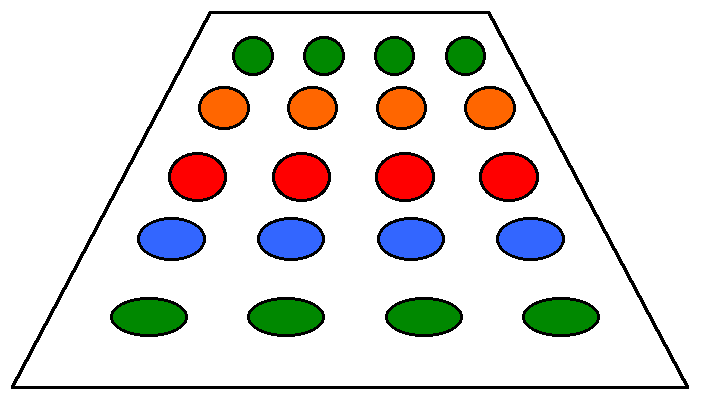
This multidisciplinary project involves collaboration of nano-fabrication, liposome technology, and molecular biology. The goal is to design and fabricate a novel artificial-cell based biosensor microchip to be used for high throughput detection of chemical and biological agents, environmental monitoring, clinic diagnosis, and rapid ion channel drug screening.
Properties and theory of superlattices
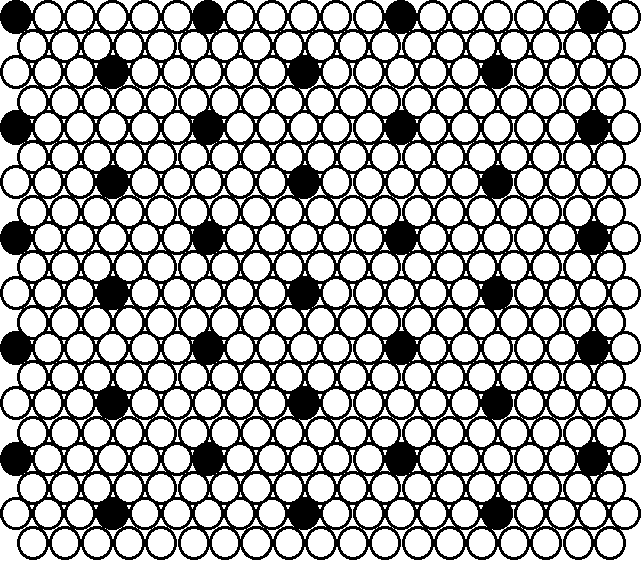
Cholesterol superlattice is an interesting phenomenon. Cholesterol can adopt a crystal-like lateral distribution (superlattice) in a fluid-phase lipid membrane without the help of rigid chemical bonds. Such structures reflect some unique multibody interactions in biomembranes. We are interested in experimental characterization and the theory of the superlattices.
Nonviral DNA delivery
This collaboration project aims to develop and characterize an effective non-viral DNA vector system for gene therapy. The long-term goal is to create "immunoliposomes" to targeting cell surface receptors for gene and drug delivery.
Membrane heterogeneity and anomalous diffusion
Biomembranes are quite heterogeneous, due to the existence of many micro-domains, such as caveolae and lipid Rafts. Diffusions of biomolecules on a cell membrane are often anomalous, i.e., they don't follow the usual diffusion equation <r^2> = 4Dt. We investigate the anomalous diffusion of cholesterol, phospholipids, and membrane proteins using quantitative microscopy techniques and Monte Carlo simulation.
Techniques
- Membrane protein binding and activity assays
- Liposome fabrication
- Fluorescence spectroscopy, fluorescence anisotropy, and fluorescence resonance energy transfer (FRET)
- Synchrotron X-ray diffraction
- Quantitative fluorescence microscopy
- Light scattering
- Monte Carlo and Molecular Dynamic computer simulations
Department of Physics and Astronomy
-
Address
Texas Tech University, Department of Physics & Astronomy, Box 41051, Lubbock, TX 79409-1051 -
Phone
806.742.3767 -
Email
physics.astronomy.webmasters@ttu.edu