

Research AreaPhysics Education
Overview
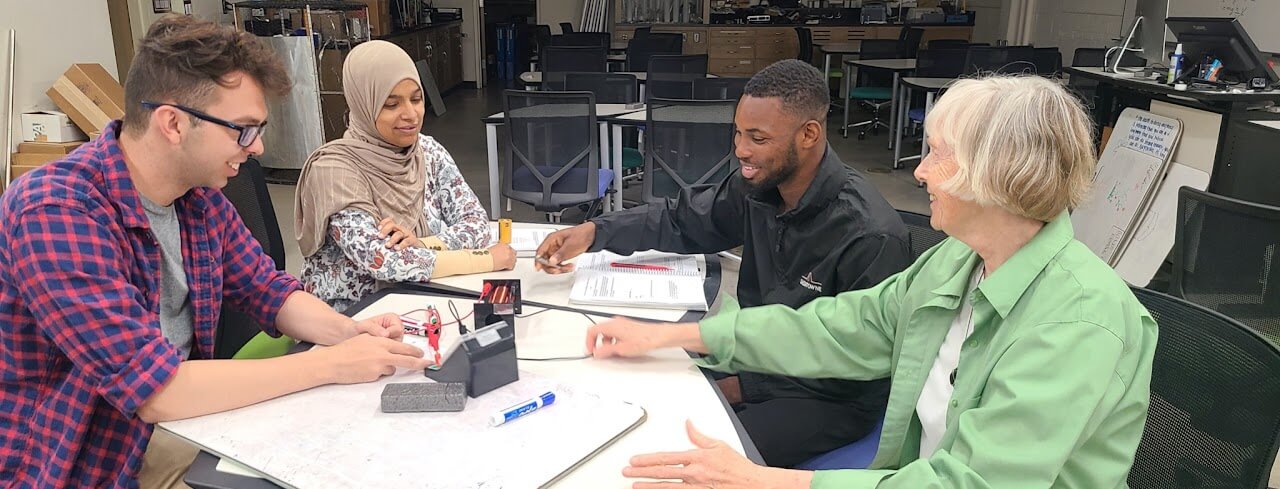
The Texas Tech University Physics Education Research Group presently consists of Prof. Beth Thacker and three graduate students, Kyle Wipfli, Eric Ji and Yaren Ulu. They are working
on assessing pedagogical content knowledge (PCK) of Learning Assistants (LAs) in an
inquiry-based physics class, graduate students' understanding of symmetry and conservation
laws in classical mechanics and students' understanding of Quantum Computing (QC)
at the undergraduate level. Dr. Thacker welcomes graduate students who are interested
in physics education research.
Research Topics
- Assessing pedagogical content knowledge (PCK) of Learning Assistants (LAs) in an inquiry-based physics class
- Assessing students' thinking skills across pedagogies, class sizes and covid/non-covid
- Educational Augmented Reality
- Assessing Thinking Skills in Free-Response Exam Problems
- Exploration of Symmetry and Conservation laws in Classical Mechanics at the Graduate Level
- Student Understanding of Quantum Computing at the Undergraduate Level
- Students' Physics Identity and Metacognition
Projects
Evidence-based Materials for Teaching Quantum Information Science and Technology
Recent growth in Quantum Information Science and Technology (QIST) in both the governmental and commercial sectors is opening up jobs for quantum computer scientists and challenging universities to build interdisciplinary STEM pathways to degrees in QIST. We are taking up that challenge, developing evidence-based materials for use in undergraduate QIST courses. The main goals of this project are to:
- Develop a set of evidence-based materials (pre- and post-tests and mini-tutorials) to be used in an introductory undergraduate QIST course.
- Answer the research question: What are students’ strengths and difficulties in an introductory undergraduate QISTcourse?
Our research will result in data on students’ conceptual understanding and reasoning
skills in QIST, identifying common strengths and difficulties with key QIST concepts
and reasoning skills. The results will be used to develop a set of educational materials
(pre- and post-tests and mini-tutorials) to help educate undergraduate students studying
QIST, expanding the QIST workforce. We are an interdisciplinary collaboration, consisting
of researchers and educators in QIST across physics, engineering, computer science
and science education. Our results will be made available to others for use in educating
the next generation of QIST scientists at other colleges and universities also.
Funded by NSF DUE grant 2235464
Research Group Director

Graduate Students
- Yaren Ulu
- Emmanuel Ebom
- Mahamadu Duut
- Anton Kononenko
Recent Graduates
- Kyle Wipfli
- Fatema Al-Salmani
- Tunde Kushimo
- Michael Herkommer
- Charles Ramey II
Department of Physics and Astronomy
-
Address
Texas Tech University, Department of Physics & Astronomy, Box 41051, Lubbock, TX 79409-1051 -
Phone
806.742.3767 -
Email
physics.astronomy.webmasters@ttu.edu