Texas Tech University
Skip to Summit content

Welcome to the

CECREH 2026 Summit

Transforming Housing Recovery through Research-driven Capacity Building

Thursday, October 22, 2026

Red Raider Lounge · Student Union Building · Texas Tech University

Scenes from the 2025 Inaugural Summit

Your summit day.

All times Central. Open a session for details.

9 agenda items
Filter by session type
Breakfast with student poster presentations
8:00–8:30 AM CentralRed Raider Lounge · Student Union Building

Start the day with breakfast and student poster presentations.

Explore the Summit posters
Welcome remarks
8:30–8:45 AM CentralRed Raider Lounge · Student Union Building
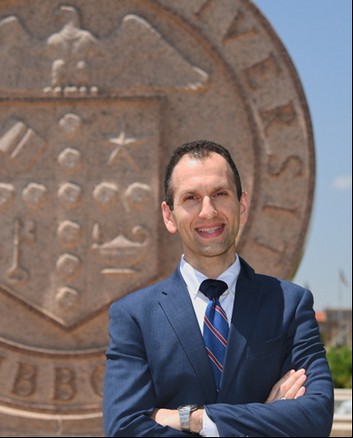
Dr. Ali Nejat

Speaker · CECREH Director · Texas Tech University

Mr. Clay Cash

Speaker · Member of the TTU Board of Regents

Dr. James Reecy

Speaker · TTU Vice President for Research and Innovation

Dr. Rod Williams

Speaker · TTU Vice Provost for Outreach and Engagement

CECREH Impact and Innovation
8:45–9:30 AM CentralRed Raider Lounge · Student Union Building
Dr. Ali Nejat

Speaker · CECREH Director · Texas Tech University

Roundtable: Research Fellow Experiences
9:30–10:15 AM CentralRed Raider Lounge · Student Union Building
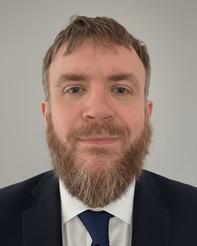
Jesse Andrews

Roundtable participant · Postdoctoral Research Associate · Texas Tech University

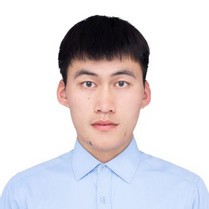
Kaifa Lu

Roundtable participant · Postdoctoral Research Associate · Texas Tech University

Amin Sobhani

Roundtable participant · Research Assistant · Texas Tech University

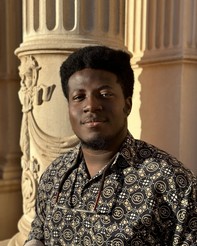
Temidayo Popoola

Roundtable participant · Research Assistant · Texas Tech University

Paul Iyoha

Roundtable participant · Research Assistant · Texas Tech University

Mehrdad Nourbakhsh

Roundtable participant · Research Assistant · Texas Tech University

Miranda Sauceda

Roundtable participant · Research Assistant · Texas A&M University at Galveston

Summer Pylant

Roundtable participant · Research Fellow · Texas A&M University at Galveston

Aaron Ford

Roundtable participant · Texas Southern University

Lamin Kabia

Roundtable participant · Texas Southern University

Dr. Ashley Ross

Moderator · CECREH Associate Director · Texas A&M University at Galveston

Coffee break with student poster presentations
10:15–10:45 AM CentralRed Raider Lounge · Student Union Building

Continue the conversation over coffee and student posters.

Explore the Summit posters
Post-Hurricane Harvey Construction Quality Study
10:45–11:30 AM CentralRed Raider Lounge · Student Union Building
Dr. Shannon van Zandt

Participant · Texas A&M University

Dr. Ivis Garcia

Participant · Texas A&M University

Cecelia Fontenot

Participant · FHNR

Julia Orduña

Moderator · Texas Housers

Break for group photo and box lunches
11:30 AM–12:00 PM CentralRed Raider Lounge · Student Union Building

A break for the group photo and box lunches before the final roundtable.

Roundtable: Housing Recovery and the Road Ahead
12:00–12:45 PM CentralRed Raider Lounge · Student Union Building
Maddie Sloan

Roundtable participant · Texas Appleseed

Dr. Andrew Rumbach

Roundtable participant · Urban Institute

Julia Orduña

Roundtable participant · Texas Housers

Adam Pirtle

Roundtable participant · Legal Aid of NorthWest Texas

Dr. Ali Nejat

Moderator · CECREH Director · Texas Tech University

Closing remarks
12:45–1:00 PM CentralRed Raider Lounge · Student Union Building
Dr. Ali Nejat

Speaker · CECREH Director · Texas Tech University

Your saved sessions stay on this device. Calendar files work with Outlook, Apple Calendar and Google Calendar.

Summit booklet

The Summit, page by page.

Browse the complete program, people and research portfolio.

Open PDF
of 20
 
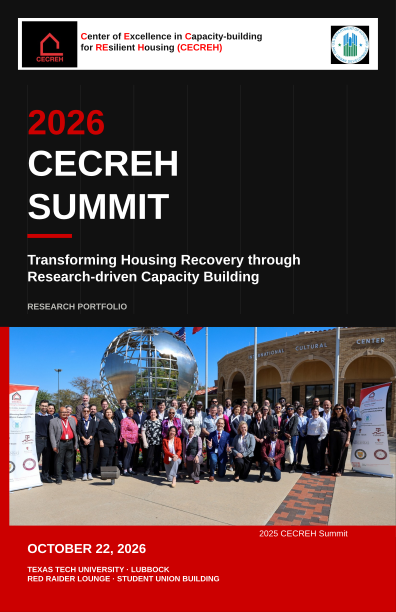
Cover of the CECREH 2026 Summit booklet

Turn the pages to explore the Summit.

20-page Summit bookletDrag a corner or use the arrows to turn a page.

People behind the conversation.

Speakers, moderators and roundtable participants. Open a name for their sessions.

Meet the people behind the program.Speakers, moderators and research fellowsView all participants
22 program participants
Aaron FordTexas Southern University
Adam PirtleLegal Aid of NorthWest Texas
Dr. Ali NejatCECREH Director · Texas Tech University
Amin SobhaniResearch Assistant · Texas Tech University
Dr. Andrew RumbachUrban Institute
Dr. Ashley RossCECREH Associate Director · Texas A&M University at Galveston
Cecelia FontenotFHNR
Mr. Clay CashMember of the TTU Board of Regents
Dr. Ivis GarciaTexas A&M University
Dr. James ReecyTTU Vice President for Research and Innovation
Jesse AndrewsPostdoctoral Research Associate · Texas Tech University
Julia OrduñaTexas Housers
Kaifa LuPostdoctoral Research Associate · Texas Tech University
Lamin KabiaTexas Southern University
Maddie SloanTexas Appleseed
Mehrdad NourbakhshResearch Assistant · Texas Tech University
Miranda SaucedaResearch Assistant · Texas A&M University at Galveston
Paul IyohaResearch Assistant · Texas Tech University
Dr. Rod WilliamsTTU Vice Provost for Outreach and Engagement
Dr. Shannon van ZandtTexas A&M University
Summer PylantResearch Fellow · Texas A&M University at Galveston
Temidayo PopoolaResearch Assistant · Texas Tech University

Evidence for better recovery.

Nine projects across three research objectives. Open a project to explore the work.

Documentation Hub
9 research projects
Objective 1Understand climate risk
1AModel Historic Climate Risk

Locally tested models of insured flood losses support screening after major storms.

Research approach

National Flood Insurance Program loss data cover the Tax Day Flood, Harvey and Irma in Texas and Florida. Spatial and cross-event comparisons test statistical and machine-learning models.

Findings and applications

The 2026 Urban Climate article reports XGBoost AUC values of 0.84, 0.90 and 0.83 for the three events. Classification outperformed loss-magnitude regression. The models screen observed insured losses; they do not estimate total physical damage.

Research team

Dr. Ali Nejat · Dr. Katharine Hayhoe · Temidayo Popoola · Jesse Andrews · Kaifa Lu

1BModel Future Climate Risk

Climate projections, housing growth and vulnerability identify persistent exposure hotspots in Harris County.

Research approach

A public dashboard links precipitation at four warming levels with 2020–2050 population, households, employment, land use and vulnerability. The team tests 432 index specifications across 1,115 tracts.

Findings and applications

Ninety-four tracts remain top-quintile priorities in at least 90% of specifications. The 163 growth-only tracts account for 67.8% of projected household growth. Preliminary planning-gap analysis identifies 167 priority tracts.

Research team

Dr. Ali Nejat · Dr. Katharine Hayhoe · Temidayo Popoola · Jesse Andrews · Kaifa Lu

1CIdentify Underserved Future Needs

Community capitals and local capacity shape future housing needs in the Lower Rio Grande Valley.

Research approach

A published review, interviews with 14 officials and community leaders, BRIC mapping and an exploratory system dynamics model examine six capitals. A resident housing-access survey is planned.

Findings and applications

Interviews identify drainage constraints, slow assistance, staffing shortages, language barriers and coordination gaps. The exploratory model supports scenario discussion rather than forecasts.

Research team

Dr. Ashley Ross · Dr. Ali Nejat · Danielle Craig

Objective 2Measure recovery capacity
2AIdentify Benchmarks of Recovery Needs

Explicit reference points help agencies judge whether housing recovery is adequate and equitable.

Research approach

The review distinguishes a 61-study manuscript sample from 112 eligible supplemental studies. Expert interviews and Hurricane Ian recovery records in Lee County inform the work; household interviews are planned.

Findings and applications

Supplemental analysis found 65 inclusive benchmark mappings across 34 studies and 19 strict indicators across 12 studies. The manuscript sample contained no strict benchmarks. The manuscript is under final internal review.

Research team

Jesse Andrews · Dr. Sara Hamideh · Dr. Ashley Ross · Dr. Ali Nejat

2BDefine Local Capacity for Equitable Recovery

Administrative, technical, financial, intergovernmental and community-engagement capabilities support equitable recovery.

Research approach

Five decades of scholarship and roughly 20 practitioner interviews inform a framework of local government recovery capacity. Continuing Houston and Harris County interviews add CDBG-DR experience.

Findings and applications

Practitioners emphasize engagement and collaboration more than scholarship does. The framework informs capacity-building guidance, participatory training and coordination; coding continues.

Research team

Dr. Ashley Ross · Dr. Laura Solitare · Abigail Ulman · Miranda Sauceda · Summer Pylant · Dr. Ali Nejat

2CIdentify Levers of Housing Recovery

System dynamics and agent-based models examine funding, administrative review and construction capacity.

Research approach

The system dynamics model follows 22,476 post-Harvey homeowner cases. RAAbIT models households, insurers and contractors and is tested against rebuilding records in Santa Rosa and Paradise. Related studies compare grants across three states and review 35 computational recovery studies.

Findings and applications

The preliminary system dynamics model separates funding limits on completed homes from timing effects on recovery pace; calibration is the next step. RAAbIT reproduces observed wildfire rebuilding patterns. The models support comparison of recovery policies.

Research team

Dr. Rodrigo Costa · Dr. Ali Nejat · Dr. Sara Hamideh · Amin Sobhani

Objective 3Tools and interventions
3AModel How Capacity Affects Equitable Recovery

Program-specific government capacity is linked to CDBG-DR spending, completion and equitable delivery.

Research approach

A national study examines 130,605 quarterly-performance records across 18 disaster cohorts through June 2025. A public database covers 2001–2023 disasters and appropriations across 40 states and territories.

Findings and applications

Heavier workloads are consistently associated with weaker recovery performance. Timing analyses retain programs that are not complete, and spatial screening helps identify capacity and implementation gaps for technical assistance.

Research team

Dr. Sara Hamideh · Dr. Laura Solitare · Dr. Ali Nejat · Kaifa Lu · Jesse Andrews

3BImprove Action Plans with Forward-Looking Risk

Climate information and simulation can strengthen recovery planning for underserved communities.

Research approach

State Action Plan and expenditure comparisons track allocation changes. Houston interviews examine data and coordination needs. A drafted wildfire-risk review integrates climate, land use, exposure, vulnerability, infrastructure, health and loss.

Findings and applications

Preliminary interviews reveal recurring data and coordination gaps. The framework remains a research synthesis, with operational policy testing ahead; planned focus groups will refine practical uses of simulation.

Research team

Dr. Rodrigo Costa · Dr. Ashley Ross · Dr. Ali Nejat · Kaifa Lu

3CAssess Resilience–Cost Tradeoffs

Manufactured housing and new construction methods must balance affordability with resilience.

Research approach

Price and retrofit-cost data, benefit-cost and life-cycle analysis, wind fragility and anchorage models complement full-scale Wall of Wind tests of three homes and seven configurations. RAMP adds concrete printing, debris-impact testing and finite-element analysis.

Findings and applications

The pricing manuscript is in revision and other analyses remain drafts. The simulated mean benefit-cost ratio is 10.72 under baseline assumptions for 252 Texas counties. Installation and anchorage remain critical to wind performance; wall-response analysis supports further validation.

Research team

Dr. Elaina Sutley · Dr. Bradley Ewing · Dr. Ali Nejat · Paul Iyoha · Mehrdad Nourbakhsh

Research on display · Summit posters

Explore the work presented by CECREH researchers at the 2026 Summit.
View the collection in the Documentation Hub
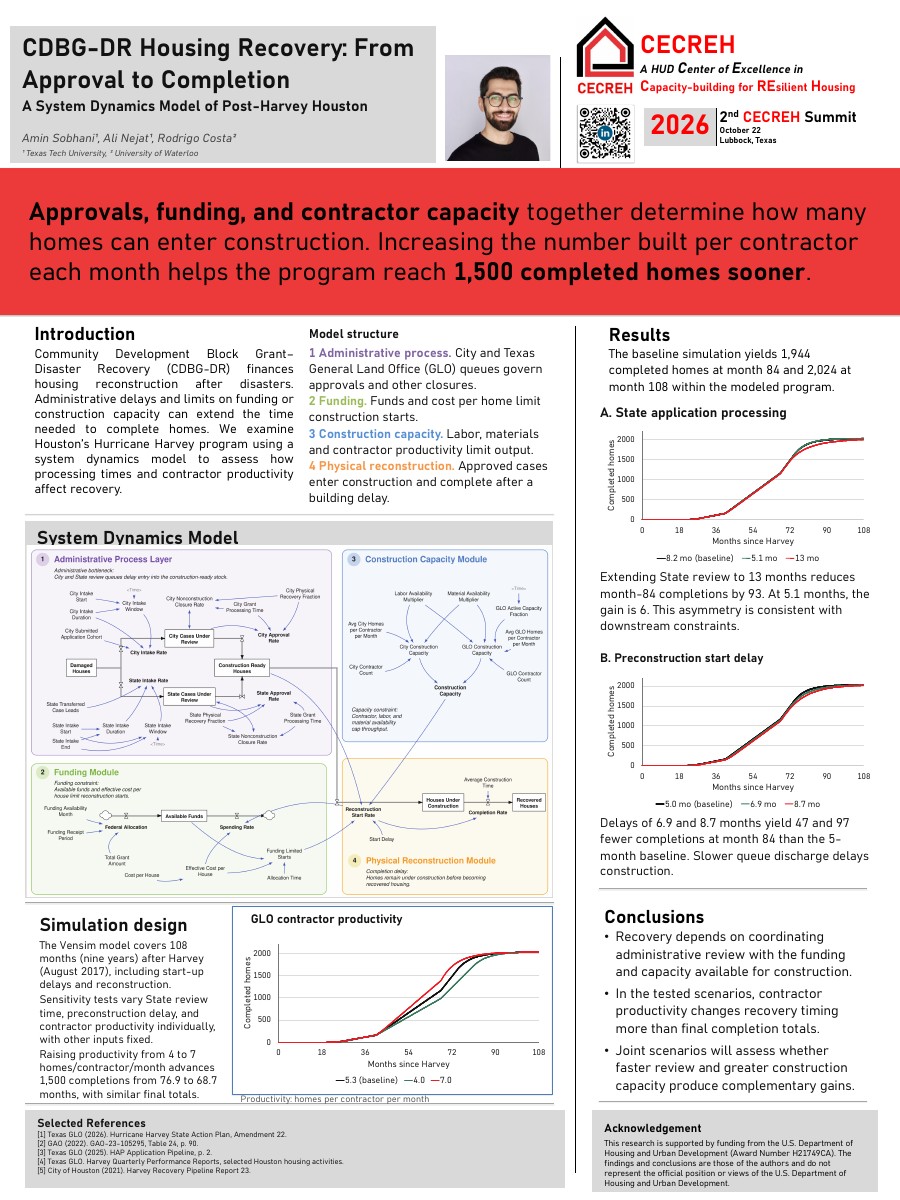
CDBG-DR Housing Recovery: From Approval to Completion — A System Dynamics Model of Post-Harvey Houston

CDBG-DR Housing Recovery: From Approval to Completion — A System Dynamics Model of Post-Harvey Houston

Amin Sobhani, Ali Nejat, Rodrigo Costa

Uses a system dynamics model of Houston’s post-Harvey housing program to examine how application processing, funding, construction delays, and contractor productivity affect the pace of home completion.

Open poster · PDF
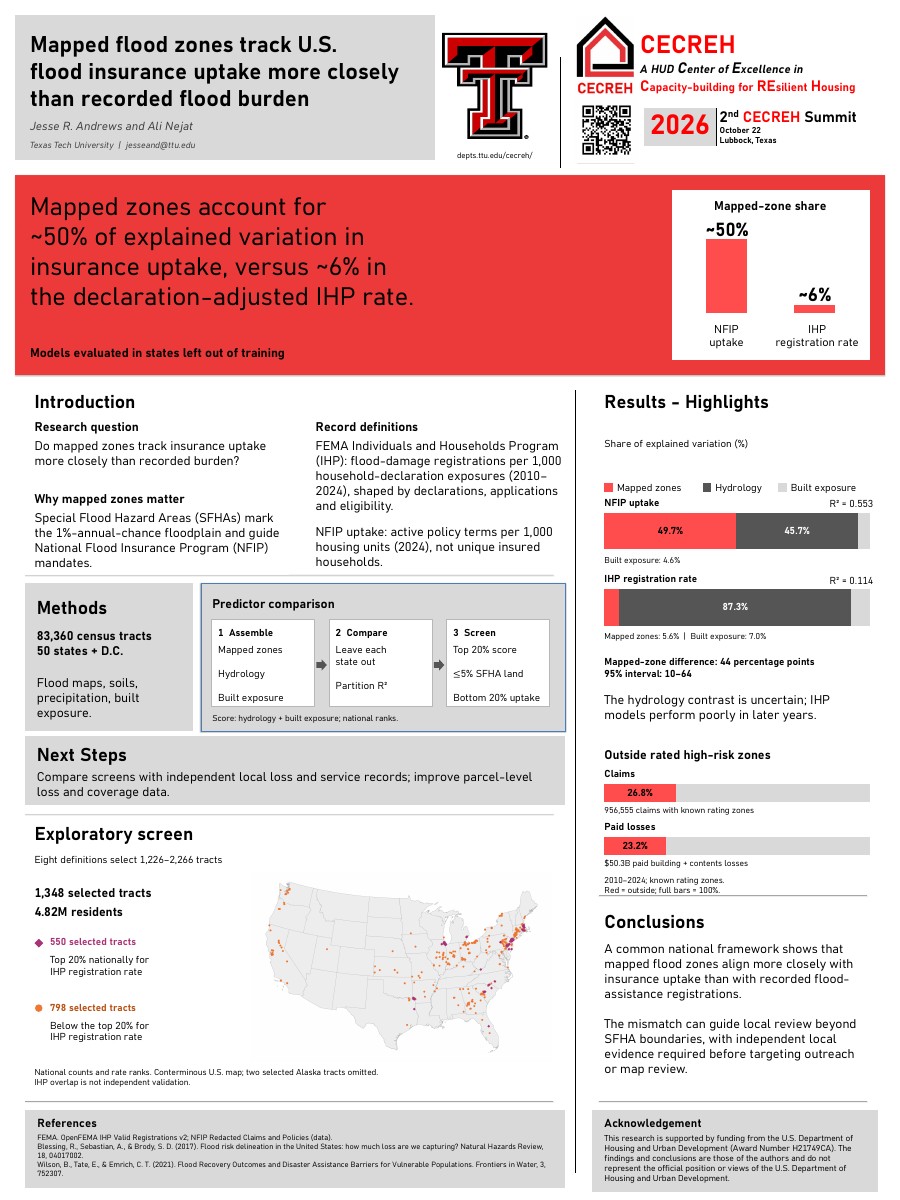
Mapped flood zones track U.S. flood insurance uptake more closely than recorded flood burden

Mapped flood zones track U.S. flood insurance uptake more closely than recorded flood burden

Jesse R. Andrews, Ali Nejat

Compares mapped flood zones, hydrology, and built exposure with flood insurance uptake and FEMA flood-damage registrations across U.S. census tracts, including exploratory screening beyond mapped high-risk zones.

Open poster · PDF
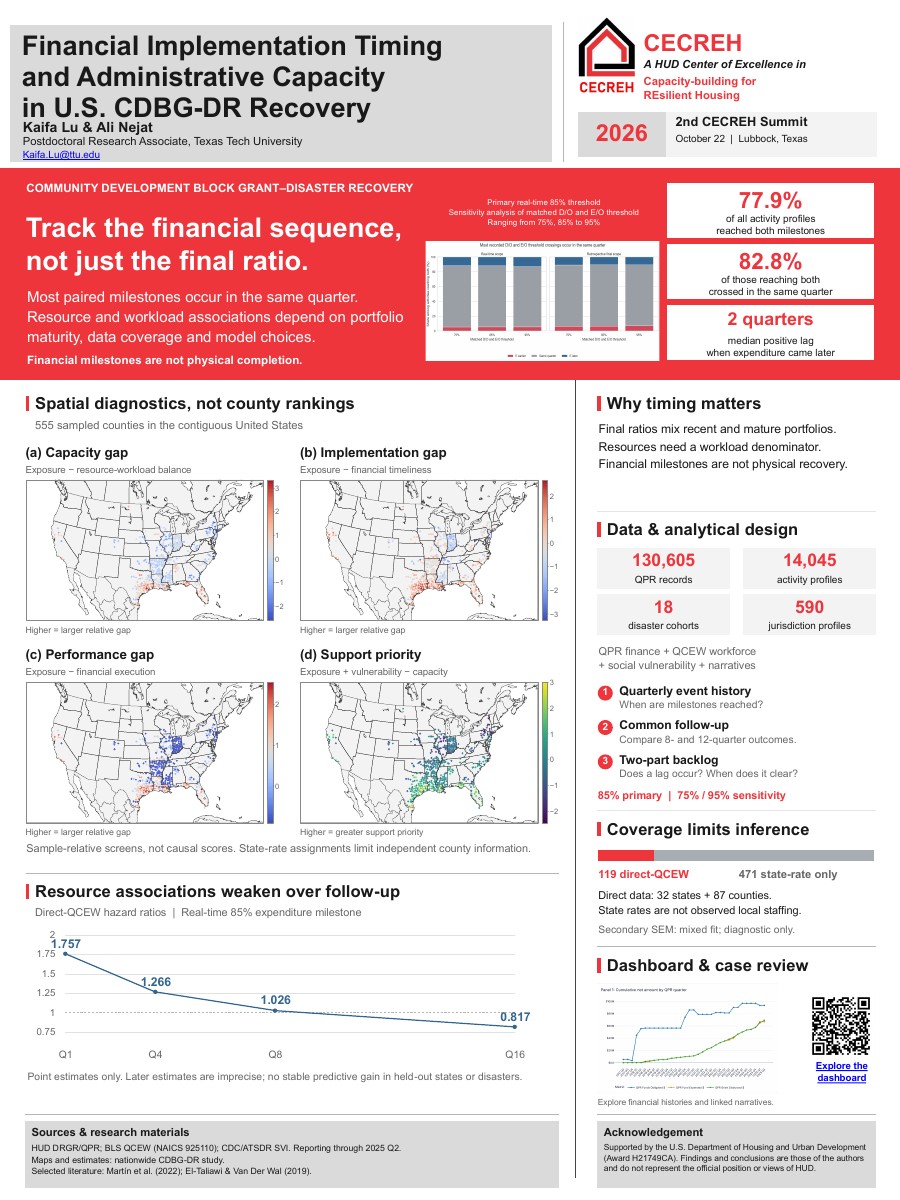
Financial Implementation Timing and Administrative Capacity in U.S. CDBG-DR Recovery

Financial Implementation Timing and Administrative Capacity in U.S. CDBG-DR Recovery

Kaifa Lu, Ali Nejat

Examines the timing of CDBG-DR financial milestones and resource–workload relationships using QPR records, workforce data, and spatial diagnostics. Financial milestones are distinguished from physical housing recovery.

Open poster · PDF
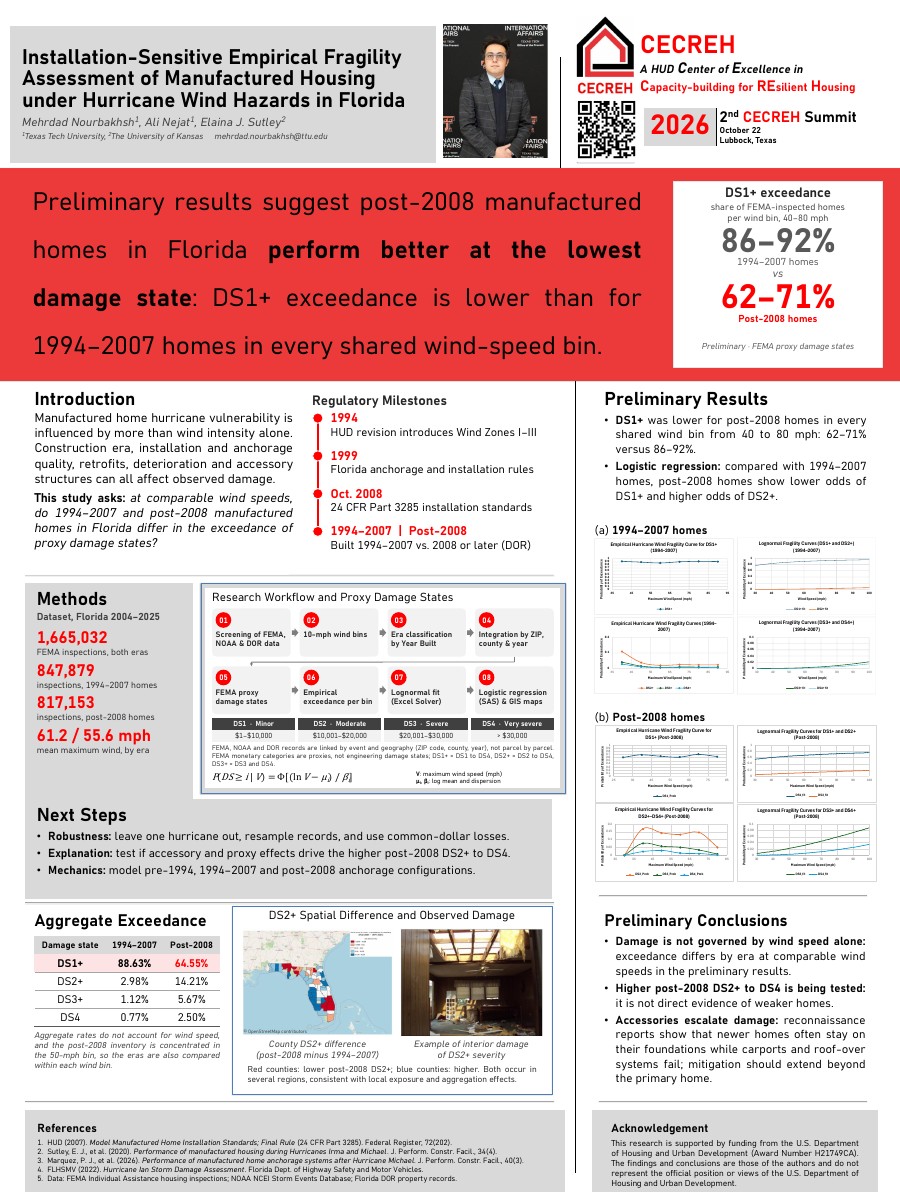
Installation-Sensitive Empirical Fragility Assessment of Manufactured Housing under Hurricane Wind Hazards in Florida

Installation-Sensitive Empirical Fragility Assessment of Manufactured Housing under Hurricane Wind Hazards in Florida

Mehrdad Nourbakhsh, Ali Nejat, Elaina J. Sutley

Compares hurricane-wind fragility across manufactured-home construction eras in Florida, considering installation standards and FEMA-based proxy damage states. Results are preliminary.

Open poster · PDF
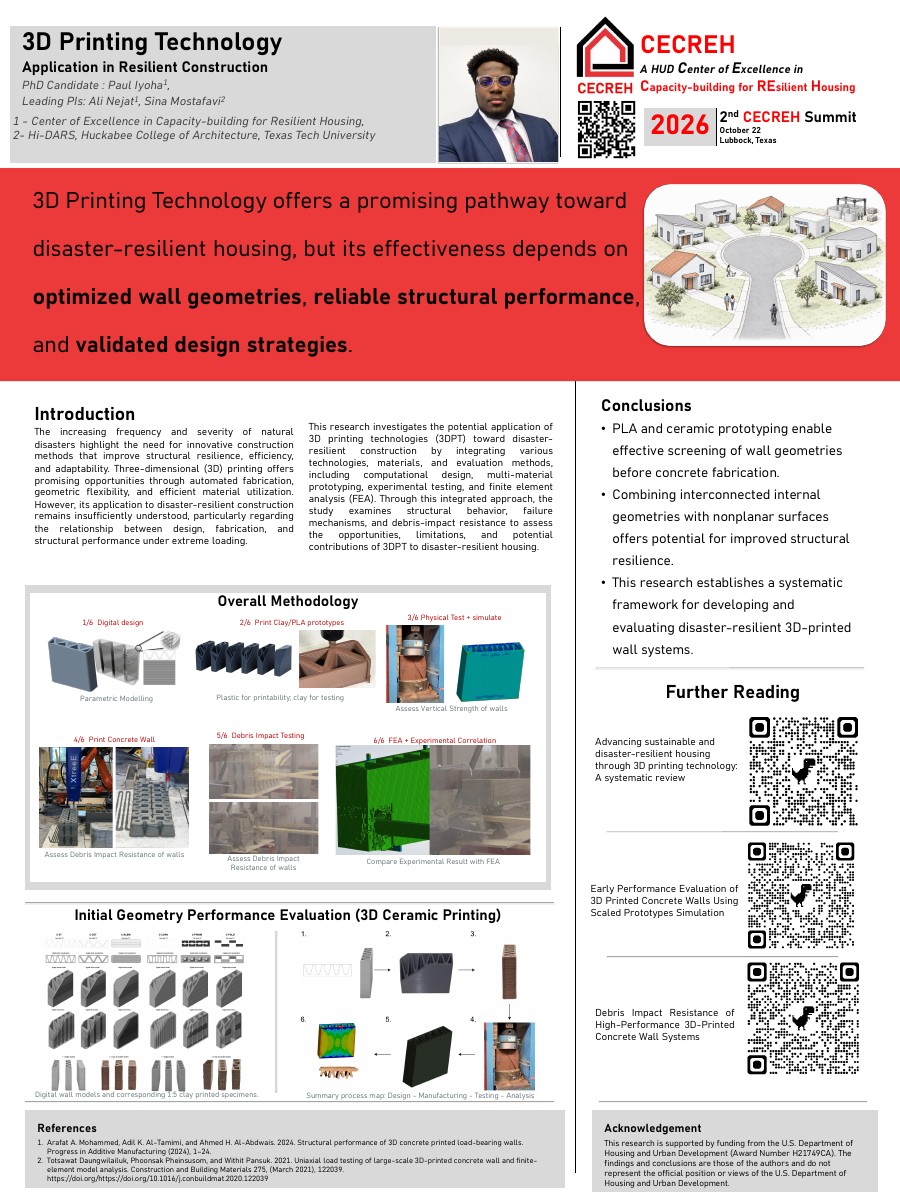
3D Printing Technology: Application in Resilient Construction

3D Printing Technology: Application in Resilient Construction

Paul Iyoha, Ali Nejat, Sina Mostafavi

Integrates computational design, multi-material prototyping, concrete fabrication, debris-impact testing, and finite-element analysis to evaluate wall geometries for disaster-resilient 3D-printed construction.

Open poster · PDF
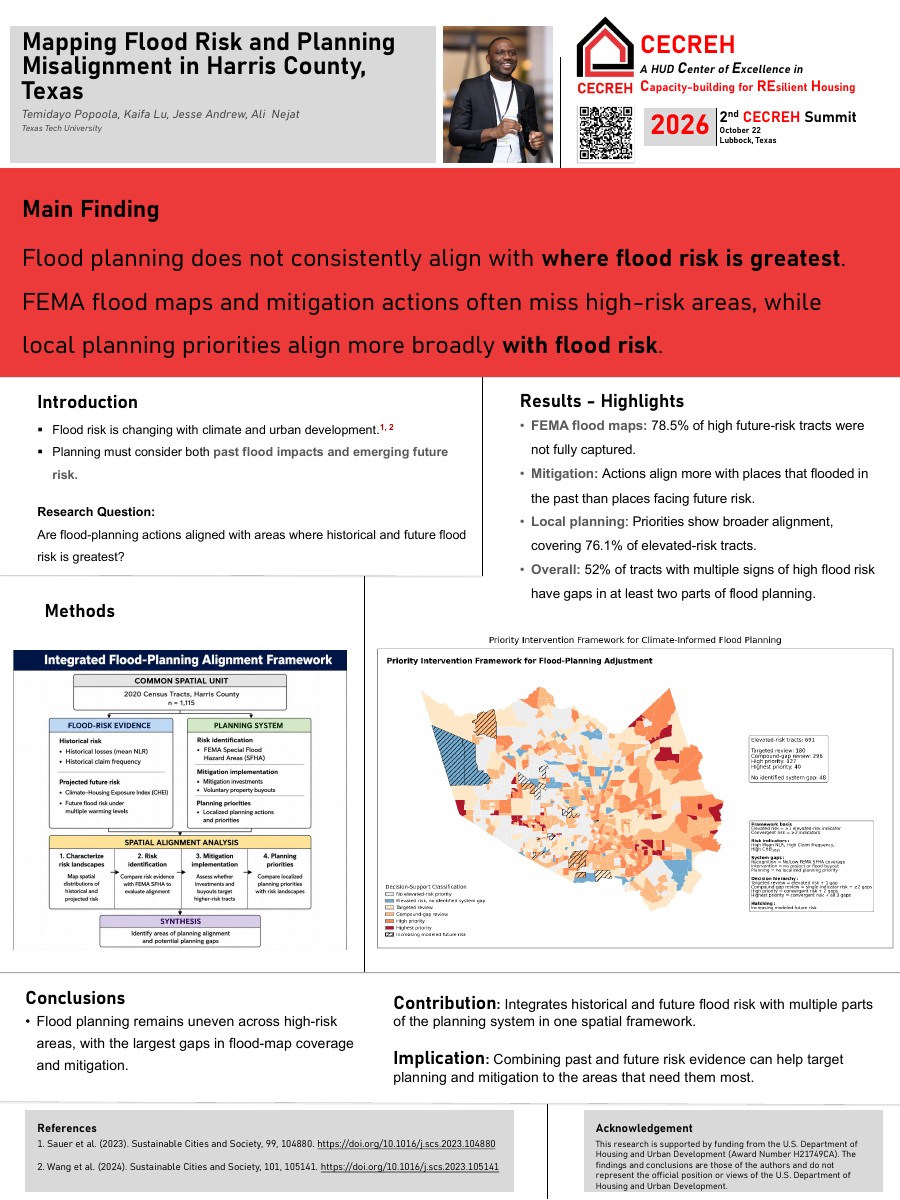
Mapping Flood Risk and Planning Misalignment in Harris County, Texas

Mapping Flood Risk and Planning Misalignment in Harris County, Texas

Temidayo Popoola, Kaifa Lu, Jesse Andrews, Ali Nejat

Combines historical and future flood risk with flood maps, mitigation actions, and local planning priorities to examine planning misalignment across Harris County, Texas.

Open poster · PDF
Publications, tools and professional development

Explore five journal articles, two interactive dashboards and 21 research posters in the summit booklet and Documentation Hub.

Plan your visit

Join us in Lubbock.

Everything you need for your time at Texas Tech.

The Student Union Building at Texas Tech University
The venue

Red Raider Lounge

Student Union Building · Texas Tech University
1502 Akron Avenue, Lubbock, TX 79409

October 22 · 8:00 AM–1:00 PM Central

An aerial view of downtown Lubbock
Around town

Things to do in Lubbock

Explore local art, music, food and places to spend time before or after the Summit.

Photos: Texas Tech University · Overton Hotel & Conference Center

Registration, access and accommodations

Complete the Summit registration form. For participation, accessibility or accommodation questions, contact CECREH@ttu.edu or 806.834.4065.

Looking back · The 2025 Inaugural Summit

Highlights from October 16–17, 2025.

Explore the 2025 Summit story