
It was a quiet season in the Atlantic, but one Gulf Coast landfall kept the Texas Tech Hurricane Research Team busy.

The Texas Tech Hurricane Research Team during the Hurricane Isaias deployment.
With the 2026 Atlantic hurricane season winding down, the Texas Tech University Hurricane Research Team (TTUHRT) is looking back on a year that took a long time to get going. It was one of the quietest seasons in recent memory. The first eight named storms all stayed at tropical storm strength, and the first hurricane didn’t arrive until October. That storm was Hurricane Isaias, and it was the team’s one deployment of the year.
As forecasts showed Isaias heading toward the northern Gulf Coast, an 11-person team loaded all four StickNet trailers and left Lubbock on Wednesday, October 7. After arriving on the coast, the team spent Thursday, October 8, spreading platforms along a stretch of coastline more than 200 miles long. The line ran from the Alabama coast near Mobile Bay, through Pensacola, Navarre and Destin, to Apalachicola and St. George Island. Some platforms also went inland to capture how the winds changed as the storm moved over land.
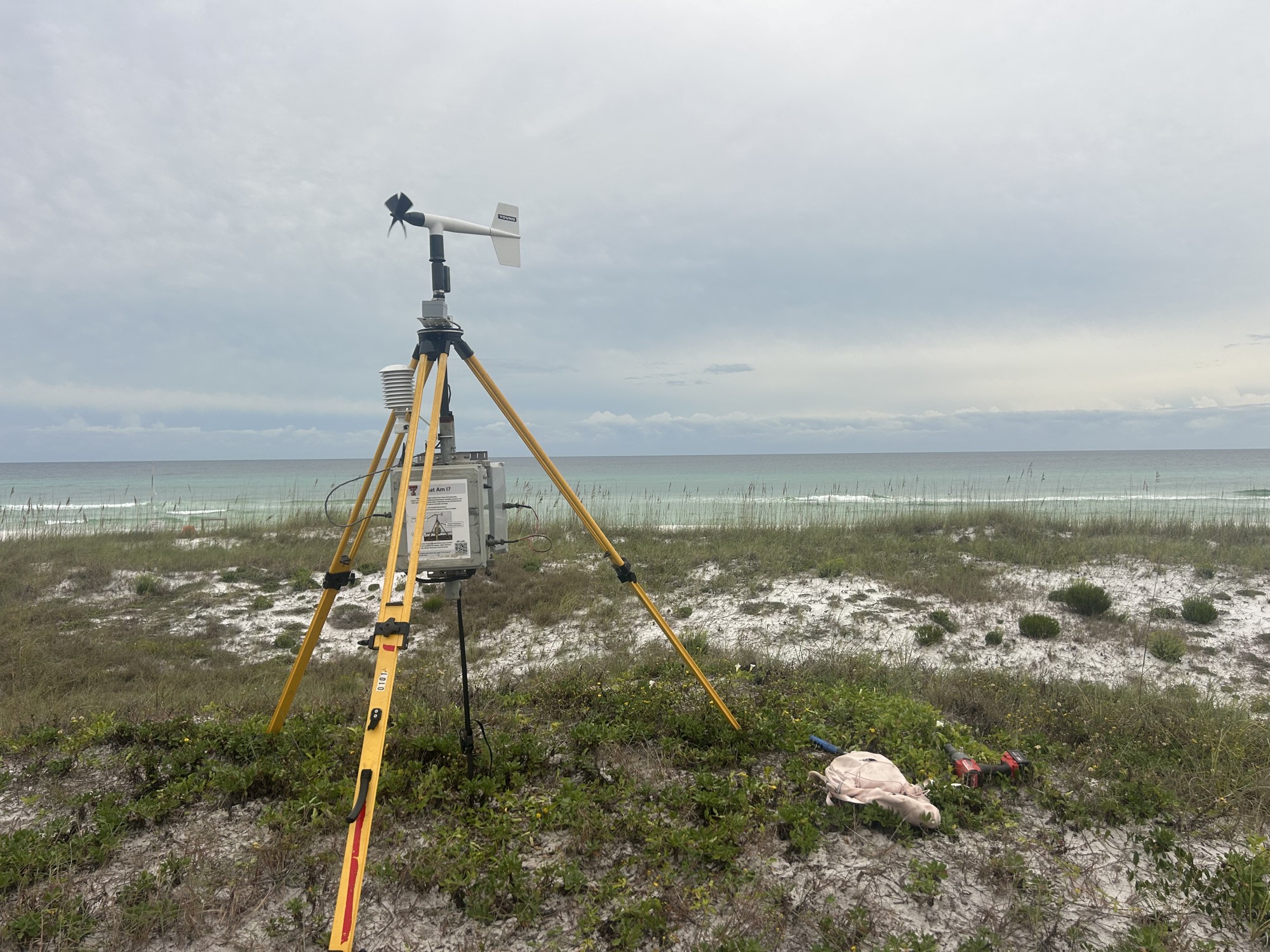
A StickNet platform stands in the dunes along the Florida Panhandle coast on October 8, ready to measure Hurricane Isaias’s winds.
Isaias came ashore near Destin, Florida, on the evening of Friday, October 9, as a Category 2 hurricane. The StickNet platforms recorded the whole thing, and 44 of the 48 deployed platforms reported data. Preliminary results show the strongest winds just east of Pensacola. One platform on Santa Rosa Island recorded a peak 3-second gust of nearly 117 mph, and three more stations in the area topped 100 mph. Platforms near the landfall point also recorded the storm’s pressure dropping as the center moved ashore.
After the storm passed, the team went back to retrieve every platform and returned to Lubbock. The data will now be quality-controlled and analyzed. They add to TTUHRT’s long-running record of measuring wind fields in landfalling hurricanes and help researchers better understand how hurricane winds behave at the surface as storms move inland.
 Isaias’s winds stripped exterior cladding from a high-rise building in Pensacola Beach,
near where StickNet platforms recorded gusts over 100 mph.
Isaias left damage across the Florida Panhandle and southern Alabama. Fallen trees damaged homes, and hundreds of thousands of people lost power. Our thoughts are with the communities still recovering.
Thanks to everyone who made this deployment possible. Here’s to the 2027 season!