
EOR Research
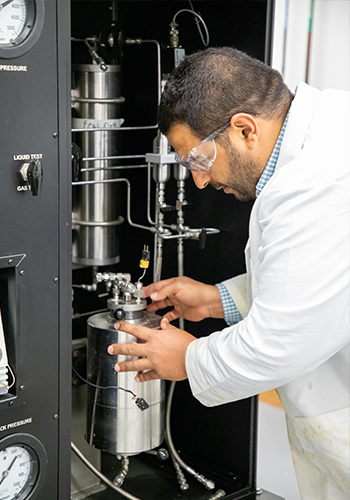
Our EOR research focuses on shale oil and gas reservoirs. We have conducted a significant work on gas injection to enhance oil and condensate recovery. In particular, we have proposed and developed licensed huff-n-puff gas injection technology which has been accepted and widely used in the industry. Currently, we are further optimizing technology.

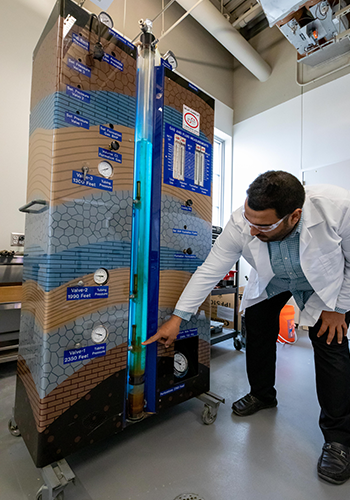
Surfactants as additives in fracturing fluid may reduce formation damage by fracturing fluid and increase oil and gas recovery from shale and tight reservoirs. The current research includes EOR mechanisms, surfactant screening, simulation analysis of laboratory experiments, and design of field-scale projects. Air has immense resources and high injectivity, and air injection may also have a thermal effect to enhance oil recovery. Currently, we are exploring EOR potential of air injection and studying the thermal cracking phenomenon.
 |
 |
Chemical additives in fracturing fluid may increase formation flow capability through dissolving solids, generating fractures, or removing formation damage. Currently, we are investigating the chemical additives which may stimulate shale and tight formation to enhance oil and gas recovery. This work is also extended to study the fluid-rock interactions.
We are also developing technologies to design the flow back of fracturing fluid, well spacing, optimized fracturing. In addition, we are also working on chemical EOR methods in producing heavy oil reservoirs where thermal methods are not applicable or economical.
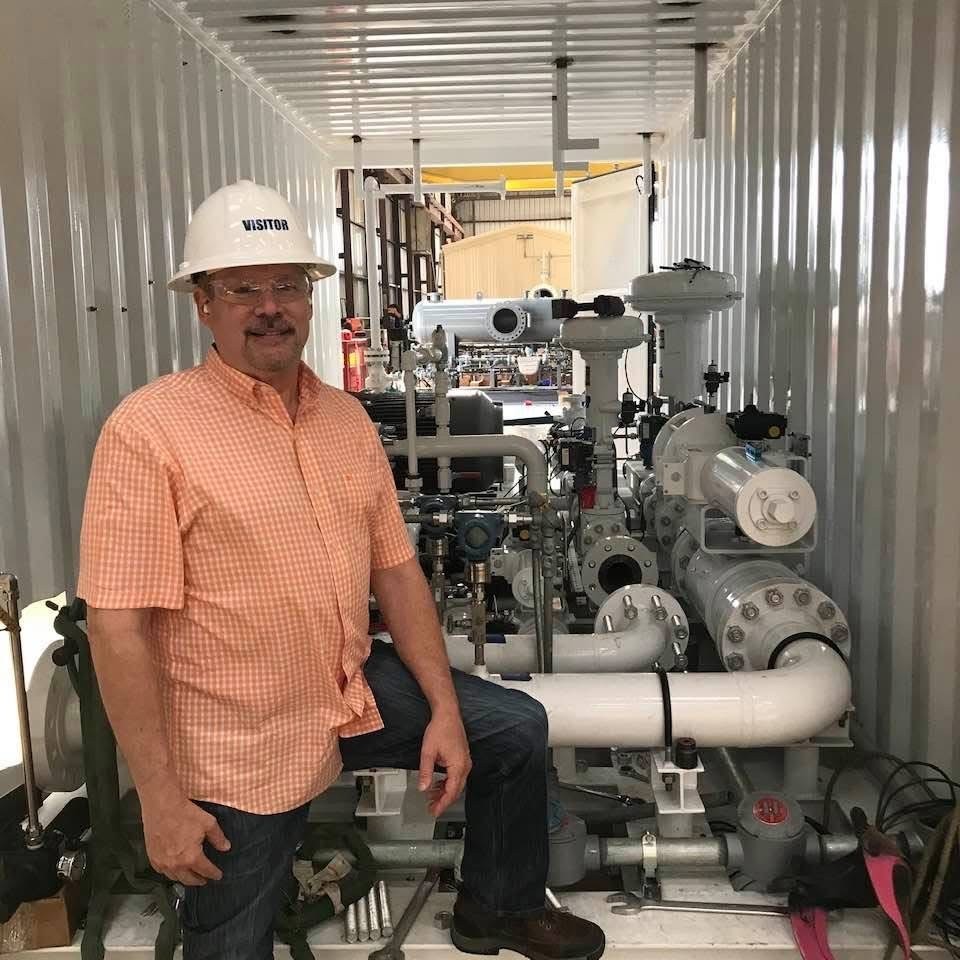
Gas-Liquid Co-Injection EOR for Unconventional Reservoirs - Dr. Scott’s focus in the EOR area has been on the delivery process, ie. developing methods to make EOR economical and efficient by utilizing existing infrastructure. He is the inventor of gas-liquid co-injection EOR and co-author of the patent on the “Rapid Switch Stacked Slug” injection process. This method utilizes produced gas, pulled from existing gas lift systems, and water pulled from existing frac/produced water systems to get costs in the $10-20 /BO range. This new Huff& Puff EOR method shows great potential to improve recoveries in unconventional reservoirs. Single-well injections projects have established an Gas Efficieincy of 250-315 BO/MMscf and a Gas Utilization Factor (GUF) in the 3-4 Mscf/BO range which is excellent when compared with other EOR processes. This method brings pressure in the Frac system above the Minimum Miscibility Pressure (MMP) while the co-injected water has been shown to improve gas conformance in the reservoir and reduce breakthrough in adjacent wells. Surfactant is added to the co-injected water, which mobilizes oil within smaller pores using surfactant and capillary effects, while the co-inject gas also mobilizing oil in the larger diameter pores using a multi-contact miscible process. The short-term goal is a field pilot to demonstrate the doubling of recovery by multiple huff & puff injection cycles in all wells on the pad in a round-robin fashion. Topics also of interest are: 1) diversion methods - allowing EOR injection to target specific frac clusters along the lateral length over multiple injection cycles, 2) physics informed machine learning - for EOR optimization, and 3) adapting artificial lift systems to long lateral horizontal wells and the special issues associated with the new 2nd phase of production provided by EOR.
 |
Faculty:
Selected recent publications:
- Scott, S. L., Schechter, D., Pospisil, G., and Brandon Moore. 2025. "Novel Gas-Liquid Co-Injection EOR Process Enters the Permian." Paper presented at the SPE Permian Basin Energy Conference, Midland, Texas, USA. doi: https://doi.org/10.2118/230250-MS
- Sheng, J.J. 2022. Evaluation of EOR potential of energized fluid fracturing – From an energy perspective, Fuel, 307, 121856.
- Tatsipie, N.R.K., Sheng, J.J. 2022. Deep learning-based sensitivity analysis of the effect of completion parameters on oil production, Journal of Petroleum Science and Engineering, 209, 109906.
- Sheng, J.J. 2019. Enhanced Oil Recovery in Shale and Tight Reservoirs, Elsevier, to be republished at the end of 2019.
- Sheng, J.J. 2011. Modern Chemical Enhanced Oil Recovery: Theory and Practice, Elsevier, Burlington, MA 01803, USA.
- Wijaya, N., Sheng, J.J. 2019. Shut-In Effect in Removing Water Blockage in Shale-Oil Reservoirs With Stress-Dependent Permeability Considered, SPEREE, 1-16, online, SPE-195696-PA.
- Tangirala, S., Sheng, J.J., 2019. Investigation of oil production and flowback in hydraulically-fractured water-wet formations using the Lab-on-a-Chip method, Fuel, 254, 115543.
- Yang, L., Sheng, J.J. 2019. Feasibility of Using the Frank−Kamenetskii Theory to Predict the Spontaneous Ignition of the Crude Oil−Sand Mixture, Energy Fuels, 33, 4816−4825.
- Sheng, J.J. 2018. Discussion of shale rock wettability and the methods to determine it, Asia Pacific Journal of Chemical Engineering, e2263, https://doi.org/10.1002/apj.2263
- Sharma, S. and Sheng, J.J. 2018. Comparison of huff-n-puff gas injection and solvent injection in large-scale shale gas condensate reservoirs, Journal of Natural Gas Science and Engineering 52, 434–453.
- Sheng, J.J. 2017. Performance Analysis of Chemical Flooding in Fractured Shale and Tight Reservoirs, Asia Pacific Journal of Chemical Engineering, 13(1), e2147; https://doi.org/10.1002/apj.2147
- Li, L., Zhang, Y., and Sheng, J.J. 2017. Effect of the Injection Pressure on Enhancing
Oil Recovery in Shale Cores during the CO2 Huff-n-Puff Process When It Is above and
below the Minimum Miscibility Pressure. Energy Fuels, 31, 3856−3867.
Bob L. Herd Department of Petroleum Engineering
-
Address
Bob L. Herd Department of Petroleum Engineering | Box 43111 | Lubbock, TX 79409-3111 -
Phone
806.742.3573 -
Email
pe@ttu.edu