
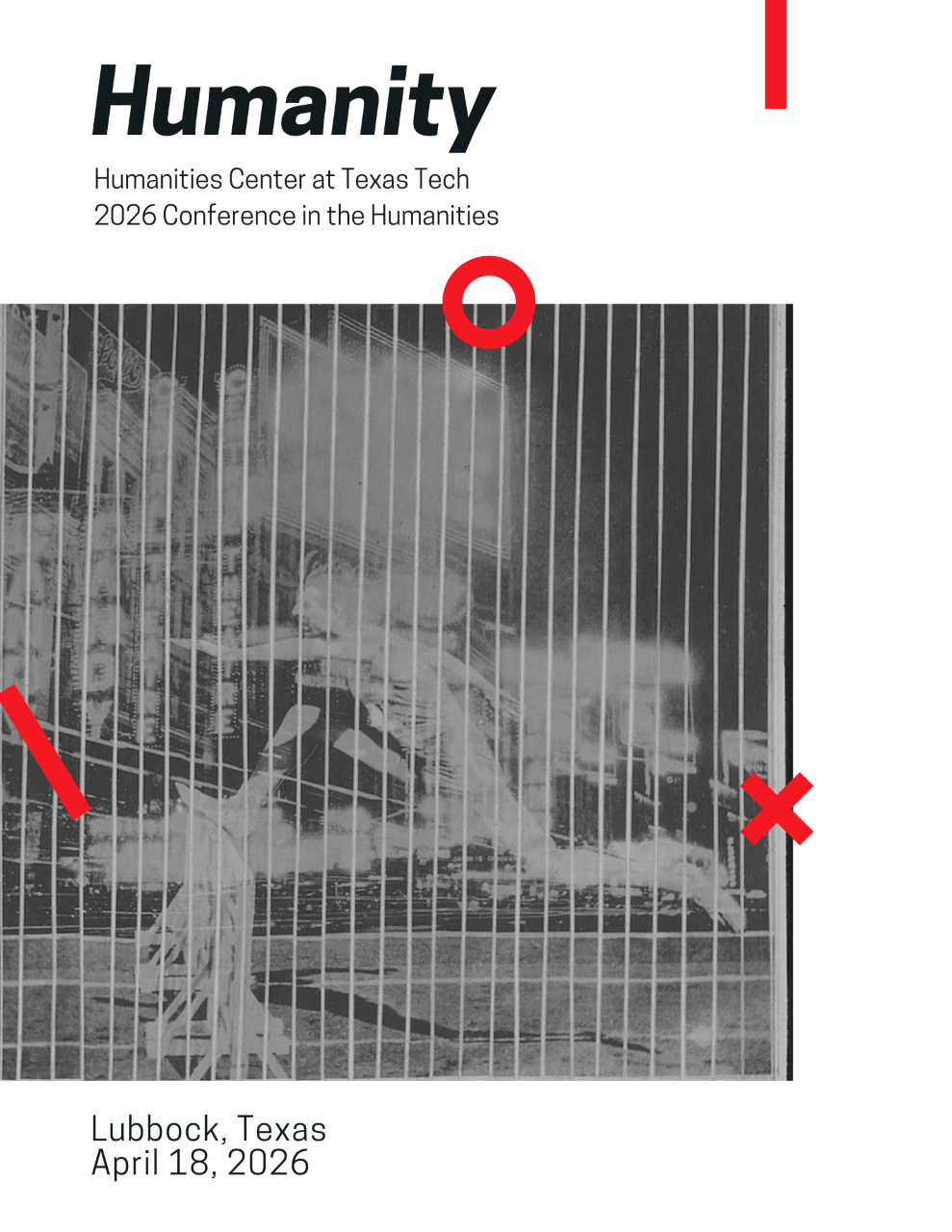
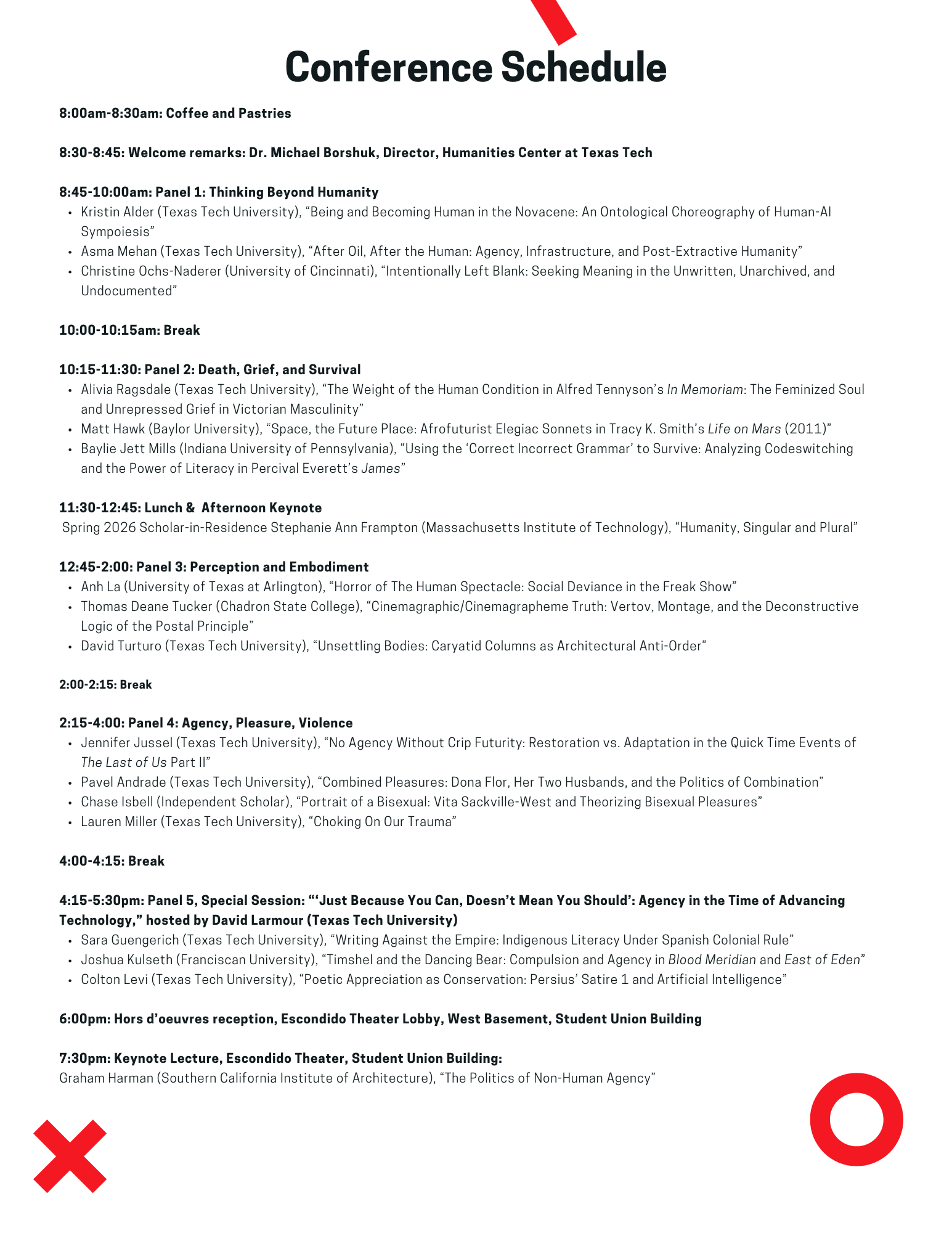
Conference 2026: Humanity - Schedule and Details
Abstracts and Presenter Bios:
PAVEL ANDRADE
COMBINED PLEASURES: DONA FLOR, HER TWO HUSBANDS, AND THE POLITICS OF COMBINATION
The plot of Jorge Amado’s Dona Flor e seus dois maridos (Dona Flor and Her Two Husbands, 1966) is fairly straightforward: Vadinho, Dona Flor’s first husband, mischievous malandro, drops dead during carnival. After a reasonable mourning period, Dona Flor gets remarried to Dr. Teodoro Madureira, a respectable local pharmacist who is the virtual opposite to the blasphemous and salacious Vadinho in every possible way. Although the new couple leads a peaceful and comfortable life, Dona Flor finds herself increasingly longing for the warm embrace (and sexual prowess) of her first husband. Vadinho’s ghost returns from the dead and seduces Dona Flor while Teodoro remains blissfully oblivious to their resuscitated relation. The three live happily ever after. At least initially, the novel turns the traditional comic structure based on the pursuit of erotic union upside down, since no amount of “ingenuity and trickery” would be enough to overcome death’s “superior force.” But in the world of the Brazilian northeast, as the reader will eventually come to find out, not even death can contain erotic ambition. Flooding the interstices of this otherwise simple tale of reconciliation is the everyday world of Bahia, a sprawling painting of its social hierarchies and a corrosive satire of the habits and ambitions of its “definitely hopeless petty bourgeoisie.” This logic produces a “problematics of distribution” that opposes the three protagonists to the hundreds of minor characters that continually encroach upon larger swaths of narrative space. Bound by the logic of mistura (mixture), the novel recursively and extensively performs combination—of social classes, religious systems, culinary traditions, sexual proclivities, and so on. This paper argues that, as a corollary to this logic, Dona Flor renders combination thinkable as a Latinamericanist problematic. Performing combination, Dona Flor delivers an aesthetic mode that dissolves the social-scientific concern for the articulation of different modes of production into the recurrent emergence of multiple horizons of possibility, the sensuous outline of an ever-dissipating boundary between the possible and the impossible in Latin America.
PAVEL ANDRADE is Assistant Professor of Spanish at Texas Tech University. His research and teaching focus on Mexican and Latin American literary and cultural studies, theory of the novel, architectural humanities, and hemispheric modernisms. He is the founding organizer of the Mexican Studies Research Collective, a member of the Modern Language Association’s LLC Mexican Forum Executive Committee, and the book reviews editor of the journal Mexican Studies/Estudios Mexicanos. Before moving to Lubbock, he was a Visiting Assistant Professor of Mexican/Latinx Literature at the University of Cincinnati and a Mellon Doctoral Dissertation Fellow with the Humanities + Urbanism + Design Initiative at the University of Pennsylvania.
SARA GUENGERICH:
WRITING AGAINST THE EMPIRE: INDIGENOUS LITERACY UNDER SPANISH COLONIAL RULE
Alphabetic literacy was introduced in the Andes in the sixteenth century as an instrument of Spanish colonial power, but it was quickly appropriated by Indigenous peoples as a tool of negotiation and critique. In this presentation, I first examine how Spaniards deployed reading and writing to classify populations, extract tribute, and subordinate Andean oral and visual knowledge systems and beliefs. Then, I turn to exemplify how Indigenous people, including women, learned to work with letters by producing petitions, legal documents, and chronicles that invoked the empire’s own laws and Christian ideals to contest abuses and defend local interests. This presentation shows that literacy never remained a purely imposed colonial technology. Instead, it became a contested terrain where domination and resistance unfolded simultaneously, complicating any assumption that the power to introduce a technology guarantees control over how it will be used.
SARA GUENGERICH is Associate Professor of Spanish at Texas Tech University. She researches and writes about colonial Indigenous women, some who were born into noble lines and thus retained both prestige and a variety of concrete legal claims and many who were born without the privileges of power. She includes their stories in the larger historical narrative of the early modern Hispanic world. She is co-editor of Cacicas. The Indigenous Women Leaders of Spanish America, 1492-1825 (University of Oklahoma Press, 2021) and is currently writing a social history of indigenous Andean women under colonial rule.
RONNY AZUAJE is a Ph.D. candidate in Spanish at TTU. His research focuses on the African Diaspora and their mobility through the Atlantic networks of cacao in coastal Venezuela, the Dutch Antilles, and the larger Caribbean in the long eighteenth-century. His training in this research area has been possible through the generous support of the Newberry Library in Chicago, the Unlocking the Colonial Archive project at UT Austin, and the Volkswagen Foundation/Goethe University in Frankfurt, Germany.
MATT HAWK
SPACE, THE FUTURE PLACE: AFROFUTURIST ELEGIAC SONNETS IN TRACY K. SMITH’S LIFE ON MARS (2011)
Tracy K. Smith’s elegiac collection Life on Mars (2011) grapples not only with the death of her father, but also with public tragedies, like mass-shootings of schoolchildren and the crash of the Challenger space shuttle. Several of these elegiac poems take the form of the sonnet in which to couch their treatments of grief and mourning, while also reimagining a future in which Black bodies do not become murdered victims because of racist violence. This chapter explores the connection between lamenting the death, dying, and loss of Black persons, coupled with hope for a future world in which needless death is not suffered so regularly, a future that is often found in an interstellar, intergalactic realm, as opposed to a heavenly post-death afterlife. In this paper I will extend literary histories from Hollis Robbins and Timo Mueller about the use of sonnets by Black U.S. poets, as well as apply Max Cavitch, Jahan Ramazani, Diana Fuss’s understandings of death and elegy to Smith’s work, to show that what I call her elegiac sonnets function as a type of salve to treat the ills enacted by the grief that both personal loss and systemic racism inflict in similar ways. The collection Afrofuturism: A History of Black Futures will guide my study as well. I will ultimately contend that there is a turn in Smith’s elegiac sonnets away from despair and sorrow, coupled with a movement towards hopefulness and agency. My conception of the linked formal and theoretical underpinnings of elegiac sonnets as the impetus for personal and communal intervention against grief is in line with Fred Moten’s understanding of Black optimism, which will also serve as a lens through which Smith’s Afrofuturist elegiac sonnets can be understood, thus further establishing the larger elegiac sonnet trend in contemporary Black U.S. poetics today.
MATT HAWK is a PhD Candidate (ABD) in English at Baylor University, specializing in modern and contemporary American poetry. His scholarly work has appeared in The Southern Quarterly, Arkansas Review, and Mississippi Quarterly. He holds an MFA in Creative Writing from the University of Memphis, and both a B.A. and M.Ed. from the University of Notre Dame. His own poetry has been published by Appalachian Review, Rio Grande Review, and Iron Horse Literary Review. His chapbook of original poems, entitled Poems from the Heart, was published by Desert Willow Press in 2018.
CHASE ISBELL
PORTRAIT OF A BISEXUAL: VITA SACKVILLE-WEST AND THEORIZING BISEXUAL PLEASURES
Vita Sackville-West, in her memoir featured in Portrait of a Marriage, identifies the pleasures of bisexuality as twofold: the ability to take both male and female lovers and the capacity to embody both masculinity and femininity. While scholarly consensus has cast Sackville-West as a proponent of inversion to explain her same-sex attraction, this paper argues that her own writing about gender and sexuality suggests more complicated psychosexual mechanisms at play. Indeed, Sackville-West articulates through her meticulous documentation of her sexual feelings a theory of bisexuality as both a sexual orientation and as the source of her dimorphic gendered embodiment. Rather than her sexuality arising from an innate sex identity, as inversion would suggest, Sackville-West describes bisexual desire as the driving force behind her “dual-gendered” personality. In this way, the memoir invokes a Foucauldian order of operations by which sex is created through the mechanisms of sexuality. Bisexuality, for Sackville-West, makes the sex of her body.
This sexuation is comprised of a psychical and an affective component, namely identification and Einfühlung (empathy). In this context, identification, defined by Diana Fuss as the psyche taking the external love object into itself, affords Sackville-West the means to transform her sex. For Sackville-West, sexual orientation becomes an act of identification through which she constructs her bodily identity with and against her lovers. The vehicle for this identification with the external love object is Einfühlung, or empathizing with the lover. Following Lucas Crawford’s argument that empathy is latent with cross-gender identifications, this paper concludes that Sackville-West’s capacity for Einfühlung allows her desire to “feel into” alternative sexual embodiments as an act of sexuality oriented towards the lover.
CHASE ISBELL (she/they/he) is a poet and independent scholar who writes about desire and language. Their research examines bisexuality in European literature and theory of the long twentieth century. Previously, they have presented on sadomasochism and psychoanalysis in Angela Carter’s reading of the Marquis de Sade at Tufts University and on bisexual theories of the gaze in Céline Sciamma’s Portrait of a Lady on Fire at Washington and Lee University. They are at work on a scholarly monograph theorizing bisexuality in the romans à clef and life writing of Virginia Woolf, Vita Sackville-West, and Violet Trefusis. They are the Blog Editor of Shenandoah, where you can find their interviews and writing about contemporary literature.
BAYLIE JETT MILLS
USING THE “CORRECT INCORRECT GRAMMAR” TO SURVIVE: ANALYZING CODESWITCHING AND THE
POWER OF LITERACY IN PERCIVAL EVERETT’S JAMES
Percival Everett’s 2024 novel James is a retelling of one of the most classic works of American literature, Mark Twain’s Adventures of Huckleberry Finn, from the perspective of the enslaved man Jim. Although initially Everett’s novel contains some striking similarities with Twain’s plot, it eventually departs from Twain’s story significantly and meaningfully to humanize Jim’s character and allow him to deploy tactics that establish identity and agency in a society that denies his humanity. We can learn much about literacy as a tool for resistance and self-expression by examining the role of codeswitching in Everett’s James. Codeswitching is a survival tactic under slavery and White supremacy but abandoning it paradoxically leads James to openly express his intellectual depth and emotions, increase his agency, resist the dehumanizing impact of slavery, and eventually find his family and freedom. I argue this aids our understanding of how Everett foregrounds James’ strategic language shifts between Standard American English and the slave language to complicate and critique the construction of racial identity, deconstruct the meaning of freedom within the context of slavery, and highlight literacy as a tool for resistance, selfhood, and sharing the stories of enslaved people. I will examine how language is a tool of protection, yet it is also a form of oppression as enslaved people must suppress their emotions, their intellectual capacity, and the ability to freely articulate their thoughts. A close analysis of the purpose of James’ codeswitching and his decision to cease codeswitching reveals that it is not the use of SAE that lends him power, but rather the use of the marked language that undermines the power imbalance.
BAYLIE JETT MILLS is a first-year doctoral student in Indiana University of Pennsylvania’s Literature and Criticism program. She graduated from Texas Tech University in December 2025 with an MA in English with a concentration in American literature. Baylie also earned her BA in English with a concentration in creative writing at Texas Tech. Her research focuses on nineteenth- to twenty-first-century American literature, including centering marginalized voices. Baylie has had work published in Western American Literature, Harbinger: A Journal of Art and Literature, and Sigma Tau Delta Review.
JENNIFER JUSSEL:
NO AGENCY WITHOUT CRIP FUTURITY: RESTORATION VS. ADAPTATION IN THE QUICK TIME EVENTS
OF THE LAST OF US PART II
The Last of Us Part II is a controversial game because it does not deliver the total victory players desire. Chronic illness narratives—stories featuring sick characters who are neither killed nor cured—make audiences similarly uncomfortable because their protagonists may never return to “full health.” Such narratives raise the question: can agency exist in the absence of curative power? If a body can never be fixed, the world never freed of zombies, and Joel never brought back from the dead, why even pick up our controllers?
This paper pairs disability scholarship with analyses of key cutscenes and quick time events in The Last of Us Part II to argue such a cure-based conception of futurity limits agency for both Ellie and the player. Unable to accept loss without restoration, Ellie uses revenge—in the form of murdering Joel’s killer, Abby—to find meaning in her life story. Like zombies compelled to kill by spores, Ellie and the player are thus forced to enact violence to progress through the game. The boundaries of heroism/villainy, life/death, and agency/ powerlessness are obfuscated through details of mise-en-scène, sound design, and button prompt placement in cutscenes during which Ellie and the player attempt to reanimate Joel through uncharacteristic acts of cruelty. It is not until Ellie refuses to kill Abby at the end of the game that she accepts her permanently cripped future. This paper contends that by accepting loss without recompense and choosing adaptation over restoration, Ellie finally asserts agency over her narrative. In so doing, she and the player both find meaning outside the binary of death vs. full health in their incurably cripped worlds. Free of curative pressure, Ellie ultimately shambles into a future as chronically diseased yet infinitely possible as our own—if only we’ll choose to play.
JENNIFER JUSSEL is the author of Mellitus: Essays on Up/Rooting (forthcoming fall 2026 from Howling Bird Press) and the winner of the 2026 Howling Bird Nonfiction Book Prize. Her work has been supported by the McCormack Writing Center, the Vermont Studio Center, and the Southwest Popular/American Culture Association's Heldrich Dvorak Award. Her essays and poetry have been published most recently or are forthcoming in Spectrum Literary Magazine, Radar Poetry, Booth, the Santa Clara Review, Cleaver, and more. She earned her MFA in creative writing from Eastern Washington University and is currently pursuing a PhD in English and creative writing at Texas Tech University, where she teaches undergraduate literature and writing.
JOSHUA KULSETH
TIMSHEL AND THE DANCING BEAR: COMPULSION AND AGENCY IN BLOOD MERIDIAN AND EAST OF EDEN
As a kid, the only inevitability I perceived in the great American voyage to the western frontier was that everyone, without exception, contracted dysentery and died. Of course, at the time my only exposure to pioneering expansionism was playing “Oregon Trail” on an Apple II Microcomputer in second grade when I was supposed to be learning how to type.
We are tempted by jingoistic cliches to obscure the violent history of America, and our literature has grappled with questions of national greatness since the 19th century genre of the “Great American Novel” became popular fodder for our writers of genius and ability. Thankfully for the sake of good literature and honest self-appraisal, these works rarely settled for the comfortable and benign.
Two such novels with concomitant themes revolving around American expansionism arise to complement and contradict one another: John Steinbeck’s sprawling quasi-memoir, East of Eden, and Cormac McCarthy’s brutally philosophical, Blood Meridian. Different in scope, character, language, and conclusion, they nevertheless grapple stridently with two essential considerations in their assessment of the American ethos: that of compulsion and agency. “Timshel” and the Dancing Bear are thematic doppelgangers in East of Eden and Blood Meridian, respectively, which argue opposite suppositions: “Thou Mayest” and “Thou Must.” To what extent are we bound, as both humans and American citizens, to our bloody impulses; to what extent free to cling to the better angels of our nature; and what consequences await us as a result, facing as we must the uncertainties of our national present?
JOSHUA KULSETH earned his M.F.A. from Hunter College and Ph.D. from Texas Tech University in poetry. He is Assistant Professor of English and Creative Writing at Franciscan University of Steubenville. His poems have appeared in Tar River Poetry, The Emerson Review, The Potomac Review, The Windhover, The South Carolina Review and elsewhere. He was the grand-prize winner of Poet Hunt 30, for his poem “Kalanchoe.” His poetry collection, Leaving Troy, was shortlisted for the Cider Press Review Competition and published by Finishing Line Press (2025). He is also co-author of W.H. Auden at Work: The Craft of Revision (2023) and Agony: Brazilian Jiu Jitsu and the Ancient Greeks (2023).
ANH LA
HORROR OF THE HUMAN SPECTACLE: SOCIAL DEVIANCE IN THE FREAK SHOW
In the mid-nineteenth century, the proliferation of “freaks” and “freak shows” exoticized human abnormalities as specimens of Western mass entertainment. Human displays were exhibited by showmen, where the rejection of humanity rendered a market of exoticism– a mechanism which functioned on mysticism of the human body and a public taste in the grotesque. Despite being a thriving entertainment medium during the mid-nineteenth century, freak shows eventually faced public disapproval moving into the twentieth century. With reviewing spectatorship, what can account for the change in the freak show narrative? Even as freak show production no longer flourishes as a formal establishment, how have remnants of freak show spectatorship remained?
With analyzing nineteenth and twentieth century advertisements and newspaper coverage, it is suggestive that in this transformative period the social archetype of the freak changed from a public spectacle to the case of moral and scientific discourse. The commodification of human oddities during freak show attendance further signified representations of race and disability status. Furthermore, with the ghastly as an enterprise, contemporary cultural engagement with freak show tropes continues to exist. In studying the progression of the freak narrative, insight is given to social perception and cultural displays of social deviance. It is concluded that investigation of freak show spectatorship helps illuminate the social processes and dynamics of the wavering period, and uncover how society has perpetuated and perceived otherness and disability stereotypes.
ANH LA recently obtained a Bachelor’s of Science in Economics with a Minor in History at the University of Texas at Arlington. Her presentation, Horror of The Human Spectacle, explores the development of circus freak shows since the mid-nineteenth century and discusses how the freak show narrative persists in contemporary society. Anh will be attending the University of Chicago this fall to earn her Master's Degree in History. As a graduate student, she intends to pursue research regarding Body Politics within Social and Cultural History.
COLTON LEVI
POETIC APPRECIATION AS CONSERVATION: PERSIUS’ SATIRE 1 AND ARTIFICIAL INTELLIGENCE
A common compliment paid to A.I. is that it can streamline production of the menial or pedantic features of art (in its broadest sense). Plot issues, brainstorming, polishing are all performed by machines steps removed from the humanity that created them. It is timely that we ‘look under the hood’ at what is at stake for art in the age of artless composition, thinking with antiquity about what constitutes good art in order to curb the ‘A.I. slop’ constantly produced by machines.
Persius, a satirist from the 1st century C.E., addresses in his 1st satire the quality of art, particularly poetry, in his day. At the heart of his poem, he is questioning if artistic refinement for the sake of pure aesthetic pleasure, not meaningful substance, should constitute real art. Encapsulated by his example of the shipwrecked beggar, he is moved to give a penny by the actual event, not the narrative concocted overnight to elicit his donation.
The issue at present is that A.I. produces a facsimile of what we recognize as art. Its ability to construct nearly without flaw the façade of art allows it to pass almost freely under a nail, like a seamless statue. Persius would have us beware of this path. The ability to make art does not make the output genuine, or sincere, but simply allows that one can fit words to the meter. It is then up to us as viewers to discard or reproach compositions fraught with the coldness of machines. We have to show that these outputs do not meet our standard of art, and that its appearance as art does not justify its existence. Recalling Persius’ poets glutted with praise, the argument is that just because humanity (or its machines) can make these things and be rewarded with a “nice!” does not mean that it should continue to do so.
COLTON LEVI is finishing his MA in Classics at Texas Tech University, having come from the Univ. of South Carolina and won a Pickford scholarship and has since received other funding awards. His interests include Latin poetry, especially epic, and the literature of the Neronian Age, as well as Greek tragedy. His MA thesis investigates landscape as a permanent record of the effects of Civil War in the Pharsalia (Civil War) of Lucan. Since coming to TTU, he has given several conference papers, on a diverse range of topics—at the Classical Association of the UK in St Andrews, the Classical Associations of the Atlantic States and of the Middle West and South, as well as the Society for Comparative Literature and the Arts. In August, Colton will leave to start his PhD in Classics at the University of Virginia.
ASMA MEHAN
AFTER OIL, AFTER THE HUMAN: AGENCY, INFRASTRUCTURE, AND POST-EXTRACTIVE HUMANITY
This paper draws on the conceptual framework developed in After Oil: A Comparative Analysis of Oil Heritage, Urban Transformations, and Resilience Paradigms to interrogate how extractive infrastructures have historically produced—and continue to destabilize—dominant categories of “the human.” Oil landscapes are not merely economic or environmental systems; they are ontological regimes that organize labor, mobility, violence, and value while scripting human hierarchies through race, class, gender, and geography. By examining post-oil territories across comparative contexts, this paper argues that extractive modernity redefined human agency through asymmetrical relations between bodies, machines, land, and capital. The decline of oil thus marks not only an energy transition but also a profound crisis of human self-definition. Who counts as human in landscapes shaped by sacrifice zones, slow violence, and infrastructural abandonment? And what forms of agency remain possible once the promise of extractive progress collapses? Engaging debates in philosophy, design, and critical infrastructure studies, the paper reframes oil heritage sites as spaces where humanity is renegotiated through more-than-human relations—between material remnants, ecological systems, and social memory. Rather than treating infrastructure as a passive backdrop for human action, the paper foregrounds its active role in redistributing agency, producing differential vulnerability, and mediating collective futures. Conceptually, the paper aligns with post-anthropocentric and object-oriented perspectives while remaining grounded in spatial, political, and ethical questions central to the humanities. It proposes “post-extractive humanity” as a critical lens through which agency is no longer defined by mastery over resources but by relational responsibility, ecological coexistence, and infrastructural care. Ultimately, this paper contributes to the conference theme Humanity by arguing that the end of oil compels a rethinking of the human not as a sovereign subject but as an entangled actor within damaged yet generative material worlds—where justice, memory, and survival must be reimagined together.
ASMA MEHAN is an internationally recognized architect, urban scholar, and academic leader working at the intersection of architectural humanities, critical urban studies, planning, and heritage. She is a tenure-track Assistant Professor at the Huckabee College of Architecture, Texas Tech University, where she also serves as Director of the Architectural Humanities and Urbanism Lab (AHU_Lab). She is Editor-in-Chief of plaNext: Next Generation Planning (AESOP). Dr. Mehan’s research is deeply interdisciplinary and transnational, focusing on industrial and energy heritage, adaptive reuse, climate resilience and the integration of digital technologies and AI in planning and design. Grounded in architectural history and theory and informed by anthropology, geography, and policy studies, her work spans North America, Europe, the Middle East, and Australia, positioning her as a field-shaping scholar rather than a discipline-bounded specialist.
LAUREN E. MILLER, Ph.D., is an Associate Professor of Anthropology at Texas Tech University. She studies performance and tourism in the U.S. and Latin America. Her early work focused on the Afro-Brazilian martial art capoeira and how non-Brazilian practitioners use travel to Brazil to increase their legitimacy within this genre. This work has been published in Annals of Tourism Research, the Journal of Sport and Tourism, and Theatre Annual. She is the author of In Search of Legitimacy: How Outsiders Become Part of the Afro-Brazilian Capoeira Tradition (Berghahn Books, 2016) as well as Apprenticeship Pilgrimage (coauthored with Jonathan S. Marion, Lexington Books, 2018). Lauren’s more recent work is on the relationship between globalized art forms and locally focused civic engagement. Her 2023 book with the University of Illinois Press, titled Graceful Resistance, explores how being part of the capoeira community actually changes practitioners’ affective orientation to the world. Currently, Lauren is working on questions related to how recovering from trauma affects practitioners’ abilities to participate in Brazilian Jiu-Jitsu.
CHRISTINE OCHS-NADERER
INTENTIONALLY LEFT BLANK: SEEKING MEANING IN THE UNWRITTEN, UNARCHIVED, AND UNDOCUMENTED
In past projects, I have sought to understand how everyday writing, routines, and material objects hold meaning in the field of writing studies. These everyday artifacts and practices—whether intentionally curated, acquired by chance, forgotten, or discarded—have rhetorical power. They help us “compose” the narrative of our own humanity, and help us understand the worlds of others. Now, though, I wonder about the blank spaces: the message not written, the project unfinished. Objects left off the shelf, photographs and texts deleted, experiences and relationships forgotten—or never even begun. In his book The Memory Palace, Nate Dimeo considers the deep meaning to be found in “those in-between moments you don’t remember later. The in-between feelings you can’t quite put a name to.” Like Dimeo, I am drawn to “the magic that seems to exist in a place between and beyond concrete facts and the well-worn language of familiar stories” (255). I also draw on scholars from my discipline of writing studies, including Ann Berthoff and Jody Shipka, who both insist that composition is a broadly-defined activity that includes many forms of thinking, creating, questioning, and understanding. I am in the midst of conducting a participatory study where participants share an object, piece of writing, or other artifact that represents some version of their own path not taken. By asking people to seek out their “lost future”—to grapple with the idea that our lives don’t move forward in clean, predictable ways—I hope to better understand how people compose their own lives, and how disrupted progress narratives impact this sort of embodied composition. I hope, together with conference participants, to grapple with these disrupted life stories, and explore how we collectively grieve (or even celebrate) the non-linear directions that lives often take.
CHRISTINE OCHS-NADERER is a PhD candidate in English Rhetoric and Composition at the University of Cincinnati. Her research explores storytelling, memory, and relationships through personal objects and everyday things. Christine is especially interested in projects that integrate participatory art, collage, and mixed media into academic research and writing. She has publications forthcoming this spring in Sport in Society and Literate Activity: Perspectives on Textual Practices in the World.
ALIVIA RAGSDALE
THE WEIGHT OF THE HUMAN CONDITION IN ALFRED TENNYSON’S IN MEMORIAM: THE FEMINIZED SOUL AND UNREPRESSED GRIEF IN VICTORIAN MASCULINITY
The Victorians, like every literary period before and after, feature authors who grapple with the human condition, specifically, death. Poet Laureate, Lord Alfred Tennyson, explores grief in his long elegiac poem, In Memoriam A.H.H. Composed over the course of seventeen years, Tennyson uses his poem as a way to publicly mourn the sudden death of his closest friend, Arthur Henry Hallam. In this analysis, I compare section 60 to Judith Butler’s theory of gender performance to examine how Tennyson anticipates public perception of his intense grief. Using this theory, I argue that Tennyson’s emotional expression, laced with guilt and repression, becomes a vivid example of how despair at the death of a loved one encroaches upon masculine expression in the Victorian mourning cycle. Ultimately, unable to deny his natural and human emotions when faced with the death of his best friend, Tennyson queers his soul to highlight his longing for a social acceptance of male vulnerability in a rigidly heteronormative society. And while he may hide the depth of his grief by queering himself (as I establish that he is his speaker due to biographical information that pairs the two), Tennyson wastes no time in his elegy in expressing his grief through a feminized soul—a powerful extended metaphor that showcases the depth of his humanity and severity of emotional suppression while still living his life, comfortable in his sexuality. My argument thus determines that Tennyson himself challenges the repressive norms of Victorian masculinity and the perceived accepted boundaries of male vulnerability in the mourning cycle; This reading, grounded in Butler’s theory, thus offers a nuanced contribution to Victorian literary studies by moving the conversation away from strictly defining Tennyson’s sexuality and toward analyzing the political and social performance of gendered grief within a rigidly policed public sphere.
ALIVIA RAGSDALE is an English student pursuing her Master’s degree at Texas Tech University. In her research, she explores the intersections of gender, literature, and social dynamics, focusing on how writers challenge and reinterpret societal norms through their works. As a McNair Scholar, Alivia has had the chance to work with other scholars on how literature can bridge societal divisions and interrogate complex social hierarchies across historical and contemporary contexts. She has published three articles: One on Virginia Woolf’s Mrs. Dalloway and how Woolf uses Henri Bergson’s theories of Time, another on Taylor Swift’s Eras Tour and how Swift utilizes Possible World Theory to create a nostalgic, yet fictionalized version of her musical trajectory, and, most recently, on the classifying Jovita Gonzales and Eve Raleigh's Caballero: A Historical Romance as "Frontier Gothic" to accommodate the forgotten layers of colonization that serves as the basis of the haunting oppressive ideologies for generations of the Mendoza y Robles/Soria family. Alivia has also presented at various academic conferences on topics spanning medieval literature, anxiety of authorship, pop culture, and the justification of violence against women in stories.
THOMAS DEANE TUCKER
CINEMAGRAPHIC/CINEMAGRAPHEME TRUTH: VERTOV, MONTAGE, AND THE DECONSTRUCTIVE LOGIC
OF THE POSTAL PRINCIPLE
This paper situates Dziga Vertov’s The Man with the Movie Camera within the philosophical problem of cinematic truth and mediation. Reframing Vertov through Derrida’s postal principle and the deconstructive logic of the supplement, it argues that kino-truth—the belief in cinema’s capacity for unmediated perception—ultimately exposes the instability of realism itself. Vertov’s vision of the kino-eye as a fusion of human and machine anticipates a bio-mechanical ontology later realized in technologies such as the Steadicam, where perception and apparatus merge into a single cinematic body. Yet this very union reveals cinema’s paradox: the more completely human and camera align, the more visible mediation becomes. Montage, interval, and self-reflexive imagery demonstrate that truth in cinema is not captured but constructed, emerging through absence, delay, and difference. In this sense, The Man with the Movie Camera performs a philosophy of its own—showing that film’s ontology lies not in transparency but in writing, transmission, and perpetual deferral. Vertov’s kino-eye thus becomes an adestined message: a vision of human–machine unity that never fully arrives.
THOMAS DEANE TUCKER is a Professor of Humanities at Chadron State College where he has been on the faculty since 1998. He earned my Ph.D. in Interdisciplinary Humanities from Florida State University in Tallahassee. His research and teaching interests are in continental philosophy, philosophical aesthetics, and film philosophy. He is the author of two books and an edited collection of essays exploring Terrence Malick as a film philosopher entitled Terrence Malick: Film and Philosophy (Bloomsbury, 2012). His two monographs are Derrida: Duchamp as Readymade Deconstruction (Lexington, 2008) and The Peripatetic Frame: Images of Walking in Film (Edinburgh University Press, 2020).
DAVID TURTURO
UNSETTLING BODIES: CARYATID COLUMNS AS ARCHITECTURAL ANTI-ORDER
What is the relationship between architecture and the human body? The earliest known text about architecture begins by paralyzing bodies in stone, inventing architectural history in the likeness of women. Not just any women — Caryatids: columns shaped like the "slave women" of a conquered state. Vitruvius, the ancient Roman author who made this claim and coined the word caryatid, was wrong about this and many other things. Nevertheless, the bond between buildings and bodies endures.
This paper reconsiders the caryatid column as an architectural frame—structural, representational, and political—by situating it at the intersection of historiographic error, bodily agency, and the contested concept of chora. Conventionally understood as anthropomorphic columns—female figures bearing entablatures—caryatids appear marginal within architectural discourse. It is precisely this liminality that reveals their critical power. By fixing the animate human body into a load-bearing element, caryatids transform the figure from an object of aesthetic contemplation into a pragmatic architectural device, materializing tensions between agency and constraint, ornament and structure, sculpture and architecture.
By dismantling the canonical narrative of slave women and tracing the caryatid’s replication and amplification from antiquity to modernity, a different story emerges. Caryatids appear not as enslaved matrons but as korai—maidens whose posture, dress, and ritual movement align more closely with the philosophical lineage of chora, as invested, resistant, and perpetually reconfigured bodies. Through feminist exhibitions and contemporary interventions, the caryatid emerges as an architectural anti-order: a figure that frames space without fixing it, bears weight without submission, and unsettles architecture’s own foundations.
DAVID TURTURO is an architect, historian, and assistant professor of architecture at Texas Tech University. Turturo's research examines figuration and the politics of architectural form in the 1960s and '70s. Turturo's first monograph, Caryatid: Architecture and the Framing of Bodies will be published by Axiomatic Editions later this Fall, as will a second book focusing on Turturo's photographs, Atlas of Caryatids. Turturo's ongoing research is directed towards a critical monograph on the architect and so-called Texas Ranger John Hejduk. A portion of this work, titled "Alone Together: John Hejduk's Refusal as a Social Contract," will be published in the upcoming issue of Log.
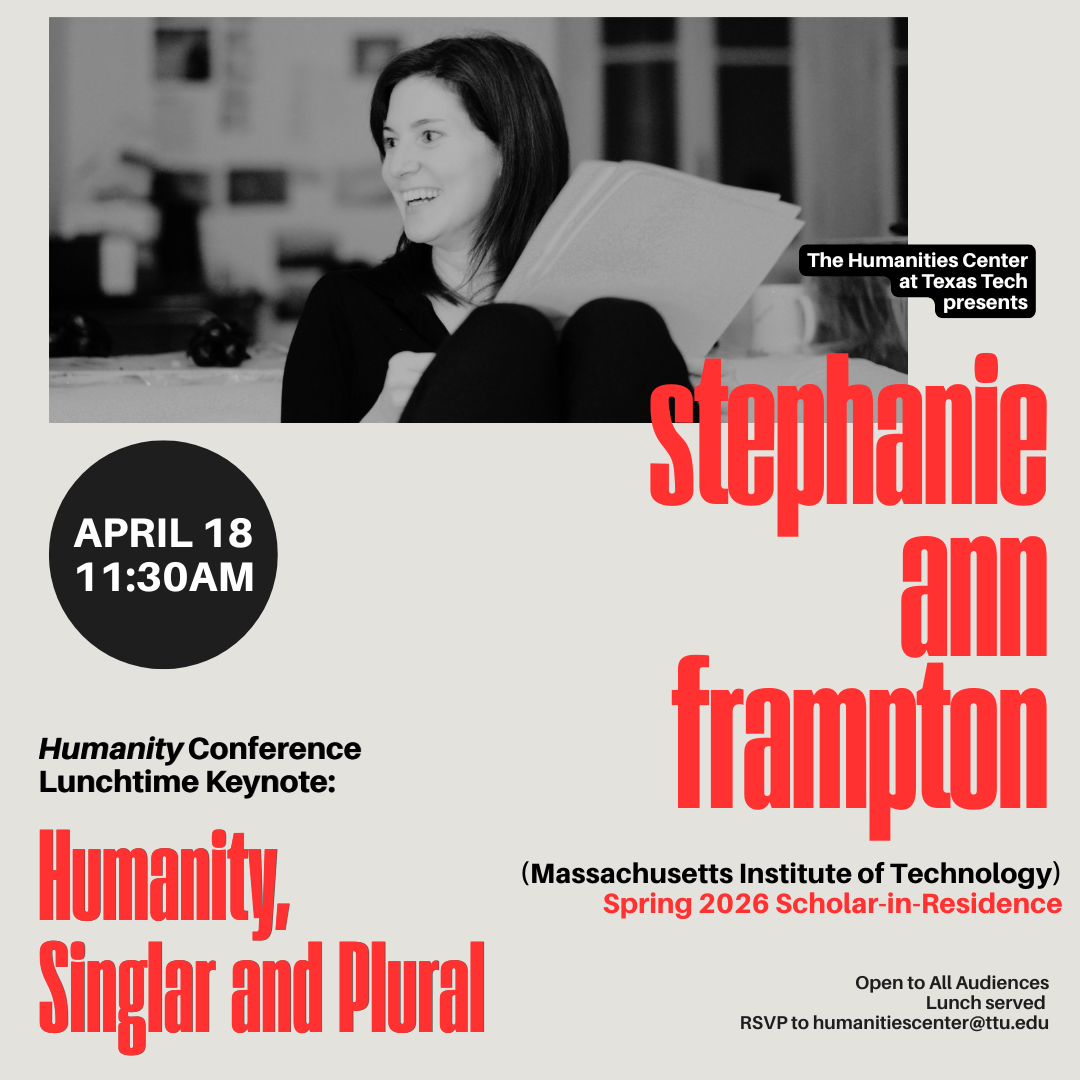
Lunchtime Keynote:
STEPHANIE ANN FRAMPTON:
HUMANITY, SINGULAR AND PLURAL
The modern “humanities” are often treated as a stable category of academic disciplines, but the term has a much more complicated history. Here we return to Latin humanitas, a word that holds a fundamental tension between an inclusive sense of fellow-feeling and an exclusive ideal of cultivated education, aligned with Greek paideia. When humanitas enters English as “humanity” in the late fifteenth century, it designates a field of study opposed to divinitas, encompassing everything outside theology. Only later does the plural “humanities” emerge to name a more delimited set of disciplines, associated with Greek and Roman classics. Read alongside accounts of thinking as a dialogic practice—from Aristotle’s “other self” to Hannah Arendt’s “two-in-one”—this history invites us to rethink what the humanities—and indeed humanity itself—mean today in the university and beyond.
STEPHANIE ANN FRAMPTON, the Spring 2026 Scholar-in-Residence at the Humanities Center at Texas Tech, is a writer and scholar based at MIT in Cambridge, MA. She has published widely in on the history of books and their readers from antiquity to today.
Her first book, Empire of Letters (Oxford, 2019), examines how Roman authors like Vergil and Cicero reimagined literature, philosophy, and society through the very artifacts of writing: papyrus scrolls, wax tablets, and inscriptions on stone and bronze. Her current project, Words with Friends, is a reflection on how we make connections with others by sharing texts in common and what we can learn about the past and the future from reading the classics in the twenty-first century.
Prof. Frampton is a co-convener of the Seminar in the History of the Book at Harvard. She serves on the Fellowship Committee of the Bibliographical Society of America and the Program Committee of the Society for Classical Studies. She is a Fellow of the American Academy in Rome and the Andrew Mellon Society of Fellows in Critical Bibliography. In fall 2025, she was a Writer in Residence at the Vermont Studio Center in Johnson, VT.
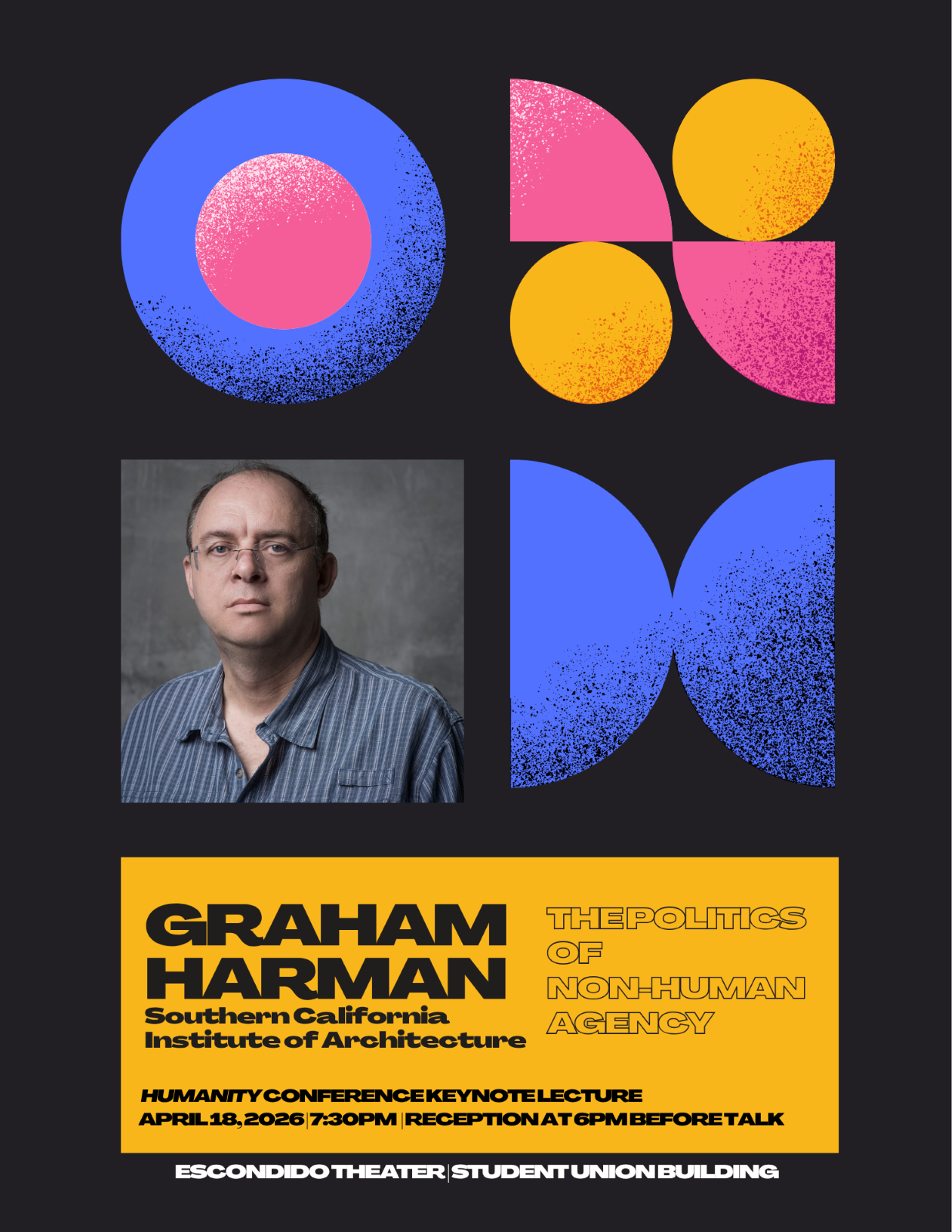
Conference Keynote:
GRAHAM HARMAN:
THE POLITICS OF NON-HUMAN AGENCY
Modern political theory has given us the familiar spectrum running from Left to Right, beginning in the late Renaissance period but consolidated during the French Revolution. What all points on the spectrum share in common is the notion that politics should be grounded in the question of whether human nature is either good/improvable or evil/dangerous (as manifest in the infamous "state of nature"). David Graeber and David Wengrow, in their recent bestseller The Dawn of Everything, challenge this modern opposition. Yet they merely replace it with yet another theory of human nature: this time the idea that humans are naturally experimental and innovative. What the recent turn to non-human agency enables us to do is reconstruct political theory in terms other than those of human nature. The climate crisis itself should be sufficient illustration that non-human actors are becoming more central to the polis. In the process of discussing Bruno Latour's contributions to this shift, I will respond to Andreas Malm's rather harsh critique of Latour in The Progress of This Storm.
GRAHAM HARMAN is Distinguished Professor of Philosophy at the Southern California Institute of Architecture.
Humanities Center
-
Address
Texas Tech University, 2508 15th Street, Weeks Hall 221, Lubbock, TX 79409-1002 -
Phone
806.742.3028 -
Email
humanitiescenter@ttu.edu