
Lewis Irving Held, Ph.D.
Email: See TTU Directory
Phone: +1 (806) 834-3283

Education & Awards
- Ph.D., Molecular Biology, University of California Berkeley, 1977.
- B.S., Life Sciences, Massachusetts Institute of Technology, 1973.
Teaching Awards
- President's Excellence in Teaching Medal, TTU, 1995.
- Professing Excellence Award, University Student Housing, 2010.
- Professing Excellence Award, University Student Housing, 2016.
- Apple Polishing Award, TTU Mortar Board, 2 Nominations, 2020.
- Apple Polishing Award, TTU Mortar Board, 1 Nomination, 2021.
- Apple Polishing Award, TTU Mortar Board, 2 Nominations, 2023.
- Apple Polishing Award, TTU Mortar Board, 3 Nominations, 2024.
- Apple Polishing Award, TTU Mortar Board, 1 Nomination, 2025.
Book Awards
- 2nd Place Medal, TTU University-wide Book Competition, 2004.
- 2nd Place Medal, TTU University-wide Book Competition, 2011.
- 3rd Place Medal, TTU University-wide Book Competition, 2016.
- 3rd Place Medal, TTU University-wide Book Competition, 2019.
- 2nd Place Medal, TTU University-wide Book Competition, 2023.
Web Links:
Interviews
Wall Street Journal interviews Prof. Held about Darwinian evolution
Cambridge Univ. Press interviews Prof. Held about Darwin's legacy
"Playgrounds" for Pre-medical Student Explorers
Cornucopia of CONCEPTUAL FRAMEWORKS (Medical).
NCBI: The National Center for Biotechnology Information.
PubMed: Database of (clinically-related) published articles.
OMIM: Database of genetically caused diseases in humans.
Research Interests
Research in my lab has focused on pattern formation: how do cells construct anatomy? The model system we have used is the leg of the fruit fly and its exquisitely intricate patterns of bristles. Over the years we have probed how various signaling pathways (TGF-beta, Wnt, and EGFR) establish the axes, boundaries, and coordinates of the leg landscape. Recently, we have been investigating cell logic on a smaller scale. We'd like to know the extent to which cuticular patterns depend upon cell size? Because cell size is proportional to ploidy (= the number of sets of chromosomes in a cell), we have been trying to increase overall ploidy by (1) using cold temperature to disable meiotic spindles--yielding unfertilized eggs that have twice the normal number of chromosomes, (2) using a strain of parthenogenetic flies to make tetraploid offspring, and (3) using the tubulin-binding drug Colcemid to double the ploidy of germ cells. Our ultimate goal is to create flies that have huge cells due to higher-than-normal numbers of chromosomes, which should allow us to figure out the cellular basis of cuticular patterning.
Selected Publications
 Held, L. I. (2025) Recounting the history of polyploid research in D. melanogaster: 1 century since 2 reports of 3 flies with 4 sets of chromosomes. FLY 19(1), 8 pp. Link to research article.
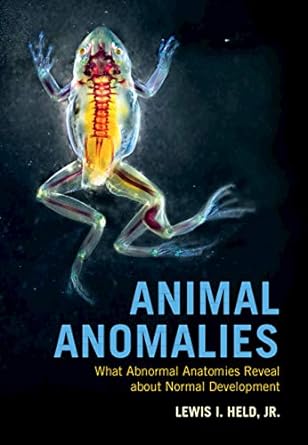
- Held, L. I., Jr. (2021) Animal Anomalies: What Abnormal Anatomies Reveal about Normal Development. Cambridge University Press. 272 pp. Click here for Powerpoint excerpts of chapters on fly genetics. [This book is a survey of monstrosities that divulge deep secrets about how cells build anatomy. It teaches the same concepts as embryology textbooks, but with more whimsy. Just as Lewis Carroll wrote his Alice books in a spirit of "recreational mathematics," this book was written in the spirit of "recreational embryology."] book review 1, book review 2, book review 3, book review 4.
- Held, L. I., Jr., and Sessions, S. K. (2019) Reflections on Bateson's rule: Solving an old riddle about why extra legs are mirror-symmetric. J. Exp. Zool. B (Mol. Dev. Evol.), 332B, 219-237. [How right-handed legs grow from the left side of the body (and vice versa) in deviant animals--a perplexing paradox from 125 years ago.]
- Held, L. I., Jr., McNeme, S. C., and Hernandez, D. (2018) Induction of ectopic transverse rows by Ubx on fly legs. Dros. Info. Serv.101, 25-32. [Extension of the conclusions from our 2017 paper to include another important Hox gene aside from Scr--namely, Ubx.]
- Held, L. I., Jr., Davis, A. L., and Aybar, R. S. (2017) Instigating an "identity crisis" to investigate how a Hox gene acts on fly legs. Dros. Info. Serv. 100, 75-89. [Switching the segmental identity of bristle cells at the last minute allows us to see how they make decisions.]
-
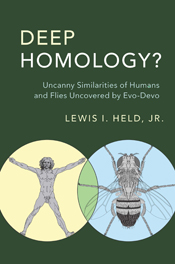
Held, L. I., Jr. (2017) Deep Homology? Uncanny Similarities of Humans and Flies Uncovered by Evo-Devo. Cambridge University Press. 272 pp. [Comparison of the genomic "operating systems" of humans and flies in terms of how the very same algorithms can build wildly different anatomies.] This book is the third volume in a trilogy of books about evo-devo: Quirks = Vol.1; Snake = Vol.2; DH = Vol.3. book review 1, book review 2, book review 3, book review 4, book review 5, book review 6.
-
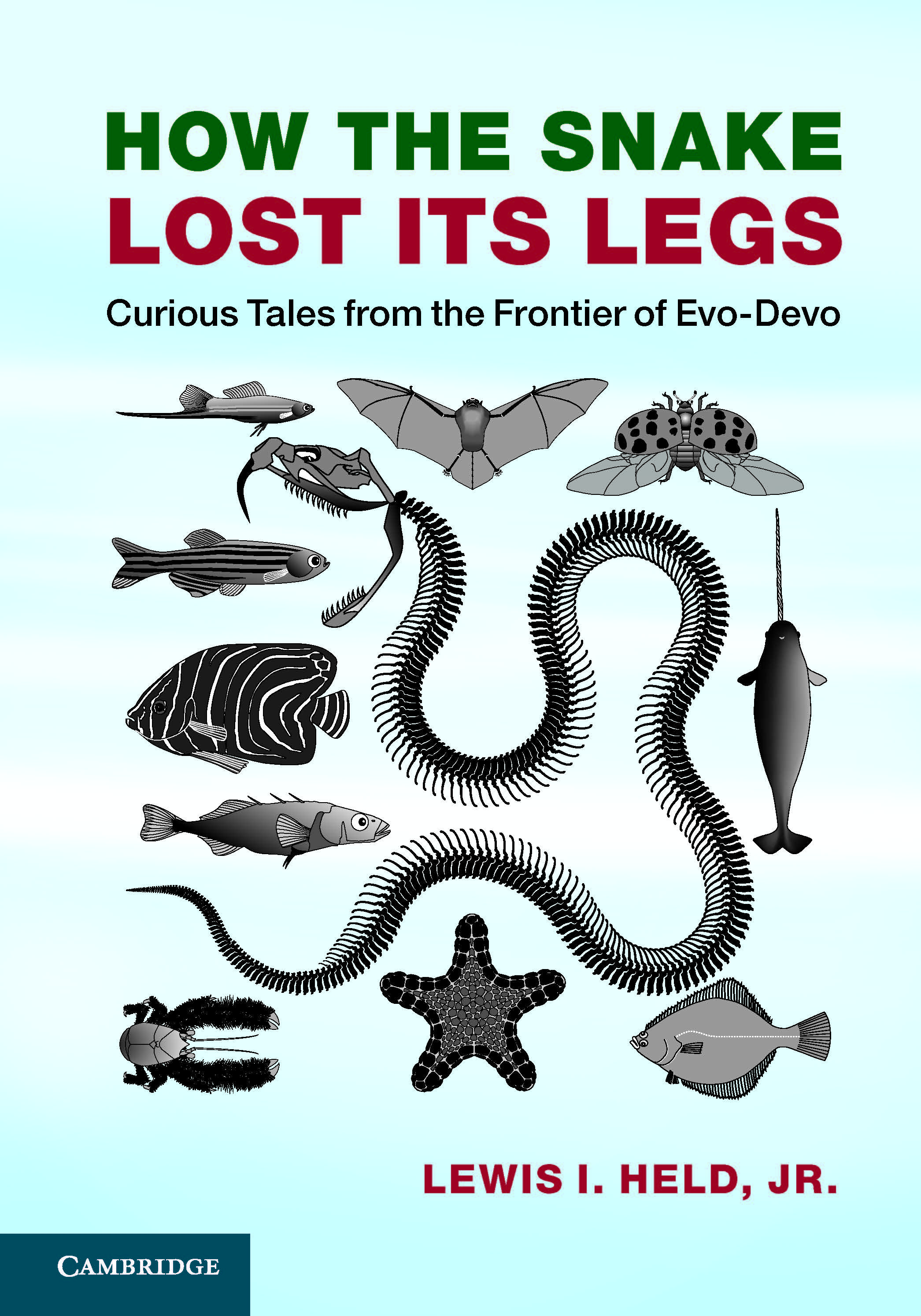
Held, L. I., Jr. (2014) How the Snake Lost its Legs: Curious Tales from the Frontier of Evo-devo. Cambridge University Press. 285 pp. Profiled on Wikipedia. [A factual homage to Rudyard Kipling's fanciful Just So Stories . How the leopard actually got its spots, the zebra its stripes, the camel its hump, etc., from a modern genetic perspective.] book review 1 , book review 2, book review 3, book review 4, book review 5, book review 6.
- Held, L. I., Jr., Billingsley, S. A., and Muñoz, J. O. (2014) Disabling Cdc42 disrupts bristle patterning. Dros. Info. Serv. 97, 45-51. [Filopodia may mediate bristle-cell movements.]
- Held, L. I., Jr. (2013) Rethinking butterfly eyespots. Evol. Biol. 40, 158-168. [A new evo-devo hypothesis for how butterflies got their spots.]
- Held, L. I., Jr. (2011) When does the spiny legs1 allele of the prickle gene cause extra joints? Dros. Info. Serv. 94, 47-52. [Probing the etiology of a bizarre syndrome.]
- Held, L. I., Jr. (2010) How does Scr cause first legs to deviate from second legs? Dros. Info. Serv. 93, 132-146. [A "Sherlock Holmes" study of old clues left by a Master Gene.]
- Held, L. I., Jr. (2010) The evolutionary geometry of human anatomy: Discovering our inner fly. Evol. Anthropol. 19, 227-235. [Applying insights from flies to the human genome.]
- Held, L. I., Jr. (2010) The evo-devo puzzle of human hair patterning. Evol. Biol. 37, 113-122. [Reflections on why humans are the only "naked" apes and why men go bald.]
-
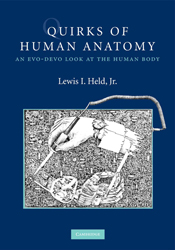
Held, L. I., Jr. (2009) Quirks of Human Anatomy: An Evo-Devo Look at the Human Body . Cambridge University Press. 260 pp. [Musings on many flaws we inherited via evolution.] book review 1 , book review 2 , book review 3 , book review 4 , book review 5 , book review 6.
- Held, L. I., Jr. (2009) 101 Unsolved Puzzles in Evo-Devo . Ancillary Workbook (Problem Sets) for Quirks of Human Anatomy . [Mental exercises for those curious about oddities.]
- Held, L. I., Jr. (2005) Suppressing apoptosis fails to cure "extra-joint syndrome" or to stop sex-comb rotation. Drosophila Info. Serv. 88, 9-10. [The syndrome causes double joints.]
- Held, L. I., Jr., Grimson, M. J., and Du, Z. (2004) Proving an old prediction: The sex comb rotates at 16-24 hrs after pupariation. Drosophila Info. Serv. 87, 76-78. [A rare proof.]
- Held, L. I., Jr. (2003) Tetraploid male mosaics induced by pressure. Drosophila Info. Serv. 86, 50-53. [The cells of tetraploids are twice the volume of diploids & look a bit odd.]
-
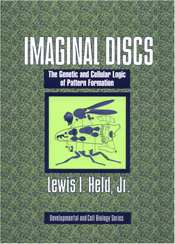
Held, L. I., Jr. (2002) Imaginal Discs: The Genetic and Cellular Logic of Pattern Formation . Cambridge University Press. 460 pp. [History of a century of fly genetics, which has succeeded in deciphering the process of metamorphosis that converts discs into legs, wings, eyes, etc.] book review 1, book review 2.
- Held, L. I., Jr. (2002) Bristles induce bracts via the EGFR pathway on Drosophila legs. Mechanisms of Development 117, 225-234. [The smallest known inductive interaction.]
- Held, L. I., Jr. (2002) Why should transverse rows need the EGFR pathway to align properly on Drosophila legs? Drosophila Info. Serv.85, 17-19. [How bristle cells align into surprisingly straight rows.]
- Held, L. I., Jr., Heup, M.A. (1996) Genetic mosaic analysis of decapentaplegic and wingless gene function in the Drosophila leg. Development, Genes and Evolution 206, 180-194. [A critical piece in the puzzle of how genes generate geometry in fly legs.]
- Held, L. I., Jr. (1995) Axes, boundaries, and coordinates: the ABCs of fly leg development. BioEssays 17, 721-732. [Overview of geometry of leg development.]
- Held, L. I., Jr., Heup, M.A., Sappington, J.M., and Peters, S.D. (1994) Interactions of decapentaplegic , wingless , and Distal-less in the Drosophila leg. Rouxs Arch. Dev. Biol. 203, 310-319. [Genetic basis for how the fly leg establishes a coordinate system.]
-
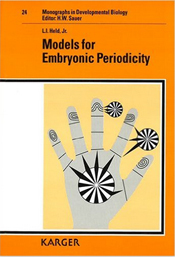 Held, L. I., Jr. (1992) Models for Embryonic Periodicity. Karger. 119 pp. [Historical survey of theories for how embryos make spatially
periodic patterns, such as fingers, phalanges, and fingerprints, tree branches, flower
petals, body segments, vertebrae, teeth, etc. An homage to William Bateson's classic
monograph Materials for the Study of Variation published a century earlier.] book review 1.
Held, L. I., Jr. (1992) Models for Embryonic Periodicity. Karger. 119 pp. [Historical survey of theories for how embryos make spatially
periodic patterns, such as fingers, phalanges, and fingerprints, tree branches, flower
petals, body segments, vertebrae, teeth, etc. An homage to William Bateson's classic
monograph Materials for the Study of Variation published a century earlier.] book review 1.
Department of Biological Sciences
-
Address
Department of Biological Sciences, Texas Tech University, Box 43131 Lubbock, TX 79409 -
Phone
806.742.2715 -
Email
biology@ttu.edu