
Fly America Act
All air travel and cargo transportation services funded by the federal government are required to use a “U.S. flag” air carrier service. You can find a complete list of certified U.S. flag air carriers on transportation.gov.
This requirement applies to
- Federal government employees and their dependents
- Consultants, contractors, and grantees
- Other travelers whose travel is paid for by the federal government
You cannot cross the U.S. border to use a foreign airline to avoid being subject to the Fly America Act. If your travel does not comply with the Fly America Act, the government will not reimburse the cost of your airline ticket. Texas Tech University recommends using Corporate Travel Planners (CTP) to book all travel funded by Federal Funding (21xxx) to ensure compliance with the Fly America Act.
Authority for the Fly America Act comes from 49 U.S.C. 40118.
Codesharing
Occasionally, two or more airlines will “codeshare” a flight by publishing and marketing the same flight under their own airline designators and flight numbers. You can purchase a seat on each airline’s designator and flight number, but the flight is only operated by one of the cooperating airlines. To comply with Fly America regulations, you must purchase the flight via the U.S. airline’s designator and flight number if the flight is shared between a U.S. and a foreign airline.
Exceptions to the Fly America Act
There are some circumstances where it’s not reasonable to use a U.S. flag air carrier, and you can make an exception to the Fly America Act. The Fly America Act waiver Checklist can be found here. These circumstances are:
- When a U.S. air carrier is not available.
- When using a U.S. carrier service, the travel time would be extended by 24 hours or more.
- When a U.S. carrier does not offer a nonstop or direct flight between origin and destination,
and uses a U.S. carrier:
- Increases the number of aircraft changes outside the United States by two or more;
- Extends travel time by six hours or more; or
- Requires a connecting time of four hours or more at an overseas interchange point.
- When the flight time from origin to destination is less than three hours and using a U.S. flag carrier doubles the flight time.
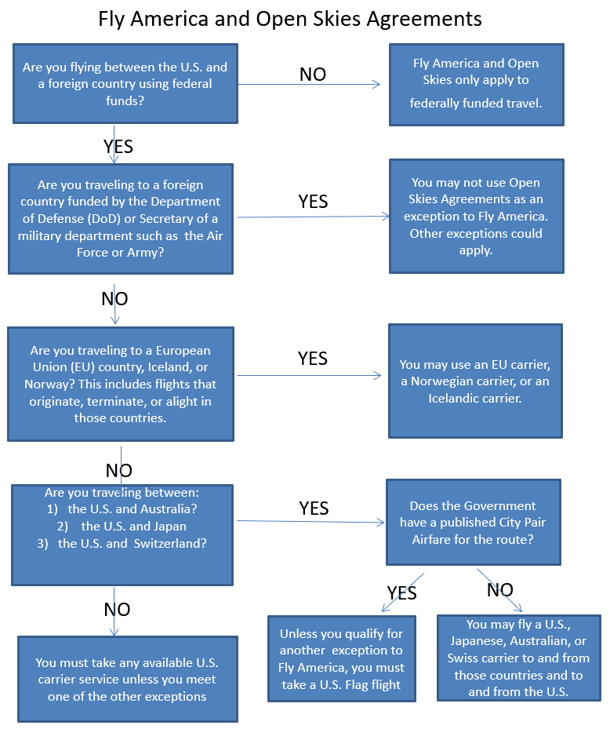
- When there is an applicable Open Skies Agreement in effect that meets the requirements of the Fly America Act.
The exceptions provided by the Open Skies Agreements for government-funded travel do not apply if your transportation is funded by the Department of Defense.
Note: Ticket cost and convenience are NOT exceptions to the Fly America Act.
Open Skies Agreements
“Open Skies Agreements” are bilateral or multilateral agreements between the U.S. Government and the governments of foreign countries that allow travelers to use foreign air carriers from these countries for government-funded international travel. Many Open Skies Agreements exist but only (4) four agreements meet Fly America Act requirements which the key factor is the statement for “U.S. Government Procured Transportation: in either the Article or Annex of the agreement.
The United States currently has Open Skies Agreements in effect with:
- European Union (28 countries) (Austria, Belgium, Bulgaria, Cyprus, Czech Republic, Denmark, Estonia,
- Finland, France, Germany, Greece, Hungary, Ireland, Italy, Latvia, Lithuania, Luxembourg, Malta,
- Netherlands, Poland, Portugal, Romania, Slovakia, Slovenia, Spain, Sweden, including Iceland and Norway)
- Australia
- Switzerland
- Japan
The agreement with the European Union permits travel on an EU air carrier outside the United States. Iceland and Norway are not EU members but are members of the EU air treaty. This is the only one of these four agreements that allows for an origin or destination in a third country, provided the flight stops in the EU.
Note: As of January 1, 2021, the United Kingdom is no longer a member of the EU. Consequently, the Open Skies Agreement with the EU does not pertain to the U.K. Travelers must use a U.S. Flag Carrier to travel from the U.S. to the U.K. and not a U.K. airline (e.g., British Airways), unless they use a different Fly America Act exception. Travelers may continue to use an EU agreement for travel from the U.S. to the U.K. as long as the flight stops in the EU before arriving in the U.S. or the U.K.
- European Union (April 30, 2007)
- Amendment 1 [PDF] (June 24, 2010)
- Amendment 2 (June 21, 2011)
The agreements with Australia, Switzerland, and Japan permit the use of an Australian, Swiss, or Japanese air carrier for international travel between the U.S. and these countries as long as a “City Pair” fare is not available between the cities of origin and destination.
- Australia [PDF - 4 MB] (October 1, 2008)
- Switzerland [PDF - 3 MB] (October 1, 2008)
- Japan [PDF] (October 1, 2011)
You can find more information on the four Open Skies Agreements and other specific country agreements on the Department of State’s website. You can also find more general information about Open Skies Agreements in Federal Travel Regulation Bulletin 11-02 [PDF - 111 KB] and Bulletin 12-04 [PDF - 81 KB].
Documenting exceptions
To document a Fly America Act Waiver Checklist, including under an Open Sky Agreement, you must include the following information in your expense report:
- A completed and signed internal agency Fly America exception form. (Linked above)
- A detailed travel itinerary from a travel agent or online travel service (i.e. Sanditz, Travelocity, Orbitz, or Expedia).
- The search results performed at the time of booking from an online travel service that documents all available flights and the existence of the Fly America exception identified on the Fly America exception form, if applicable.
If you have other questions about the Fly America Act or Open Skies Agreements, contact travelservices@ttu.edu.
This information and more can be found on the GSA website.
Rev. 9/15/2026
Procurement Services
-
Address
Box 41094, TTU Plaza, Suite 408, 1901 University Avenue, Lubbock, TX 79409-1094 -
Phone
806.742.3844 | Fax: 806.742.3820 -
Email
strategic.acquisitions@ttu.edu