Report published November 2025 for the 2025-2026 academic year.
Introduction

Institutional Compliance
Report published November 2025 for the 2025-2026 academic year.
Introduction
Texas Tech University is committed to fostering a campus community that promotes the overall wellbeing of its community members and is free from illegal drugs and alcohol abuse. In the following annual notification, you will find information about the university’s Drug and Alcohol Abuse Prevention Program (DAAPP), policies regarding drugs and alcohol, substance abuse prevention programs and services, and other resources for students, faculty, and staff.
All campus community members should be aware that the unlawful possession, use, or distribution of illicit drugs and alcohol on Texas Tech University property or as part of any Texas Tech University activity is prohibited by law and Texas Tech University policy.
The Drug-Free Schools and Communities Regulations (34 CFR Part 86) of the Drug-Free Schools and Communities Act (DFSCA) requires that, as a condition of receiving funds or any other form of financial assistance under any federal program, an institution of higher education must adopt and implement a program designed to prevent the possession, use, or distribution of illicit drugs and the abuse of alcohol by students and employees.
At a minimum, Texas Tech University must annually distribute the following in writing to all students and employees:
Texas Tech University has enacted TTU OP 40.06 (Drug-Free Schools and Communities Act to ensure understanding of and standardized procedures in compliance with the provisions of the Drug-Free School and Communities Act, as amended.
TTU OP 40.06: Drug-Free Schools and Communities Act describes the:
In addition to TTU OP 40.06, this Drug and Alcohol Abuse Prevention Program (DAAPP) has been created and annual notification of Texas Tech University’s DAAPP is distributed to all current students and employees each semester (fall, spring, and summer) through Texas Tech email. New employees receive notification at New Employee Orientation and from Human Resources electronically during the onboarding process. New students receive notification electronically upon enrollment. Employees and students can access the DAAPP and the accompanying Biennial Reports through the regularly updated Drug-Free Schools and Communities Act website.
Texas Tech University’s Office of Institutional Compliance also produces Annual Security Reports (ASRs) and Annual Security and Fire Safety Reports (ASFSRs) which describe campus policies and procedures surrounding safety and include statistics related to Clery Act crimes. On-campus alcohol and drug referrals and arrests are part of the statistics documented in the ASRs and ASFSRs. These reports are campus specific and are emailed annually to all students and employees by October 1st. All currently enrolled students, campus employees, and prospective students and prospective employees are entitled to request and receive a copy of the applicable ASR or ASFSR. They are also available online and can be requested in person at the Texas Tech Police Department (413 Flint Ave., Lubbock, TX).
Texas Tech University Office of Institutional Compliance is responsible for the annual notification of the DAAPP and the Drug-Free Schools and Communities Act biennial review, overseeing compliance with the continuing implementation and assessment of the programs included in this report.
Institutional Compliance:
The Texas Tech University Student Handbook and Code of Student Conduct outline behavioral standards developed by the university community for students and student organizations and the related procedures for addressing misconduct. The university may impose disciplinary charges against any student who violates the Texas Tech University Code of Student Conduct and/or local, state and federal laws concerning controlled substances.
The policies regarding the use and abuse of alcohol and drugs are listed in Part I, Section B.3 and B.4 of the Student Code of Conduct and state that Texas Tech University specifically prohibits:
Texas Tech University employees must abide by Texas Tech University System Regulation 07.07: Employee Conduct, Coaching, Corrective Action and Termination, Texas Tech University Operating Policy 70.20: Conducting Criminal Background Checks for Employment Purposes, and Texas Tech University Operating Policy 70.35: Drug and Alcohol Testing for Safety-and Security- Sensitive Positions.
Other applicable policies include The Drug-Free Workplace Act of 1988, the Drug-Free Schools and Communities Act of 1989, the Drug-Free Work Force Rules for Department of Defense (DOD) Contractors, and the requirements of the Department of Transportation or other regulatory bodies and applicable state laws. Specifically, Texas Tech University prohibits:
Unlawful use of alcohol or illicit drugs is strictly prohibited on all university property and at university-sponsored events. The use of alcohol on university property or at university-sponsored events is strictly regulated by the following university policies:
The health risks associated with the use and abuse of drugs and/or alcohol can be long-lasting and can result in serious injury or death. For more information about the specific health risks associated with drugs and alcohol, visit the National Institute on Drug Abuse website, or review The Drug Enforcement Administration (DEA) 2022 Resource Guide on Drugs of Abuse.
Excessive alcohol use has immediate effects that increase the risk of many harmful health conditions. These are most often the result of binge drinking (defined as a pattern of drinking that brings blood alcohol concentration, BAC, to 0.08 g/dL [0.08%] or more)and include the following:
Over time, excessive alcohol use can lead to the development of chronic diseases and other serious problems including:
By monitoring your alcohol consumption and avoiding excessive drinking, you can significantly lower the risk of both short- and long-term health issues.
The long- and short-term effects of drug use vary greatly by substance, however, the health risks associated with the use and/or abuse of illicit drugs can be very serious and result in serious injury and/or death.
For more information about the health-related risks of drug and alcohol use, contact Risk Intervention and Safety Education (806-742-2110) or Texas Tech University Student Health Services (806-743-2848) if you are a Texas Tech student or the Employee Assistance Program (EAP) (806-743-1327) if you are a Texas Tech employee.
Texas Tech University is dedicated to offering programs and services that emphasize educating students on the risks and consequences of drug and alcohol use. Support services for student seeking help are provided by the university and referrals to community resources are made when the need of the student is beyond the scope of university-provided services.
Texas Tech University is also committed to providing programs and services for employees that prioritize educating about the risks associated with drug and alcohol use. Support services for an employee seeking help are provided by the university programs and referrals may also be made to community resources.
Texas Tech University enforces all Federal and State laws and local ordinances. The Texas Tech Police Department can be contacted at 806-742-3931 for non-emergencies and 911 for emergencies.
Possession, use, or distribution of illicit drugs is prohibited by federal law. Strict penalties are provided for drug convictions, including mandatory prison terms for many offenses. Penalties increase significantly where use of the illicit drugs results in death. Serious fees, on-campus housing contract cancellation, and suspension or expulsion from the university may also occur.
The following information, although not complete, is an overview of federal penalties for first convictions.
The Federal Uniform Drinking Age Act of 1984 set the minimum legal drinking age to 21 in the United States, and every state, including the State of Texas, abides by that standard. For more information about the alcohol policy in the United States, visit the NIAAA’s Alcohol Policy Information System website.
In Texas, the following statutes guide the laws and penalties surrounding illicit drugs and alcohol:
In Texas, the sale of packaged liquor is prohibited on Sunday. Packaged liquor may be sold between 10:00 a.m. and 9:00 p.m., Monday through Saturday. The sale of packaged liquor is prohibited on New Year’s Day, January 2 (when it falls on a Monday), Thanksgiving Day, Christmas Day, and December 26 (when it falls on a Monday).
Packaged beer and wine can be sold between noon and midnight on Sunday, between 7:00 a.m. and midnight, Monday through Friday, and between 7:00 a.m. and 1:00 a.m. on Saturday.
Alcoholic beverages may be served in bars and restaurants between noon and midnight on Sunday, between 7:00 a.m. and midnight, Monday through Friday, and between 7:00 a.m. and 1:00 a.m. on Saturday. At certain restaurants, alcoholic beverages may be served with meals beginning at 10:00 a.m. on Sunday.
Costa Rica Liquor Laws identify the legal drinking age as 18. Minors, those under 18 years of age, need to know that it is illegal to knowingly:
Under Costa Rica law, it is illegal to drink in public areas such as street, parks, beaches, and sidewalks.
In Costa Rica, a prison sentence of one to three years will be imposed in the following driving under the influence of alcohol cases:
· For any type of driver, if the blood alcohol concentration (BAC) exceeds 0.75 grams per liter or breath alcohol concentration (BrAC) exceeds 0.38 milligrams per liter
· For professional drivers or those who received their driver’s license for the first time less than three years ago if the BAC exceeds 0.50 grams per liter or the BrAC exceeds 0.25 milligrams per liter.
Infractions of the state’s alcohol laws can be punishable by fines, probation, and/or jail time. It is a $360 fine for the illegal possession or public consumption of those under the age of 18.
Costa Rica drug laws prohibit possession, sale, manufacture, and distribution of marijuana and other controlled substances (i.e. cocaine, LSD, PCP, hallucinogenic substances, stimulants, narcotics), and possession of drug paraphernalia. There are two laws the regulate drug-related activities, the General Health Law (Law 5395) and the Narcotics and Psychotropic Substances Law (Law 8204).
Drug use has been decriminalized in Costa Rica. The General Health Law prohibits the planting, cultivation, import, export, and trafficking of drugs. The cultivation, manufacture, storage, transport, distribution, and trafficking of drugs are criminal acts.
The punishment established for all these activities is a prison sentence of between 8 and 15 years. This is the penalty appliable to anyone who distributes, markets, supplies, manufactures, prepares, refines, processes, extracts, cultivates, produces, transports, stores or sells any of the drugs, substances or products listed in the law or who grows the plants from which these substances or products are obtained, without being legally authorized to do so. The same punishment is imposed upon anyone who has these drugs, substances, or products in their possession without proper authorization for any of the purposes listed, and anyone who possesses or sells seeds that can be germinated or other natural products that are used to produce the listed drugs.
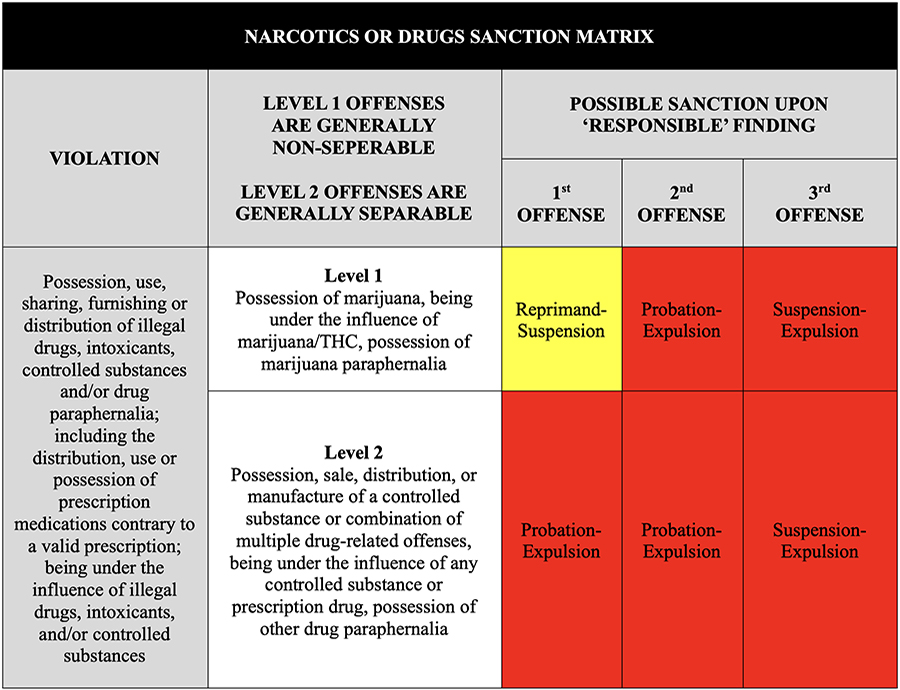
Texas Tech University will impose sanctions on students and employees for violations of Texas Tech University policies and standards of conduct which may include suspension, expulsion, and/or termination of employment. Students who are also employees may also be held accountable under both student and employee policies.
The Texas Tech Office of Student Conduct (OSC) is responsible for cases of Code of Student Conduct violations and may issue sanctions. The OSC is in the Student Union Building (SUB), Suite 307 (1502 Akron Ave. Lubbock, TX 79409) and can be reached by calling 806-742-1714. Sanctions for violations of the Code of Student Conduct are proportionate to the severity of the violation and to the cumulative conduct history of the student found responsible. Common sanctions for alcohol and drug related violations include participation in an alcohol or drug education workshop and/or the completion of a drug and alcohol assessment through Risk Intervention and Safety Education (RISE) or Student Health Services at Texas Tech University, mandated counseling or substance abuse treatment, eviction from on-campus housing, and could include probation, suspension, or expulsion from the university.

*Law School and Professional School Students may enter at a step higher.
*Law School and Professional School Students may enter at a step higher.
For a complete explanation of the General Conduct Sanction Grid, visit GeneralConductSanctionGrid.pdf (ttu.edu) (https://www.depts.ttu.edu/studentconduct/GeneralConductSanctionGrid.pdf)
The university may, at its discretion, offer amnesty for conduct violations to:
If amnesty is offered, educational options may be explored, but no conduct actions or sanctions will result.
Abuse of amnesty provisions may result in a violation of the Code of Student Conduct. Amnesty does not preclude students from being charged with allegations of misconduct related to the Actions against Members of the University Community and Others section of the Code. The Code of Student Conduct amnesty provisions do not influence criminal proceedings or charges. Amnesty does not preclude students from being required to meet with university staff or to participate in conditions such as counseling, alcohol assessments, and other requirements. The Office for Student Civil Rights and Sexual Misconduct may also assist with questions related to amnesty provisions, but the final determination regarding amnesty will be made by the ADOS/SD of the Office of Student Conduct or designee or the Title IX Coordinator or designee in Title IX cases.
Staff employees found in violation of university policy will be addressed under TTU System OP 07.07: Employee Conduct, Discipline, and Terminations. An employee who violates the standards established in this policy may be subject to coaching, corrective action, suspension with or without pay, administrative leave, and/or termination from Texas Tech.
Faculty employees found in violation of university policy will be addressed under TTU OP 32.04: Conduct of University Faculty. A violation of the standards established in this policy may result in the assessment of a penalty ranging from an oral reprimand to termination from Texas Tech. In the case of non-tenured and non-tenure track faculty members, all disciplinary procedures other than non-renewal of appointment, termination, or denial of tenure will be governed by TTU OP 70.31. Tenured faculty members’ termination will be controlled by the tenure policy (OP 32.01).
Oversight Responsibility
The Drug-Free Schools and Communities Act Biennial Review Committee was headed by the Office of Institutional Compliance and was comprised of the following members. Ad hoc members were included as needed.
Claire Nevarez, Clery Compliance Officer
Tyler Patrick, Deputy Compliance Officer
Kim Simon, Chief Compliance Officer
Angela Chisum, Staff Senate President
Dawn Payne, Equal Employment Opportunity Director
Eric Maki, University Recreation Managing Director
Grant Stovall, Senior Associate Athletics Director
Jawana Green, Office of Student Conduct Senior Director
Serena Shade, Risk Intervention and Safety Education (RISE) Senior Director
Todd Phillips, Human Resources Administration Senior Director
Lisa Viator, Student Counseling Center Managing Director
Faith Geistweidt, Student Government Association President
Tammy Diaz, Student Health Services Nurse Manager
William (Buddy) Gerber, Center for Students in Addiction Recovery Director
Introduction
Texas Tech is a public, co-educational research university located in the city of Lubbock, Texas, a city with a population of more than 260,000. Established in 1923, it is part of the Texas Tech University System.
Texas Tech currently has five (5) regional campus and academic sites around the state of Texas - TTU at DFW, TTU at El Paso, TTU at Highland Lakes, TTU School of Veterinary Medicine, and TTU at Waco - and an international location in San Jose, Costa Rica. Each of the regional and international campus locations report alcohol and drug-related violations to the Office of Institutional Compliance and the Office of Student Conduct.
This DFSCA Biennial Review does not pertain to Texas Tech University Health Sciences Center (TTUHSC) in Lubbock, Texas Tech University Health Sciences Center El Paso, or any regional TTUHSC teaching sites. The DFSCA and Drug and Alcohol Abuse Prevention Programs (DAAPP) for each Health Sciences Center campus is on their respective websites.
Texas Tech University is committed to fostering a campus community that promotes the overall wellbeing of its community members and is free from illegal drugs and alcohol abuse. All campus community members should be aware that the unlawful possession, use, or distribution of illicit drugs and alcohol on Texas Tech University property or as part of any Texas Tech University activity is prohibited by law and Texas Tech University policy.
Questions about this Biennial Review should be directed to the Texas Tech Clery Compliance Officer at clerycompliance@ttu.edu or by calling 806-834-1884.
Drug-Free Schools and Communities Act’s (DFSCA) Drug and Alcohol Prevention Program (DAAPP) and Biennial Review
The Drug-Free Schools and Communities Regulations (34 CFR Part 86) of the Drug-Free Schools and Communities Act (DFSCA) requires that, as a condition of receiving funds or any other form of financial assistance under any federal program, an institution of higher education must adopt and implement a program designed to prevent the possession, use, or distribution of illicit drugs and the abuse of alcohol by students and employees.
At a minimum, Texas Tech University must annually distribute the following in writing to all students and employees:
The DFSCA also requires a biennial review that includes the following objectives:
Texas Tech University Drug-Free Schools and Communities Act Policy
Texas Tech University has enacted TTU OP 40.06 (Drug-Free Schools and Communities Act) to ensure understanding of and standardized procedures in compliance with the provisions of the Drug-Free School and Communities Act, as amended.
TTU OP 40.06: describes the:
Annual Report Notifications
In addition to TTU OP 40.06, Texas Tech’s Drug and Alcohol Abuse Prevention Program (DAAPP) has been created and annual notification of Texas Tech University’s DAAPP is distributed to all current students and employees each semester (fall, spring, and summer) through Texas Tech email. New employees receive notification at New Employee Orientation and from Human Resources electronically during the onboarding process. New students receive notification electronically upon enrollment. Employees and students can access the DAAPP and the accompanying Biennial Reports through the regularly updated Drug-Free Schools and Communities Act website.
Texas Tech University’s Office of Institutional Compliance also produces Annual Security Reports (ASRs) and Annual Security and Fire Safety Reports (ASFSRs) which describe campus policies and procedures surrounding safety and include statistics related to Clery Act crimes. On-campus alcohol and drug referrals and arrests are part of the statistics documented in the ASRs and ASFSRs. These reports are campus specific and are emailed annually to all students and employees by October 1st. All currently enrolled students, employees, and prospective students and prospective employees are entitled to request and receive a copy of the applicable ASR or ASFSR. They are also available online and can be requested in person at the Texas Tech Police Department (413 Flint Ave., Lubbock, TX).
Strengths, Opportunities, and Recommendations
Campus-Wide Biennial Review Process
Texas Tech University conducted a biennial review of both students’ and employees’ knowledge and awareness of alcohol and drug-related policies, prevention programs, and the number of alcohol and drug related referrals and arrests for the 2023-2024 and 2024-2025 academic years.
In November 2024, Drug-Free Schools and Communities Act compliance (including the Drug and Alcohol Abuse Prevention Programs and biennial review) was moved under the Office of Institutional Compliance as it directly pertains to the department’s Jeanne Clery Campus Safety Act compliance requirements. The Office of Institutional Compliance determined that the focus of its first biennial review should be to determine the baseline of where the Texas Tech University community is in understanding AOD policies, available resources, and prevention programs. The results will describe objectives for future DFSCA Biennial Reviews.
Objective 1: Evaluate students’ knowledge and understanding of AOD-related policies and available prevention resources.
Process: A SurveyMonkey questionnaire was developed and distributed through email requests and TechAnnounce promotion to gather information. The questionnaire consisted of 2 likert-scale questions and 10 questions that had “yes”, “no”, or “unsure” options as answers and was available to be completed from November 6, 2025, through December 5, 2025. Students were able to provide their email address if they wanted to be contacted about available drug/alcohol resources. The eight email addresses provided were sent to RISE (Risk Intervention and Safety Education) for information distribution.
Fifty-seven students completed the TTU Student Drug and Alcohol Policies & Procedures Survey.
Likert Question: How familiar are you with the TTU Code of Student Conduct prohibitions on drug and alcohol use?
Average Answer: 65 (on a scale from 0-100)
Question: Are you aware that TTU’s Student Code of Conduct prohibits the unlawful or unauthorized possession, use, distribution, delivery, or sale of alcohol and/or public intoxication and the possession, use sharing, furnishing or distribution of illegal drugs, intoxicants, controlled substances and/or drug paraphernalia?
YES: 87.72% NO: 8.77% UNSURE: 3.51%
Question: Are you aware that TTU’s Amnesty Policy allows the University to offer amnesty to individual student(s) for conduct violations who 1) May have committed a violation at the time of an incident or 2) Offers help to those who need medical assistance and if amnesty is offered, educational options may be explored, but no conduct actions or sanctions will result?
YES: 66.07% NO: 23.21% UNSURE: 10.71%
Question: Are you aware that all local, state and federal laws pertaining to drugs and alcohol apply to all students while on campus, including those living in the residence halls?
YES: 89.29% NO: 5.36% UNSURE: 5.36%
Question: Are you aware that West Village B is the only residence hall that allows alcohol if the student is over 21 years of age?
YES: 56.14% NO: 42.11% UNSURE: 1.75%
Question: Are you aware that the Office of Student Conduct investigates and issues sanctions for alcoholic beverages and narcotics or drug violations of the Student Code of Conduct including educational opportunities, reprimands, probation, suspension, and expulsion?
YES: 80.70% NO: 17.54% UNSURE: 1.75%
Likert Question: How familiar are you with TTU’s drug and alcohol related education and programming resources?
Average Answer: 58 (on a scale from 0-100)
Question: Are you aware that TTU provides programs for education, impact, and growth surrounding alcohol and drug use?
YES: 79.63% NO: 20.37% UNSURE: 0%
Question: Are you aware that TTU provides alcohol-free programming free to students with their TTU Student ID?
YES: 64.81% NO: 33.33% UNSURE: 1.85%
Question: Are you aware that TTU’s Crisis HelpLine (806-742-5555) is available 24 hours a day, 7 days a week, 365 days a year to assist students experiencing a mental health or interpersonal violence crisis?
YES: 85.19% NO: 12.96% UNSURE: 1.85%
Question: Are you aware that TTU’s Raider Ride provides students with on-demand rides on campus from 6:00 pm-2:45 am, 7 days a week (while classes are in session) with a valid student ID through the TechRide app?
YES: 77.78% NO: 16.67% UNSURE: 5.56%
Question: Are you aware that TTU can help connect you with on-campus and community resources pertaining to alcohol and drug use and misuse?
YES: 92.59% NO: 7.41% UNSURE: 0%
Objective 2: Evaluate employees’ knowledge and understanding of AOD-related policies and available resources.
Process: A SurveyMonkey questionnaire was developed and distributed through email requests and TechAnnounce promotion to gather information. The questionnaire consisted of 2 likert-scale questions and 11 questions that had “yes”, “no”, or “unsure” options as answers and was available to be completed from November 6, 2025, through December 5, 2025. Employees were able to provide their email address if they wanted to be contacted about available drug/alcohol resources. The three email addresses provided were sent to the Office of Equal Opportunity and Human Resources for information distribution.
One hundred and thirty-one employees completed the TTU Employee Drug and Alcohol Policies & Procedures Survey.
Likert Question: How familiar are you with TTU policies and sanctions regarding alcohol and drug use?
Average Answer: 60 (on a scale from 0-100)
Question: Are you aware that Texas Tech University System Regulation 07.07 Employee Conduct, Coaching, Corrective Action and Termination (TTUS Reg. 07.07) addresses being unfit for duty, including being under the influence of drugs or alcohol, or refusing to submit to a drug or alcohol test?
YES: 77.86% NO: 14.50% UNSURE: 7.63%
Question: Are you aware that the unlawful manufacture, distribution, dispensing, possession, or use of a controlled substance, or any substance, the possession or distribution of which is regulated by federal or Texas law, except where the manufacture, distribution, dispensing, possession or use are in accordance with the laws of each is defined as a breach of trust for TTU faculty?
YES: 83.21% NO: 10.69% UNSURE: 6.11%
Question: Are you aware that all employees are required to notify their University’s human resources department of any indictment, criminal conviction or deferred adjudication, no later than three (3) calendar days after such has been rendered (not required for minor traffic offenses, unless one of the Employee’s job duties includes or involves use of a University vehicle) (TTUS Reg. 07.07)?
YES: 58.02% NO: 33.59% UNSURE: 8.40%
Question: Are you aware that violations of misconduct could result in coaching, written corrective action, suspension without pay, or demotion or reassignment?
YES: 91.60% NO: 5.34% UNSURE: 3.05%
Question: Are you aware that university funds may not be used to purchase alcohol?
YES: 89.31% NO: 4.58% UNSURE: 6.11%
Likert Question: How familiar are you with TTU’s drug and alcohol related benefits and resources?
Average Answer: 46 (on a scale from 0-100)
Question: Are you aware that the Texas Employees Group Benefits Program (GPB) insurance program, administered by the Employees Retirement Systems of Texas, administers benefits for Texas Tech employees and retirees and provides coverage for substance abuse?
YES: 39.20% NO: 52.00% UNSURE: 8.80%
Question: Are you aware that coaching and corrective action may be provided to identify conduct that is failing to meet expectations and to allow the employee a reasonable opportunity to improve deficiencies and maintain satisfactory work performance (TTUS Reg 07.07)?
YES: 70.40% NO: 23.20% UNSURE: 6.40%
Question: Are you aware of the many substance abuse resources available to Texas Tech University employees in the Lubbock community?
YES: 46.77% NO: 43.55% UNSURE: 9.68%
Question: Are you aware that the Employee Assistance Program (EAP) can provide substance use and abuse counseling, referrals, recovery support, and reentry counseling at the TTU Health Sciences Center?
YES: 72.58% NO: 22.58% UNSURE: 4.84%
Question: Are you aware that EAP Counseling services are private and confidential, records are separate and not part of an employee’s personnel file, and that information is not released to the employer or supervisor?
YES: 83.87% NO: 14.52% UNSURE: 1.61%
Question: Are you aware that EAP Counseling services can be used for TTU employees and their dependents and if more than the 8 included sessions are needed, the Counseling Center can file insurance and also accepts self-pay?
YES: 74.40% NO: 21.60% UNSURE: 4.00%
Campus-Wide Surveys Administered
The Mental Health and Well-Being Topical Module provides colleges and universities an opportunity to understand and address current concerns about students’ emotional, psychological, and social wellness. Results help institutions promote well-being by purposefully creating supportive environments and providing necessary resources for students to thrive. This module assesses students’ experiences related to a range of dimensions for mental health and well-being. It also examines sources of support and explores students’ perceptions about campus resources.
Texas Tech University Lubbock Campus administered the NSSE before Spring Break 2025. NSSE sends out the surveys directly based on a population file Texas Tech shared of first year and senior students.
Question: If you were to experience substance abuse, would you know how to get help at your institution?
Answer:
|
Year |
Response |
Texas Tech University Count |
Texas Tech University Percentage |
Carnegie R1 Institutions Count |
Carnegie R1 Institutions Percentage |
|
First Year |
No |
99 |
31 |
7,729 |
40 |
| First Year | Yes | 219 | 68 | 11,752 | 59 |
| First Year | Help for this is not available | 1 | 0 | 211 | 2 |
| First Year | TOTAL | 319 | 100 | 19,692 | 100 |
| Seniors | No | 182 | 45 | 10,089 | 47 |
| Seniors | Yes | 217 | 53 | 11,105 | 51 |
| Seniors | Help for this is not available | 8 | 2 | 452 | 3 |
| Seniors | TOTAL | 407 | 100 | 21,646 | 100 |
WISHES Survey
The Wellbeing Improvement Survey for Higher Education Settings (WISHES) provides colleges and universities with timely and actionable data to adapt and improve institutional norms, structures, and processes so all students can thrive and flourish.
Texas Tech administers the WISHES survey twice a semester and is open to all undergraduate students. The survey is administered through an internal Qualtrics account and takes about 10 minutes to complete.
Question: In the past 2 weeks, how many times have you had 5 or more drinks in a day (for men)/ 4 or more drinks in a day (for women)?
Answer:
The columns represent the number of people who selected each number as the total time they’d had 5 (men)/4 (women) drinks in a day in the last two weeks.
| Date of Survey | 0 | 1 | 2 | 3 | 4 | 5+ |
|
Fall 2023: December 1, 2023 |
1,036 |
144 |
94 |
52 |
33 |
52 |
|
Spring 2024: March 1, 2024 |
683 |
104 |
51 |
22 |
19 |
28 |
|
Spring 2024: May 1, 2024 |
504 |
78 |
61 |
21 |
25 |
35 |
|
Fall 2024: October 1, 2024 |
1,258 |
151 |
95 |
37 |
61 |
69 |
|
Fall 2024: November 1, 2024 |
518 |
68 |
40 |
20 |
18 |
26 |
|
Spring 2025: March 4, 2025 |
235 |
27 |
22 |
11 |
10 |
15 |
|
Spring 2025: April 28, 2025 |
555 |
75 |
44 |
12 |
14 |
12 |
|
Fall 2025: September 30, 2025 |
1,081 |
157 |
106 |
47 |
39 |
35 |
Amnesty
As stated in the Texas Tech University Student Code of Conduct, the University will not take any disciplinary action against a student who in good faith reports being the victim of, or witness to, an incident of Sexual Misconduct for a violation of the Code of Student Conduct occurring at or near the time of the incident, regardless of the location at which the incident occurred or the outcome of the Grievance Process regarding the incident.
Amnesty will be extended to the Complainant, Respondent, and witnesses who provide statements during an investigation and disclose their own personal drug or alcohol use. Amnesty will not be extended in situations where substances were used to facilitate sexual misconduct. Abuse of amnesty provisions can result in a violation of the Code of Student Conduct. The Code of Student Conduct amnesty provisions do not influence criminal proceedings or charges.
The University may provide educational options to students to address any concerning behavior as part of the afforded amnesty or in lieu of conduct proceedings. Amnesty does not preclude students from being required to meet with University staff and to participate in conditions such as counseling, alcohol assessments, and other requirements.
Alcohol and Other Drugs Arrests and Violations Referred for Disciplinary Action
The following tables show drug and alcohol arrests and referrals from all TTU campuses during the 2023-2024 and 2024-2025 academic years. Per Jeanne Clery Campus Safety Act compliance, the data represented reflects calendar years represented in the Annual Security Report for each campus.
Texas Tech Police Department has reported that there are zero reported deaths involving alcohol or drugs on the campuses in which they have jurisdiction in the academic years included in this Biennial Review.
LUBBOCK CAMPUS
Violation- Liquor Law Arrests
| LOCATION | 2022 | 2023 | 2024 |
| On-campus Total | 66 | 36 | 43 |
| On-campus Student Housing | 14 | 4 | 6 |
| Non-campus | 1* | 0 | 0 |
| Public Property | 3 | 4* | 4 |
Violation- Liquor Law Violations Referred for Disciplinary Action
| LOCATION | 2022 | 2023 | 2024 |
| On-campus Total | 398 | 368 | 312 |
| On-campus Student Housing | 348 | 310 | 277 |
| Non-campus | 4 | 0 | 1 |
| Public Property | 1 | 0 | 0 |
Violation- Drug Law Arrests
| LOCATION | 2022 | 2023 | 2024 |
| On-campus Total | 258 | 183 | 180 |
| On-campus Student Housing | 35 | 31 | 34 |
| Non-campus | 4* | 5* | 5* |
| Public Property | 16 | 22 | 24 |
Violation- Drug Law Violations Referred for Disciplinary Action
| LOCATION | 2022 | 2023 | 2024 |
| On-campus Total | 49 | 28 | 14 |
| On-campus Student Housing | 35 | 26 | 14 |
| Non-campus | 0 | 0 | 0 |
| Public Property | 0 | 0 | 0 |
On-campus total is a combination of incidents that are reported to have occurred within on-campus student housing facilities and other on-campus locations. Example: 50 total on-campus incidents= 21 housing incidents + 29 campus incidents
Statistics denoted with an asterisk (*) may include crime that occurred during student travel
TEXAS TECH UNIVERSITY COSTA RICA CAMPUS
Violation- Liquor Law Arrests
| LOCATION | 2022 | 2023 | 2024 |
| On-campus Total | 0 | 0 | 0 |
| On-campus Student Housing | N/A | N/A | N/A |
| Non-campus | 0 | 0 | 0 |
| Public Property | 0 | 0 | 0 |
Violation- Liquor Law Violations Referred for Disciplinary Action
| LOCATION | 2022 | 2023 | 2024 |
| On-campus Total | 0 | 0 | 0 |
| On-campus Student Housing | N/A | N/A | N/A |
| Non-campus | 0 | 0 | 0 |
| Public Property | 0 | 0 | 0 |
Violation- Drug Law Arrests
| LOCATION | 2022 | 2023 | 2024 |
| On-campus Total | 0 | 0 | 0 |
| On-campus Student Housing | N/A | N/A | N/A |
| Non-campus | 0 | 0 | 0 |
| Public Property | 0 | 0 | 0 |
Violation- Drug Law Violations Referred for Disciplinary Action
| LOCATION | 2022 | 2023 | 2024 |
| On-campus Total | 0 | 0 | 0 |
| On-campus Student Housing | N/A | N/A | N/A |
| Non-campus | 0 | 0 | 0 |
| Public Property | 0 | 0 | 0 |
TEXAS TECH UNIVERSITY AT DFW CAMPUS
Texas Tech Univeresity at DFW was not open in 2022.
Violation- Liquor Law Arrests
| LOCATION | 2023 | 2024 |
| On-campus Total | 0 | 0 |
| On-campus Student Housing | N/A | N/A |
| Non-campus | 0 | 0 |
| Public Property | 0 | 0 |
Violation- Liquor Law Violations Referred for Disciplinary Action
| LOCATION | 2023 | 2024 |
| On-campus Total | 0 | 0 |
| On-campus Student Housing | N/A | N/A |
| Non-campus | 0 | 0 |
| Public Property | 0 | 0 |
Violation- Drug Law Arrests
| LOCATION | 2023 | 2024 |
| On-campus Total | 0 | 0 |
| On-campus Student Housing | N/A | N/A |
| Non-campus | 0 | 0 |
| Public Property | 0 | 0 |
Violation- Drug Law Violations Referred for Disciplinary Action
| LOCATION | 2023 | 2024 |
| On-campus Total | 0 | 0 |
| On-campus Student Housing | N/A | N/A |
| Non-campus | 0 | 0 |
| Public Property | 0 | 0 |
TEXAS TECH UNIVERSITY AT EL PASO CAMPUS
Violation- Liquor Law Arrests
| LOCATION | 2022 | 2023 | 2024 |
| On-campus Total | 0 | 0 | 0 |
| On-campus Student Housing | N/A | N/A | N/A |
| Non-campus | 0 | 0 | 0 |
| Public Property | 0 | 0 | 0 |
Violation- Liquor Law Violations Referred for Disciplinary Action
| LOCATION | 2022 | 2023 | 2024 |
| On-campus Total | 0 | 0 | 0 |
| On-campus Student Housing | N/A | N/A | N/A |
| Non-campus | 0 | 0 | 0 |
| Public Property | 0 | 0 | 0 |
Violation- Drug Law Arrests
| LOCATION | 2022 | 2023 | 2024 |
| On-campus Total | 0 | 5 | 0 |
| On-campus Student Housing | N/A | N/A | N/A |
| Non-campus | 0 | 0 | 0 |
| Public Property | 0 | 0 | 0 |
Violation- Drug Law Violations Referred for Disciplinary Action
| LOCATION | 2022 | 2023 | 2024 |
| On-campus Total | 0 | 0 | 0 |
| On-campus Student Housing | N/A | N/A | N/A |
| Non-campus | 0 | 0 | 0 |
| Public Property | 0 | 0 | 0 |
TEXAS TECH UNIVERSITY AT HIGHLAND LAKES CAMPUS
Violation- Liquor Law Arrests
| LOCATION | 2022 | 2023 | 2024 |
| On-campus Total | 0 | 0 | 0 |
| On-campus Student Housing | N/A | N/A | N/A |
| Non-campus | 0 | 0 | 0 |
| Public Property | 0 | 0 | 0 |
Violation- Liquor Law Violations Referred for Disciplinary Action
| LOCATION | 2022 | 2023 | 2024 |
| On-campus Total | 0 | 0 | 0 |
| On-campus Student Housing | N/A | N/A | N/A |
| Non-campus | 0 | 0 | 0 |
| Public Property | 0 | 0 | 0 |
Violation- Drug Law Arrests
| LOCATION | 2022 | 2023 | 2024 |
| On-campus Total | 0 | 0 | 0 |
| On-campus Student Housing | N/A | N/A | N/A |
| Non-campus | 0 | 0 | 0 |
| Public Property | 0 | 0 | 0 |
Violation- Drug Law Violations Referred for Disciplinary Action
| LOCATION | 2022 | 2023 | 2024 |
| On-campus Total | 0 | 0 | 0 |
| On-campus Student Housing | N/A | N/A | N/A |
| Non-campus | 0 | 0 | 0 |
| Public Property | 0 | 0 | 0 |
TTU SCHOOL OF VETERINARY MEDICINE CAMPUS
Violation- Liquor Law Arrests
| LOCATION | 2022 | 2023 | 2024 |
| On-campus Total | 0 | 0 | 0 |
| On-campus Student Housing | N/A | N/A | N/A |
| Non-campus | 0 | 0 | 0 |
| Public Property | 0 | 0 | 0 |
Violation- Liquor Law Violations Referred for Disciplinary Action
| LOCATION | 2022 | 2023 | 2024 |
| On-campus Total | 0 | 0 | 0 |
| On-campus Student Housing | N/A | N/A | N/A |
| Non-campus | 0 | 0 | 0 |
| Public Property | 0 | 0 | 0 |
Violation-Drug Law Arrests
| LOCATION | 2022 | 2023 | 2024 |
| On-campus Total | 0 | 0 | 0 |
| On-campus Student Housing | N/A | N/A | N/A |
| Non-campus | 0 | 0 | 0 |
| Public Property | 0 | 0 | 0 |
Violation- Drug Law Violations Referred for Disciplinary Action
| LOCATION | 2022 | 2023 | 2024 |
| On-campus Total | 0 | 0 | 0 |
| On-campus Student Housing | N/A | N/A | N/A |
| Non-campus | 0 | 0 | 0 |
| Public Property | 0 | 0 | 0 |
TEXAS TECH UNIVERSITY AT WACO CAMPUS
Violation- Liquor Law Arrests
| LOCATION | 2022 | 2023 | 2024 |
| On-campus Total | 0 | 0 | 0 |
| On-campus Student Housing | N/A | N/A | N/A |
| Non-campus | 0 | 0 | 0 |
| Public Property | 0 | 0 | 0 |
Violation- Liquor Law Violations Referred for Disciplinary Action
| LOCATION | 2022 | 2023 | 2024 |
| On-campus Total | 0 | 0 | 0 |
| On-campus Student Housing | N/A | N/A | N/A |
| Non-campus | 0 | 0 | 0 |
| Public Property | 0 | 0 | 0 |
Violation- Drug Law Arrests
| LOCATION | 2022 | 2023 | 2024 |
| On-campus Total | 0 | 0 | 0 |
| On-campus Student Housing | N/A | N/A | N/A |
| Non-campus | 0 | 0 | 0 |
| Public Property | 0 | 0 | 0 |
Violation- Drug Law Violations Referred for Disciplinary Action
| LOCATION | 2022 | 2023 | 2024 |
| On-campus Total | 0 | 0 | 0 |
| On-campus Student Housing | N/A | N/A | N/A |
| Non-campus | 0 | 0 | 0 |
| Public Property | 0 | 0 | 0 |
Employee drug and alcohol arrests and referrals
Drug and alcohol arrests and referrals from all campuses the Office of Equal Opportunity adjudicates employee-related reports and referrals and has reported that there were zero drug and alcohol referrals or arrests in the calendar years included in this Biennial Review.
Statistics from TTU Lubbock Campus AUDIT-C usage
AUDIT-C is a questionnaire filled out at a student’s first visit and then annually to determine levels of alcohol consumption, as of January 1, 2025. (It may be administered at each visit if the appointment is regarding an alcohol consumption concern or at the discretion of the clinician at any time.) Prior to January 1, 2025, AUDIT-C was administered at every patient visit. Education is provided by the clinician regarding responsible alcohol consumption and counselors are available for further treatment
AUDIT-C screening was performed less in the 2024-2025 academic year due to an IT outage that occurred in the fall semester.
August 2024-May 2025 - 3,155 students completed AUDIT-C
| NUMBER OF STUDENTS IN LEVEL | CORRESPONDING RISK LEVEL |
| 2,492 (78.87%) | Low-Risk Range |
| 1,395 (41.22%) | Medium-Risk Range |
| 56 (1.77%) | Concerning Range |
August 2023-May 2024- 9,849 students completed AUDIT-C
| NUMBER OF STUDENTS IN LEVEL | CORRESPONDING RISK LEVEL |
| 6,180 (62.74%) | Low-Risk Range |
| 1,899 (19.28%) | Medium-Risk Range |
| 141 (1.43%) | Concerning Range |
A total score of 4 or below (out of 12) suggests a lower risk of alcohol consumption.
A total score of 5 to 8 (out of 12) suggests medium or harmful alcohol consumption.
A total score of 9 or greater (out of 12) indicates a concern of alcohol dependence.
Alcohol- and Drug-free Programming Available for Students
University Student Housing (Lubbock campus only)
University Student Housing (USH)’s mission is to empower students through innovation, service, and civility and its values include service, stewardship, innovation, inclusion, and collaboration. The student employees living within the residence halls provide various levels of programming to ensure the mission and values are portrayed to those students who reside on-campus.
During the 2023-2024 academic year, USH held 43 passive events that provided alcohol and other drug education to the students within the halls. With information formatted in ways to grab students’ attention, such as “Stop!... and Listen…”, “Concerning Baggage”, and “How Much is Too Much?”, they were able to get the information to 2,025 students. Twenty events including “Mafia, Mocktails & Mystery”, “Casino Night”, “Sip Smart and Stay Sharp”, and “Anti-heroin Night” brought 1,249 together to learn about alcohol and drug safety. Events such as “UFC Watch Night”, “Suns Out, Guns Out” group workout, and “Winter Wonderland Dance” provided 247 students with an alcohol or drug-free alternative event on a Thursday, Friday or Saturday evening. The six late night events that were hosted all started or ended later than ten in the evening.
During the 2024-2025 academic year, USH held 40 passive events that provided alcohol and other drug education to the students within the halls. Campaigns such as “Life is a Highway: Don’t Ride It Drunk”, “A ‘Shot’ of Information”, and “Think Before You Drink” were aimed at presenting information to 1,880 students. Thirty-two events focused primarily on alcohol and drug education and brought 1,349 students together. Some of the events included “Oh No, He Didn’t!: Red Flag Jeopardy”, “Root Beer and Alcohol Safety Trivia”, and “Cookies Against Crack”. The late-night events (events starting or ending after 10:00 pm and hosted on a Thursday, Friday or Saturday to provide an alternative alcohol and drug event) brough 136 students together. The seven events included various game nights, a haunted tour of the TTU campus and “Donuts Not Drugs”.
Center for Students in Addiction Recovery (Lubbock campus only)
The Center for Students in Addiction Recovery (CSAR) believes in the power of education and the ability of students in addiction recovery to transform their lives. To facilitate success, the CSAR utilizes a comprehensive approach which includes financial, academic, and recovery support in a compassionate environment. Through dynamic connections, the CSAR fosters personal growth, academic achievement, and increased awareness through the interconnected community.
The following alcohol- and drug-free events were hosted during the Fall 2023-Spring 2024 and Fall 2024- Spring 2025 academic years.
| EVENT | TOTAL ATTENDANCE |
| Overdose Awareness Event | 125 |
| Recovery Tailgates | 450 |
| Sober Event for Carol of Lights | 80 |
| Association of Students about Service (ASAS) Conventions | 526 |
| Covenant Detox Presentation | 103 |
| Recovery Ally trainings | 163 |
| NARCAN training courses | 112 |
Student Activities Board (Lubbock campus only)
The Student Activities Board (SAB) hosts alcohol- and drug-free events throughout the year, free for students with their TTU Student ID.
Late Night Movies
In collaboration with Student Union & Activities and Hospitality Services, the Student Activities Board (SAB) hosts a movie at 10:00 pm every Thursday and Friday during academic semesters. Students who attend the movie receive free popcorn and a drink.
| ACADEMIC YEAR | THURSDAY NIGHT ATTENDANCE | FRIDAY NIGHT ATTENDANCE | TOTAL ATTENDANCE |
| Fall 2023-Spring 2024 | 1,417 | 1,473 | 2,890 |
| Fall 2024-Spring 2025 | 1,393 | 1,792 | 3,185 |
National Collegiate Alcohol Awareness Week
Colleges and universities across the country sponsor programming, educational events, and social activities aimed at raising awareness of alcohol-related issues on collegiate campuses. The focus is to help students better understand alcohol abuse, impaired driving, and making healthier decisions surrounding alcohol.
Hosted annually in October, SAB collaborates with offices across campus to provide interactive activities centered around alcohol safety and education. In Fall 2023, their event Ok-Sober Fest was attended by 123 students and 60 students attended the Alcohol Awareness Week Kick-Off event in Fall 2024.
Texas Tech University Recreation Center (Lubbock campus only)
The TTU Recreation Center’s goal is to enrich the lives of Red Raiders by building community through dynamic leadership, leisure, recreation, and wellness opportunities. As a leader in collegiate recreation, University Recreation ensures that their hours reflect the interests of the community who wish to live a healthy lifestyle, providing alternate options on Thursday and Friday evenings and during the day on Saturday.
Academic Year: Fall 2023- Spring 2024
| AREA | THURSDAY (4:00 pm-close) | FRIDAY (4:00 pm-close) | SATURDAY (all day) |
| Indoor Aquatic Center | 827 | 664 | 946 |
| Outdoor Leisure Pool | 2,426 | 2,620 | 4,600 |
| Student Recreation Center | 60,287 | 43,850 | 52,865 |
| Turf Complex | 3,411 | 1,415 | 430 |
| Group X classes | 2,943 | 861 | 78 |
| Intramural Sports | 7,479 | 1,001 | 0 |
Academic Year: Fall 2024- Spring 2025
| AREA | THURSDAY (4:00 pm-close) | FRIDAY (4:00 pm-close) | SATURDAY (all day) |
| Indoor Aquatic Center | 1,657 | 990 | 861 |
| Outdoor Leisure Pool | 1,442 | 1,420 | 2,284 |
| Student Recreation Center | 60,959 | 42,264 | 51,136 |
| Turf Complex | 2,762 | 1,232 | 440 |
| Group X classes | 3,674 | 1,055 | 65 |
| Intramural Sports | 6,322 | 586 | 0 |
Texas Tech University Student Involvement
Students wishing to form, register, or reinstatement a university-recognized student organization at any campus must attend Risk Management trainings through the Office of Student Involvement. Risk Management sessions include best practices surrounding alcohol use. In the Fall 2023-Spring 2024 academic year, 1,060 students attended the Risk Management session and 1,122 students attended it in the Fall 2024-Spring 2025 academic year.
Texas Tech University Risk Intervention & Safety Education (RISE)
The Risk Intervention & Safety Education office (RISE) helps students live vital, meaningful lives through prevention education and holistic well-being strategies. Through hosting presentations, leading workshops, working resource tables, coaching students about their substance use and wellness using individualized harm reduction strategies, and providing resources, RISE plays a vital role at Texas Tech University in educating students about alcohol and drug usage.
RISE’s alcohol and drug education presentations can be requested by any Texas Tech University campus and can be tailored to specific audiences.
The information below reflects the number of events hosted and the number of students who participated in RISE’s events for the Fall 2022-Spring/Summer 2023 and Fall 2023-Spring/Summer 2024 academic years. Around 90% of their events and presentations include alcohol and other drug education and prevention.
| EVENT | FALL 2022 | SPRING/SUMMER 2023 |
| Presentations & Workshops | 55 | 33 |
| Information & Resource Fairs | 36 | 58 |
| Large Scale Events | 36 | 14 |
| Social Media Events | 15 | 17 |
| Online Prevention Courses | 4 | 4 |
| Student Coaching Programs: | 3 | 3 |
| Raider Restart: Alcohol and Other Drugs Individual | 50 | 24 |
| Raider Restart: Alcohol and Other Drugs Group | 46 | 59 |
| Raider Recharge: Wellness Coaching | 5 | 20 |
| Healthy Relationships/ Bystander Intervention | 105 | 80 |
| Total Events Hosted | 355 | 312 |
| TOTAL STUDENT/FACULTY/STAFF PARTICIPANTS | 8,944 | 5,534 |
| EVENT | FALL 2023 | SPRING/SUMMER 2024 |
| Presentations & Workshops | 46 | 26 |
| Information & Resource Fairs | 68 | 95 |
| Large Scale Events | 31 | 24 |
| Social Media Events | 70 | 64 |
| Online Prevention Courses | 4 | 4 |
| Student Coaching Programs: | 3 | 3 |
| Raider Restart: Alcohol and Other Drugs Individual | 27 | 140 |
| Raider Restart: Alcohol and Other Drugs Group | 60 | 6 |
| Raider Recharge: Wellness Coaching | 4 | 8 |
| Healthy Relationships/ Bystander Intervention | 69 | 59 |
| Total Events Hosted | 382 | 429 |
| TOTAL STUDENT/FACULTY/STAFF PARTICIPANTS | 14,404 | 6,857 |
Policies for Students
Student Code of Conduct
The Texas Tech University Student Handbook and Code of Student Conduct outline behavioral standards developed by the university community for students and student organizations and the related procedures for addressing misconduct. The university may impose disciplinary charges against any student who violates the Texas Tech University Code of Student Conduct and/or local, state and federal laws concerning controlled substances.
The policies regarding the use and abuse of alcohol and drugs are listed in Part I, Section B.3 and B.4 of the Student Code of Conduct and state that Texas Tech University specifically prohibits:
University Student Housing Policies
Students residing in on-campus housing must follow the alcohol and drug policies outlined in the Student Code of Conduct. In addition, students may possess a maximum of two empty alcohol containers (i.e., beer bottle, wine, or champagne bottle) which must be cleaned and used for decoration only. Collections of alcohol-related containers are not permitted. Alcohol use for culinary purposes is still considered a violation of the alcoholic beverages and alcohol containers policies. Students over the age of 21 residing in West Village Building B may have alcohol in the apartment if all residents and guests are over the age of 21.
Texas Tech Department of Intercollegiate Athletics Drug Policy
Student-Athlete Expectations
All student-athletes acknowledge by signature to follow the Texas Tech Athletic Department Student-Athlete Expectations (“Student-Athlete Expectations”) before they can participate in Athletics. This document states “the use of banned and/or illegal Drugs, including marijuana, and non-prescribed prescription medications, are prohibited at all times.” Failure to follow the Student-Athlete Expectations can result in dismissal from the team by the Head Coach and loss/reduction of a scholarship.
Illegal “Drugs”
The use of Drugs made illegal by local, state or federal law or by University policy is strictly prohibited.
Pre-Participation Physical Drug Screen for New Athletes
All athletes new to Texas Tech (incoming freshmen and transfers) will be screened for Drugs as part of the pre-participation physical. Any positive results may be reviewed with the athlete, the head coach, Athletics Director, and sport supervisor. The athlete may be referred to counseling for a risk assessment.
Banned Substances List
All student-athletes are subject to Drug screenings to permit testing for any or all of the substances that appear on the NCAA list of banned Drugs. The current list is located on the NCAA website (2025-26 NCAA Banned Substances). The list is subject to change and the student-athlete shall be held accountable for all banned Drug classes on the current list.
Self-Referral- SAFE HARBOR
The Department encourages each student-athlete to seek help about concerns he or she may have regarding a potential substance abuse problem. Any student-athlete who has a concern about substance abuse may notify the Drug Testing Coordinator (Sr. Associate Athletics Director for Sports Medicine or designee) of such concerns and receive education, substance use monitoring, and a referral to counseling. The first such self-referral shall not constitute a failed Drug test, provided that the self-referral is made before notice of a pending Drug test. If a student-athlete notifies a staff member, the staff member must contact the Drug Testing Coordinator no less than 5 business days of such self-referral.
Frequency of Testing
Tests will be administered on a random basis and may or may not be announced in advance. Tests may be administered at any time throughout the year. The Director of Athletics and the Sr. Associate Athletics Director for Sports Medicine shall determine the number, timing and other procedures for testing.
Failure of the student-athlete to complete the consent form or submit to an immediate drug test once he/she has been notified will be considered an automatic positive test and all corresponding sanctions will apply. Additionally, the Head Coach may request a test for Drugs at any time. The frequency of these tests will be at the discretion of the Head Coach upon approval by the Athletics Director or his designee.
Marijuana Use
All student-athletes are expected to abstain from using marijuana for any reason as it is illegal and may severely affect academic and athletic performance.
A student-athlete who has a positive test for marijuana may be subject to any of the following consequences to be determined by the Head Coach and reviewed by the Athletics Director and/or Sport Administrator:
First and Second Positives – Possible Consequences
Beginning at 3rd positive and beyond to include any of the above plus:
Repeated positives may increase the number of consequences or increase the length of any suspension.
Any positive drug test for marijuana will be reported to the Head Coach, Athletics Director and Sport Supervisor. The Head Coach should consult with Sports Medicine if there is a concern regarding substance abuse and related mental and medical health concerns.
After five positive drug tests for marijuana, then a conference with the Head Coach, Sport Administrator, Sr. Associate AD/Sports Medicine, and Director of Clinical Psychology will be scheduled to review whether additional services are needed or if further participation will be allowed.
The purpose of this policy is to curb the use of marijuana by strengthening the ability of each sport to manage student-athletes who have a positive drug test for marijuana. This policy is intended to supplement and potentially be more stringent than the NCAA, Big 12 and University policy and would be in addition to any potential legal consequences.
Remedial Action and Penalties for Positive Drug Test Results (excluding marijuana)
Upon a student-athlete’s first positive drug test:
At the discretion of the head coach, the student-athlete may be reinstated to practice and competition upon completion of the following:
If the student-athlete has a second positive test result:
The Head Coach may at his/her discretion, seek the reinstatement of the student-athlete to his/her team, but any such reinstatement requires written prior approval by the Athletics Director and only after completion of the above criteria (A-B).
If the student-athlete has a third or any subsequent positive test result:
The Head Coach may at his/her discretion, seek the reinstatement of the student-athlete to his/her team, but any such reinstatement requires written prior approval by both the Athletics Director and a written majority determination by a subcommittee of the Athletics Council, and only after completion of the above criteria (A-B).
The Athletics Council Subcommittee will consist of 3 members of the Athletics Council appointed by the Chair of the Athletics Council.
Follow up Testing and Monitoring
Once a student athlete has tested positive for Drugs (excluding marijuana), he or she will be tested weekly to monitor levels. The student-athlete will remain suspended until his/her levels reach zero. Any increase in the level may be considered reuse and result in continued suspension. Determination of reuse will be made in consultation with the lab and the team physician. Once the student athlete’s level has reached zero, the frequency of testing will be determined by the Drug Testing Coordinator with consultation from the counselor and any further positives will constitute an additional positive.
Policies for Employees
General employee conduct states that all employees are expected to understand and conduct themselves in accordance with the performance criteria for their particular job and with all rules, procedures, and standards of conduct established by the System, University, and the Employee’s department or unit. An Employee who does not fulfill the responsibilities set out by such performance criteria, rules, procedures, and standards of conduct, or who violates the standards established in this regulation, may be subject to coaching, corrective action, and/or termination. Misconduct, specifically listed in TTUS 07.07, includes ‘being unfit for duty, including being under the influence of drugs or alcohol, or refusing to submit to a drug or alcohol test”.
Texas Tech University Operating Policy and Procedure 32.04: Conduct of University Faculty
Each faculty, staff, and/or student employee is required to notify the university of any criminal drug conviction no later than five days after such a conviction. *In accordance with Section 03.02.2, Regents’ Rules.
Texas Tech University Operating Policy and Procedure 34.26: Faculty-Led Study Abroad Programs
In accordance with Texas Tech policy, TTU funds may not be used to purchase alcohol. Faculty and students of legal age in the study abroad location may purchase and consume alcohol with their own funds. Faculty may not purchase alcohol for students.
The purpose of this Operating Policy/Procedure (OP) is to establish programs designed to help prevent accidents and injuries resulting from the misuse of alcohol or the use of controlled substances by applicants for and employees in security-sensitive positions and drivers of commercial motor vehicles. It is also the intent of this OP to comply with the Federal Highway Administration (FHWA) and the Department of Transportation (DOT) regulations requiring drug and alcohol testing for employees in safety-sensitive functions.
Available Resources
The following resources are available to all students and TTU employees within the United States. For those at the Costa Rica campus, please contact Adrianne Pacheco Payne (Director of Student Life & Chief Compliance Officer at adriapac@ttu.edu) to determine if a Lubbock campus or Costa Rica campus resource is the best avenue for assistance.
Alcohol and Other Drug Training & Resources for TTU employees is available through Cornerstone under "Drug-Free Schools and Communities Act"
Institutional Compliance