

Getting back to our roots through wine, heritage and cross-cultural research
When Georgi Toskov arrived in Lubbock this spring, he had a general idea of what to expect. A large campus. A big university. But nothing quite prepared him for the scale of it.
"The idea before you came is something, and when you see it in person, you just walk around the campus, and the size of this place—it's really amazing," said Toskov, a Fulbright Visiting Scholar and associate professor at the University of Food Technologies in Plovdiv, Bulgaria. "When we make the comparison between this university and our university, we are like a fraction of this."

This semester, the Texas Wine Marketing Research Institute and the Department of Hospitality and Retail Management are jointly hosting Toskov as part of a Fulbright exchange that has been years in the making. The visit is the natural continuation of a research relationship that began when Natalia Velikova, professor of wine marketing and associate director of the Texas Wine Marketing Research Institute, served as a Fulbright U.S. Scholar at Toskov's home institution in Bulgaria.
Now it is his turn.
An Exchange Rooted in Shared Research
 Toskov and Velikova are collaborating on a research project examining how wine labels
communicate cultural heritage and tradition to consumers, specifically how brands
signal longevity, history, and a sense of roots through label design.
Toskov and Velikova are collaborating on a research project examining how wine labels
communicate cultural heritage and tradition to consumers, specifically how brands
signal longevity, history, and a sense of roots through label design.
Bulgaria, Toskov says, offers a uniquely compelling research setting. Homemade and commercial wine production coexist there, with winemaking passed from generation to generation as a national tradition.
"People do this because it passes from generation to generation," he said. "There is so much tradition in it, and it is a symbol of Bulgaria."
Velikova sees cultural depth as a meaningful counterpoint to the American wine market.
"This is something that is lacking here in the United States," she said. "People don't pay as much attention to their roots, heritage, and tradition. That research project connects the labels, the modern wine production, but also the tradition and the cultures."
Learning to Commercialize What You Create
Toskov's visit also serves a second purpose, one with significant implications for his home institution.
The University of Food Technologies is the lead coordinator for a new European Union-funded initiative called the Center of Core Competencies, a five-year project launching in 2026 with a mission to transform the university into a service provider and innovation hub for Bulgaria's agri-food sector. The goal is straightforward: help the university not just produce excellent research, but bring it to market.
The university's students already produce an impressive range of food products—lavender-infused cheese, beer brewed with traditional Bulgarian Mursalski tea, and more—in small on-campus production facilities. Right now, those products are available only on campus. They are not sold.
Toskov wants to change that.
"When they get a sample of what we are producing, the first thing they want to know is, 'Where can I buy this? Can I find it online?'" he said. "The short answer is no. It is a huge missed opportunity."
He credits his background in sales, which predates his academic career, with sharpening his eye for that gap. And Texas Tech, he says, offered exactly the model he needed to see.
"Texas Tech, in that way, is a perfect place to learn that part of the project," he said.
Dr. Toskov met with Red Raider Meats and the Innovation Hub to study the mechanisms behind TTU's thriving entrepreneurial culture. The teams at Red Raider Meats and the Innovation Hub were incredibly generous, sharing a candid look at both their hard-won successes and the obstacles encountered during the commercialization process. And rather than just presenting a finished model, they gave Georgi tailored advice to help him replicate these results at his own university.
The Biggest Barrier: Mindset
When asked what stands in the way of commercializing academic research in Bulgaria, Toskov did not hesitate.
"One word: mindset," he said. "The people are very well developed in their field, but their field is how to produce the perfect product. They are not thinking about how to sell it, how to promote it, how to make it useful for a certain target group."
That, he says, is what he hopes to bring back — not just new knowledge, but a new way of thinking about what a university can be and do for the communities it serves.
What Texas Tech Gained in Return
True to the spirit of the Fulbright program, the exchange has run both ways.
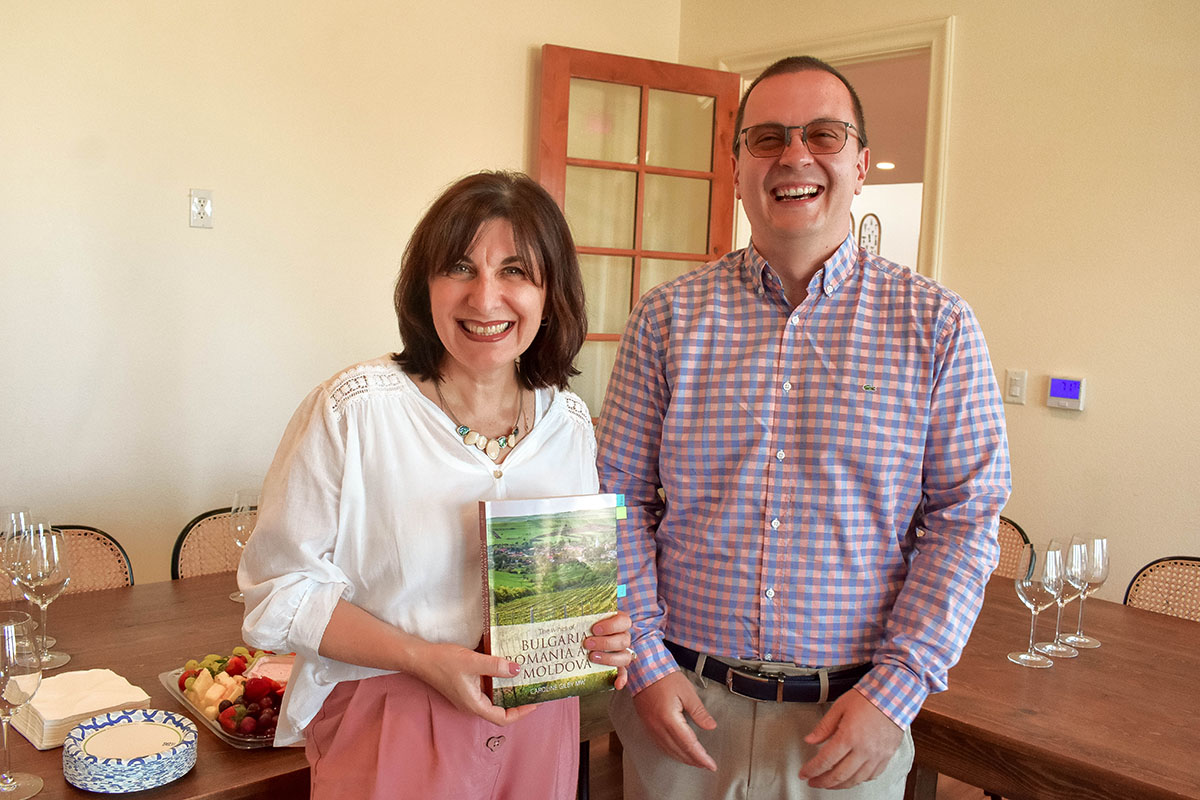
During his visit, Toskov completed the Wine and Spirit Education Trust Level 2 certification course, passing with distinction. He also led a Bulgarian wine and culture presentation and tasting for students in the program, bringing wines from home and walking the class through the country's history, geography, and winemaking traditions.
"I shared a lot about our culture, a lot about our products," he said. "I think everybody was very interested."
Size and scale aside, it is the people at Texas Tech who have made the biggest impression on Toskov.
"Even though you are a big university, everybody here is very welcoming," he said. "You can easily go around and talk with people, and everybody will do the best they can to help you with something."