
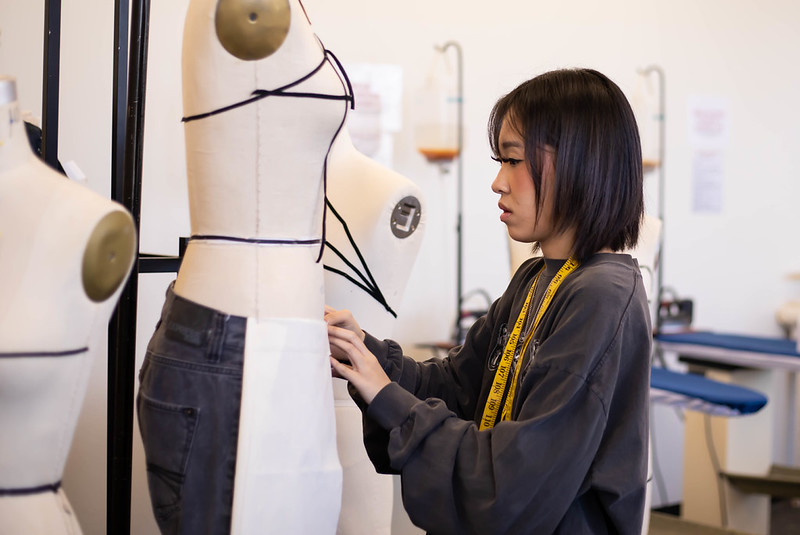
Texas Tech’s Apparel, Design, and Manufacturing program joins the Hospitality and Retail Management Department
This semester, the Apparel, Design, and Manufacturing (ADM) program is settling into its new home in the Department of Hospitality and Retail Management (HRM)—a change faculty on both sides describe not as a merger of convenience, but as a reunion of disciplines that were already working side by side.
“The move is a natural progression of the research, service, and teaching areas that have been in common for fashion design, fashion merchandising, and retail management for many years,” said Rachel Anderson, an ADM faculty member. “The move will enable us to pool resources and continue these projects in a larger capacity, producing more collaborative undergraduate research, outreach and engagement, grant opportunities, and teaching projects on a larger scale.”
That sense of overlap runs both directions. Robert Paul Jones, HRM department chair, said their mission—to provide top-tier education, research, and service while advancing students’ career trajectories—only grows stronger with ADM under the same roof.
“This department has the potential to become a real destination for students interested in more than just apparel design, but the manufacturing and business side too,” Jones said.
As a reflection of this change, in the coming months, the department will be renamed the Department of Hospitality, Fashion Design, and Retail Management.
Disciplines That Already Overlap
The two programs have collaborated for years, from a joint project last semester using CLO3D—technology that lets students design a garment from pattern to fabric and preview it on a digital avatar—to a shared history in the International Textile and Apparel Association, which has long included both retail management and ADM students.
Ashley Rougeaux-Burnes, also with ADM, said the fashion industry itself demands that kind of crossover.
“The fashion industry isn’t made up of isolated disciplines. Designers, product developers, buyers, merchandisers, marketers, and retailers all work together,” Rougeaux-Burnes said. “This move creates more opportunities for interdisciplinary projects, shared learning experiences, and industry partnerships that better prepare our students for their careers.”
Anderson pointed to the same shift playing out in classrooms and in the industry.
“Fashion designers and fashion merchandisers are working together collaboratively in the industry more closely than ever, with an industry expectation of students to have more in-depth knowledge of both disciplines,” she said. “Students will see a more cohesive and in-depth education throughout all their courses and, as a result, a more industry-ready degree.”
What It Means for Students
Jones said students will gain access to HRM core curriculum—a set of business courses in sales, marketing, consumer behavior, finance, and accounting—giving ADM students who aren’t headed toward a design house or their own label the tools to run a business instead. The combined department also opens the door to a shared alumni and industry network, expanded internship pipelines, and the option for ADM students to pursue HRM’s master’s program before going on to an MFA.
Curriculum changes will roll out gradually, Jones said, with this year focused on planning, accreditation review, and building smoother pathways for students who want to move between fashion merchandising and ADM or transfer in from another program without losing credit hours.
To help guide the transition, HRM faculty member Tun-Min (Catherine) Jai will serve as ADM’s program director for the coming year, a temporary role meant to help both faculties learn how the other operates before ADM returns to having its own program director.
Building Something Bigger
Faculty on both sides say the excitement extends well past logistics. Rougeaux-Burnes called it an opportunity to “build on what ADM already does well while creating new experiences that help prepare our students for an industry that is increasingly collaborative and interconnected.”
HRM’s hospitality faculty are already floating collaborative project ideas, such as uniform design for the hospitality industry, and the department is exploring ways to expand ADM’s presence on its annual industry trip to Dallas.
“This department has a great collegial culture,” Jones said. “And I think that supportive, team-oriented mindset, all serving the same mission, is something the ADM faculty and students will find is a good environment to land in.”