
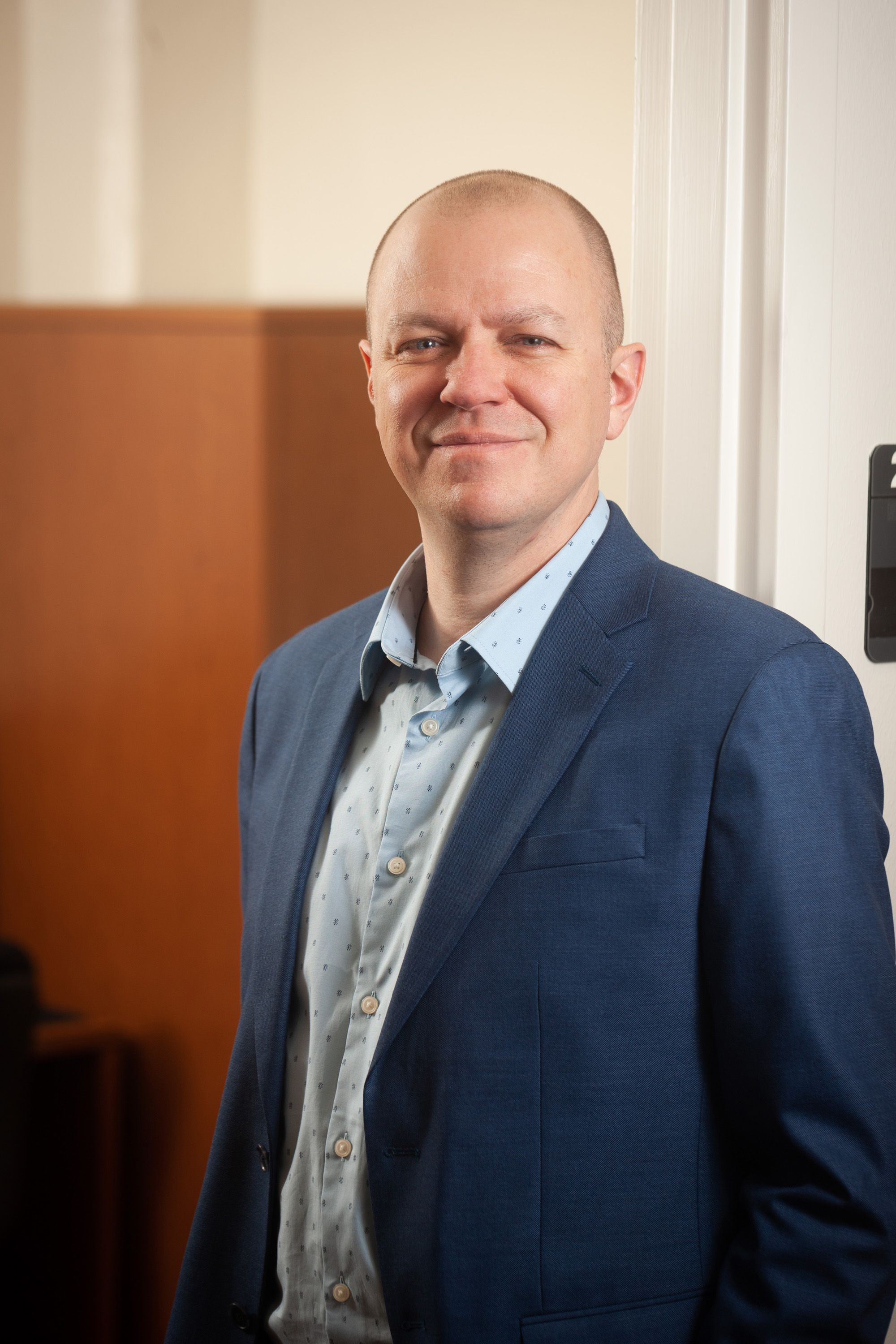
Michael Serra
Michael Serra believes true critical thinking is one of the most important skills all instructors can teach.
“Critical thinking is a skill and is unlikely to change, except perhaps in form,” he said. “Students who are critical thinkers can do a better job of correcting their own understanding of changing facts after they graduate than students who only learned content at a surface level in their courses. Critical thinking and information literacy are lifelong skills that our students need to hone, regardless of their major or future career plans.”
Serra is an associate professor of cognition and cognitive neuroscience in the Department of Psychological Sciences at Texas Tech University.
He has been honored as a 2023 Integrated Scholar at the university. Integrated Scholars are known for outstanding teaching, research and service, but also are recognized for creating synergy between those three functions by promoting active learning and infusing the results of their research and scholarship in courses. Each Integrated Scholar was nominated by faculty colleagues at Texas Tech. In 2023, six Integrated Scholars were named.
Serra said he always knew he wanted to teach, but by the time he finished his undergraduate degree, he decided he wanted to study how students learn and how learning could be improved.
“By the time I was finishing my undergraduate degree, I knew that I wanted to be a cognitive psychologist and a research professor who worked to understand and improve student learning,” Serra said.
As an undergraduate research assistant, he examined predictors of elementary school students' reading comprehension abilities. As a graduate student, he examined the accuracy of college students' self-evaluations of their own learning, as well as factors that make scientific diagrams useful for reading comprehension.
“My primary role as a postdoctoral researcher was to help conduct research on elementary school students' abilities to judge their own learning and make efficient restudy decisions. As a faculty member, I have continued examining most of these questions,” Serra said.
Most of his research involves memory or metacognition, or thinking about, evaluating and controlling one's cognitive processes such as memory or reading comprehension. He strives to find out how people learn, how they judge their own learning, and how teachers can make learning processes and study behaviors more effective.
“My expertise in human learning and study behaviors heavily informs my teaching, service and pedagogical work and supervision related to teaching,” Serra said.
As a teacher, Serra believes good instructors can convey information so their students can understand and retain it.
“But the best instructors also go beyond that: they work with their students, both mid-lesson and over time, to relate new information to old information and to make sure that students can apply what they have learned to novel situations and problems,” he said. “They check their students' learning not just by asking their students whether they understand something, but by requiring their students to demonstrate that they do indeed understand. They work with their students when learning and comprehension have fallen short.”
Serra tries to keep his lessons updated with current findings and examples from his field to integrate research and outreach into teaching.
“When appropriate, I like to talk about or use my own research and papers as examples. I think my students appreciate my ‘behind-the-scenes' approach, such as when I am teaching research methods and I walk them through the choices that went into designing my own studies, analyzing the data from those studies, or choices I had to make when writing or revising my journal articles,” Serra said. “I talk to my students about effective learning and studying behaviors which apply not only to my courses, but to all their courses.”
People seem to be naturally intrigued by memory, Serra said, and in recent years, he has been working to find ways to bring research about memory to broader audiences, including finding connections between memory and the arts.
He has given talks on the malleability of memory for the “Memory & Clay Symposium” at Louise Hopkins Underwood Center for the Arts, and he gave the inaugural talk in the university libraries' “Science Meets Popular Culture” series, which covered the accurate and inaccurate depiction of our memory processes in popular films. This also inspired an upcoming book chapter on the use of memory and flashback in the Disney+ television series “The Mandalorian” and “The Book of Boba Fett.”
He also collaborated with Kyla Olson, head of dance at the J.T. & Margaret Talkington College of Visual & Performing Arts, on a dance piece exploring reconstructive and reiterative processes associated with episodic memories.
Serra believes sharing accurate information about how students learn and how to learn more efficiently is the responsibility of both professional organizations and individual researchers. Because of that, he has been interviewed on various online podcasts and websites and was the keynote speaker for the annual faculty development colloquium at the West Texas A&M University Teaching Excellence Center in 2017.
Office of the Provost
-
Address
104 Administration Building, Box 42019, Lubbock, Texas 79409-2019 -
Phone
806.742.2184 -
Email
provost.communications@ttu.edu