
Mary Isa
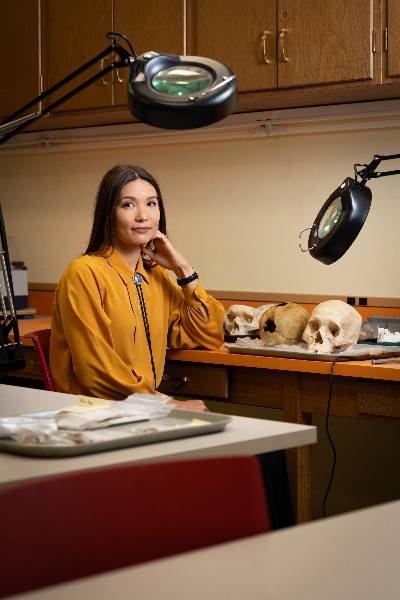
Mari Isa, an assistant professor in the Department of Sociology, Anthropology & Social Work, was named a 2026 Integrated Scholar – a meaningful honor that recognizes her deliberate integration of research, teaching and service.
In addition to teaching, Isa consults on cases involving the recovery and analysis of human skeletal remains for law enforcement and medicolegal agencies across West Texas. She also serves on committees for two nationally recognized organizations that develop and evaluate standards and best-practice guidelines for forensic anthropology.
“My forensic anthropology casework grounds my research and teaching, but it's not something I do separately from them,” Isa said. “All three components are interconnected and influence each other.”
In her forensic anthropology courses, she teaches the methods used in her professional casework and assigns readings that include standards documents she’s evaluated through her committee service. Students spend more than half the semester applying learned methods and standards to skeletal specimens in labs, thereby practicing making observations, scoring features, interpreting results and writing professional reports based on findings.
Isa has built professional relationships with local law enforcement and medicolegal agencies since joining Texas Tech, creating teaching and training opportunities for students both in and out of the classroom.
“When I get called on a case, I bring a student to observe and, under my supervision, they assist with everything from scene recovery to processing and documenting evidence to analyzing remains in the lab,” Isa said. “When I was a graduate student myself, this kind of experience was incredibly valuable in understanding how to apply what I'd learned in the classroom, make judgment calls and interact with medicolegal and law enforcement professionals.”
Isa recalls a time when she was called to a scene by the Odessa Police Department and the Ector County Medical Examiner, where she brought along a graduate student to assist in recovering human remains. Although this student learned about recovery approaches in class, she was challenged to apply that knowledge in real time while working alongside law enforcement.
While at the scene, Isa was heartened to find a former student now working as a crime scene technician, professionally documenting and collecting evidence for the case.
“She’d taken several of my classes as part of the forensic anthropology concentration, and I remembered her coming to office hours to talk through career options after graduation,” Isa said. “Seeing her there, doing the job we talked about, working alongside my current student at the same scene, felt like everything coming full circle in the best possible way.,”
Isa describes creating the Anthropology Research and Identification Lab, a biosafety level 2 forensic anthropology lab at Texas Tech, as a defining experience that not only allows her to conduct casework but also serves as a valuable space for students, research and the community.
“Each semester, one of the senior graduate students takes a turn as lab manager, taking on responsibilities related to lab safety and operations, helping me manage incoming casework and mentoring more junior students as needed,” Isa said. “The lab also serves as a research space, supporting my work and my students’' work on skeletal trauma, taphonomy and personal identification.”
For Isa, the lab is more than a facility to practice operating procedures. It’s a space that supports community partner relationships and has influenced Isa’s research since its inception.
“When something arises in casework that I don't have a good answer for, it becomes a research question,” Isa said. “What I learn from that research shapes what and how I teach and having to explain a concept clearly enough for students to apply it on their own pushes me to think about it differently, which often finds its way back into my research.”
Because of the unpredictable nature of Isa’s work, balancing teaching, research and service can be challenging, but she’s reminded they’re mutually influential, although they sometimes compete for time.
“A bad week for one of these is rarely a wasted week for the others, since something from a case usually ends up being informative to my teaching or research and a question from class often ends up being useful in my research,” Isa said. “I'm grateful to be at a university that doesn't ask me to separate the teaching, research and service components of my career and that sees value in the effort it takes to keep them connected.”
Office of the Provost
-
Address
104 Administration Building, Box 42019, Lubbock, Texas 79409-2019 -
Phone
806.742.2184 -
Email
provost.communications@ttu.edu