
Mathematical Finance Program
Research in Mathematical Finance
Research in the Texas Tech Mathematical Finance Program focuses on both risk management and the development of quantitative strategies for generating returns. Faculty and researchers investigate asset pricing, market behavior, portfolio optimization, risk analytics, option pricing, statistical dependence, financial indices, real estate pricing, and related areas of quantitative finance.
Research Areas and Projects
Current projects combine mathematical, statistical, computational, and financial methods to investigate theoretical and applied problems in modern finance.
Reconciling Behavioral Finance, Market Microstructure, and Dynamic Asset Pricing
Abootaleb Shirvani, Y. Hu, W. Brent Lindquist, Frank J. Fabozzi, and Svetlozar T. Rachev
This project has an overarching goal of unifying the seemingly contradictory theoretical bases for the major fields of rational and behavioral finance. For example, current dynamic models for asset pricing are “amazingly free” of any variables that describe the very short-term behavior, or microstructure, of markets. This arises in part because existing continuum asset pricing models assume trades can occur continuously with no transaction costs or other barriers.
Multiple Subordinated Modeling of Asset Returns
According to behavioral finance theory, investor views should be taken into account in models of the underlying asset processes. For example, investors view positive and negative returns differently according to disposition effects, such as the manner in which investors treat capital gains.
Thus, to obtain more realistic asset prices, it is essential to incorporate investor views in log-return and option pricing models. To be consistent with dynamic asset pricing theory, investor views can be accounted for by introducing an intrinsic time process, which we refer to as a behavioral subordinator.
The process is subordinated to the Brownian motion process in the well-known log-normal model, resulting in a new log-price process. In addition to incorporating investor views, the additional subordinator enables the capture of rare events of the stock-return distribution that cannot be explained well by the existing one-layer subordinated model.
Resolution of Financial Puzzles within Rational Finance
Proponents of behavioral finance have pointed to historical behaviors of the stock market that are inconsistent with rational finance theory as evidence for the failure of rational finance.
These empirical observations are referred to as “puzzles.” The three most striking puzzles are the equity premium puzzle, the stock price predictability puzzle, and the volatility puzzle.
In this project, we offer a resolution to these puzzles within the context of rational finance. We empirically show that the market's inefficiency, attributable to the equity premium puzzle and volatility of excess return across time, is caused by fitting an improper distribution to the historical returns.
We offer a statistical model within the context of rational finance that can be used without relying on behavioral finance assumptions to model stock-returns predictability.
Risk Analytics and Optimal Portfolios
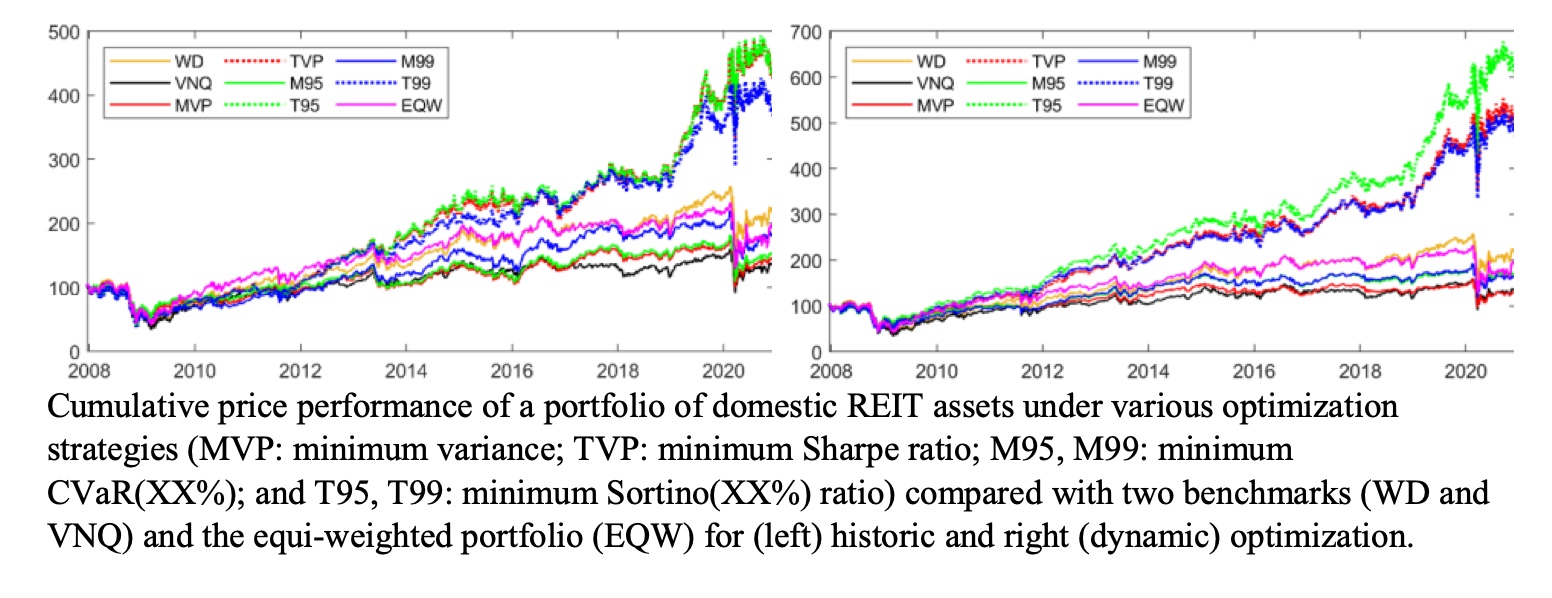
This project develops modern portfolio theory and risk analytics for portfolios composed of assets for which the finance-industry application is under-developed. This has resulted in two monographs.
A) Analytics and portfolio optimization for portfolios composed of shares of real estate investment trusts.
Abootaleb Shirvani, Yuan Hu, W. Brent Lindquist, and Svetlozar T. Rachev
B) Analytics and portfolio optimization for portfolios composed of crypto assets.
Yifan He, W. Brent Lindquist, Svetlozar T. Rachev, and David Lauria
The work has employed Black-Litterman, dynamic, robust, and performance-attribution constrained optimization techniques using tail-risk measures. It has introduced the inclusion of ESG ratings in optimization.
For the hedging of risk, it also considered option pricing using doubly subordinated Lévy processes to capture the effects of “intrinsic time” as well as skewness and kurtoses of return distributions.
Option Pricing in an Investment Setting
Abootaleb Shirvani, Y. Hu, W. Brent Lindquist, Frank J. Fabozzi, and Svetlozar T. Rachev
The classical European-style option pricing approach assumes that the sole goal of the hedger, who takes the short position in an option contract, is to perfectly replicate the short position's liability in a complete market setting.
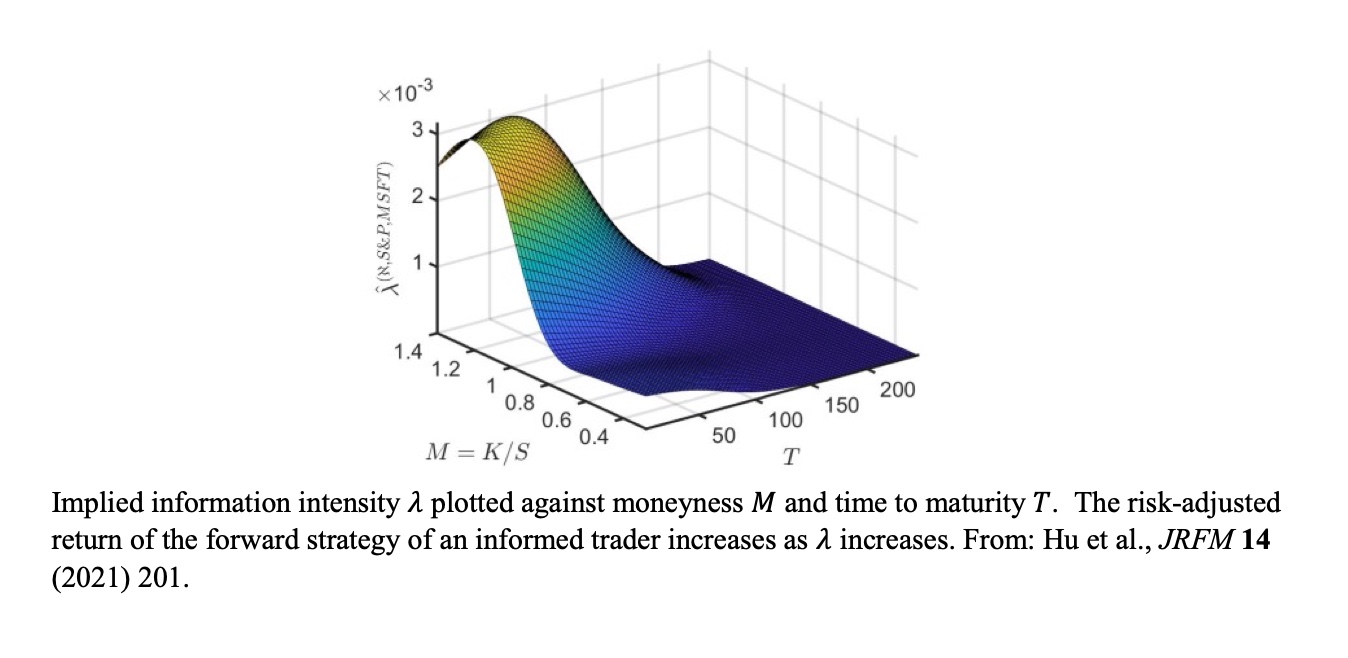
The goal of this project is to dynamically optimize the hedger portfolio so that the liability at the option expiration time is perfectly hedged while collecting risk-adjusted return until the termination of the option contract.
A New Class of Statistical Measures for Distributional Tail Dependence
Davide Lauria, Alex Trindade, and Svetlozar T. Rachev
The classical measures for distributional tail dependence, such as the coefficients for lower and upper tail dependence, lose their significance if the distributional tails are thinner than that specified by power-law decay, so-called regularly varying tails.
This work is focused on introducing and testing a new class of tail measures which are well defined and meaningful for pairs of random variables having an arbitrary distributional tail. The work will be extended to dynamic tail measures and in dimension larger than two.
Developing Non-Traditional Market Indices
A market index is a carefully chosen portfolio of investment holdings that represents a segment of a financial market. The calculation of the index value derives from a valuation of the underlying holdings. In traditional financial markets, these would be the prices of shares held in the index portfolio.
Investors cannot invest directly in an index, as the index value is used solely as a benchmark to gauge the movements of a market or market segment and for developing tradable, index-based funds in which investing can occur.
Once index-based funds exist, then derivatives, such as call and put options, can be developed and priced using the index-based fund as the underlying asset. This allows investors to implement insurance strategies against adverse market conditions.
This project has the overarching goal of developing indices for non-traditional “markets” that have huge financial impacts. Generally, index valuation is based on a simple method such as equal or market-capital weighting of the values of the assets in the portfolio. We seek to employ risk-minimizing or return-maximizing valuation methods based upon modern portfolio theory.
Indices on Financial Losses Caused by Natural Disasters and Crime
Thilini Mahanama, Abootaleb Shirvani, and Svetlozar T. Rachev
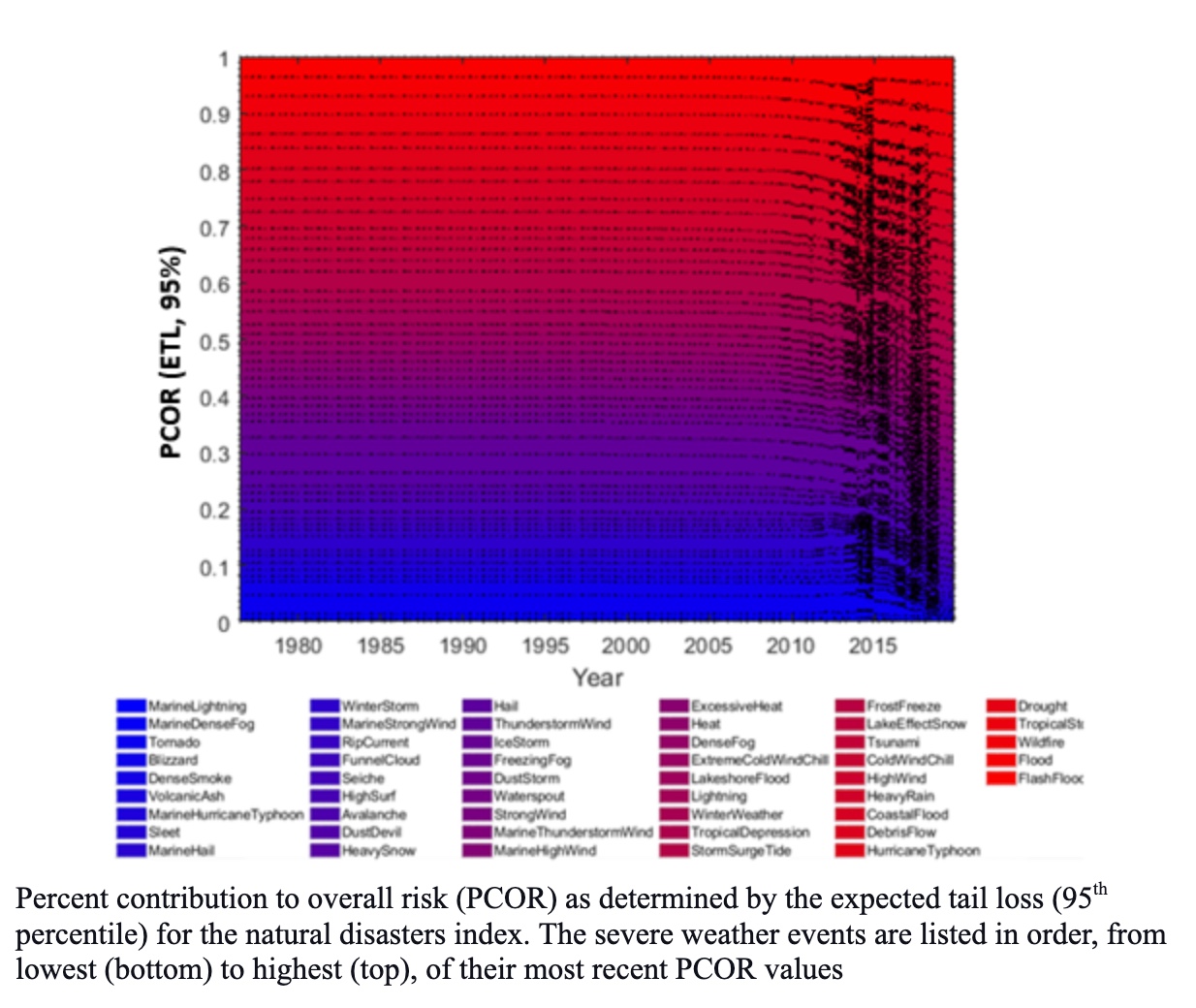
This project is aimed at the development of index-based insurance portfolios for natural disasters and crime in the United States by taking their economic impacts into account.
Underlying the indices, investments would be hedged by issuing marketable options and providing risk budgets. The performance of each index is evaluated to determine its resilience to economic crises.
The indices are intended to help investors gauge investment risk based on their desired risk level and provide hedge strategies for potential losses due to economic crashes.
An ESG Index
Thilini Mahanama, Abootaleb Shirvani, Yuan Hu, W. Brent Lindquist, and Svetlozar T. Rachev
There is a strong societal push for investing in market segments that reflect social responsibility, such as environmental sustainability and human rights. Strongly related to this are corporate governance attitudes.
Socially responsible investing relies on portfolios comprised solely of assets that reflect such investor attitudes. We consider the development of an environmental, social, and corporate governance (ESG) market index based on CVaR(99%) portfolio optimization and normal compound NIG dynamics.
Market Volatility Index
Abootaleb Shirvani, Y. Hu, W. Brent Lindquist, Frank J. Fabozzi, and Svetlozar T. Rachev
The goal of this project is to create an index to measure actual market volatility. The VIX index is a popular measure of the stock market's expectation of volatility based on S&P 500 index options.
It is calculated and disseminated on a real-time basis by the Chicago Board Options Exchange and is often referred to as the fear index or fear gauge. The VIX index measures the implied volatility of the S&P 500 index and does not measure actual market volatility.
VIX has been criticized as a reliable predictor of future volatility; it has been described instead as a measure of the current price of index options.
Our research is focused on creating an index to measure actual market volatility. We investigate construction of this index from three options: exchange-traded funds, the actual volatility of the 500 large companies comprising the S&P 500, and the actual volatility of the 30 companies comprising the Dow Jones Industrial Average, in order to detect the best representative of actual market volatility and perhaps a fundamental index for the markets.
Hedonic Modeling of Real Estate Prices
Jason R. Bailey, W. Brent Lindquist, and Svetlozar T. Rachev
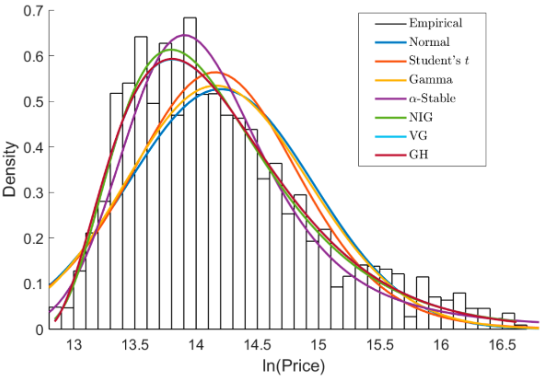
The goal of this project is to analyze real estate prices based on traditional factors, such as number of bedrooms and number of bathrooms, and non-traditional factors, such as environmental and governance input factors.
We use various hedonic models to do so. We contrast the commonly used Generalized Linear Model (GLM) against a more sophisticated Generalized Additive Model (GAM).
The GAMs consistently outperform the GLMs, which is notable given that many input factors may not be linear. City-dependent results, especially for Environmental, Social, and Governance (ESG) factors, are present for many of the analyzed cities.
In evaluating relevant input factors and predictive models, we can improve the price-estimating tools currently in use in the real estate space.
Publications by the Texas Tech Mathematical Finance Group
Books and peer-reviewed publications by Mathematical Finance faculty and collaborators.
2026 Publications
M. Mohammadi and W.B. Lindquist. (2026). Prediction of stable GARCH time series using auxiliary processes.Metrika.
D.C.W. Hettiachi-Halpe-Kankanamalagea, A. Shirvani, N. Appiah, S.T. Rachev, W.B. Lindquist, and F.J. Fabozzi. (2026). Downside-sensitive portfolio optimization and risk overlays for real estate securities.Journal of Risk and Financial Management, 19(6), 385.
P. Yegon, W.B. Lindquist, and S.T. Rachev. (2026). Asset pricing in the presence of market friction noise.Journal of Risk and Financial Management, 19(4), 243.
J.R. Bailey, W.B. Lindquist, and S.T. Rachev. (2026). Evaluating factor contributions for sold homes.Journal of Risk and Financial Management, 19(2), 146.
T.-J. Lee, A. Shirvani, W.B. Lindquist, and S.T. Rachev. (2026). Option-implied zero-coupon yields: Unifying bond and equity markets.Journal of Risk and Financial Management, 19(1), 91.
2025 Publications
Y. He, W.B. Lindquist, S.T. Rachev, and D. Lauria. (2025). Risk Management for Cryptocurrency Portfolios. Berlin: De Gruyter. ISBN: 978-1-5015-2009-9.
D. Lauria, W.B. Lindquist, S.T. Rachev, and Y. Hu. (2025). Bridging asset pricing and market microstructure: Option valuation in Roll's framework.Journal of Risk and Financial Management, 18(5), 230.
N. Asare Nyarko, A. Shirvani, B. Divelgama, P. Yegon, W.B. Lindquist, S.T. Rachev, and F.J. Fabozzi. (2025). ESG financial market with informed traders within the Bachelier-Black-Scholes-Merton model.Journal of Sustainability Research, 7(2), e250022.
A. Deep, A. Shirvani, C. Monico, S.T. Rachev, and F.J. Fabozzi. (2025). Risk-adjusted performance of random forest models in high-frequency trading.Journal of Risk and Financial Management, 18(3), 142.
D. Lauria, S. Mittnik, W.B. Lindquist, and S.T. Rachev. (2025). Environmental, social and governance-valued portfolio optimization and dynamic asset pricing.Journal of Risk and Financial Management, 18(3), 153.
A. Jaffri, A. Shirvani, A. Jha, S.T. Rachev, and F.J. Fabozzi. (2025). Optimizing portfolios with Pakistan-exposed exchange-traded funds: Risk and performance insight.Journal of Risk and Financial Management, 18(3), 158.
Y. He, A. Shirvani, B. Shao, S.T. Rachev, and F.J. Fabozzi. (2025). Beyond the bid-ask: Strategic insights into spread prediction and the global mid-price phenomenon.Econometric Reviews.
J. Gnawali, W.B. Lindquist, and S.T. Rachev. (2025). Hedging via perpetual derivatives: Trinomial option pricing and implied parameter surface analysis.Journal of Risk and Financial Management, 18(4), 192.
Y. Hu, W.B. Lindquist, and S.T. Rachev. (2025). Sustainability-valued discrete option pricing in complete markets.Journal of Sustainable Finance & Investment, 15(2), 403-437.
W.B. Lindquist and S.T. Rachev. (2025). Alternatives to classical option pricing.Annals of Operations Research, 346(1), 489-509.
2024 Publications
J.R. Bailey, W.B. Lindquist, and S.T. Rachev. (2024). Hedonic models incorporating ESG factors for time series of average annual home prices.Journal of Risk and Financial Management, 17, 375.
W.B. Lindquist, S.T. Rachev, J. Gnawali, and F.J. Fabozzi. (2024). Dynamic asset pricing in a unified Bachelier-Black-Scholes-Merton model.Risks, 12, 136.
A. Shirvani, S. Mittnik, W.B. Lindquist, and S.T. Rachev. (2024). Bitcoin volatility and intrinsic time using double-subordinated Lévy processes.Risks, 12, 82.
Y. Hu, W.B. Lindquist, S.T. Rachev, and F.J. Fabozzi. (2024). Option pricing using a skew random walk pricing tree.Journal of Risk and Financial Management, 17, 138.
2023 Publications
Y. He, Y. Hu, and S.T. Rachev. (2023). The implied views of bond traders on the spot equity market.Frontiers in Applied Mathematics and Statistics, 9, 1324079.
N. Asare Nyarko, B. Divelgama, J. Gnawali, B. Omotade, S.T. Rachev, and P. Yegon. (2023). Exploring dynamic asset pricing within Bachelier's market model.Journal of Risk and Financial Management, 16(8), 352.
L.B. Klebanov, Y.V. Kuvaeva-Gudoshnikova, and S.T. Rachev. (2023). Heavy-tailed probability distributions: Some examples of their appearance.Mathematics, 11(14), 3094.
Y. He and S.T. Rachev. (2023). Exploring implied certainty equivalent rates in financial markets: Empirical analysis and application to the electric vehicle industry.Journal of Risk and Financial Management, 16(7), 344.
2022 Publications
J.R. Bailey, D. Lauria, W.B. Lindquist, S. Mittnik, and S.T. Rachev. (2022). Hedonic models of real estate prices: GAM models; environmental and sex-offender-proximity factors.Journal of Risk and Financial Management, 15, 601.
W.B. Lindquist, S.T. Rachev, Y. Hu, and A. Shirvani. (2022). Advanced REIT Portfolio Optimization: Innovative Tools for Risk Management. Cham: Springer.
Y. Hu, W.B. Lindquist, S.T. Rachev, A. Shirvani, and F.J. Fabozzi. (2022). Market complete option valuation using a Jarrow-Rudd pricing tree with skewness and kurtosis.Journal of Economic Dynamics and Control, 137, 104345.
T. Mahanama, A. Shirvani, and S.T. Rachev. (2022). A natural disasters index.Environmental Economics and Policy Studies.
2021 Publications
A. Shirvani, F.J. Fabozzi, B. Racheva-Iotova, and S.T. Rachev. (2021). Option pricing with greed and fear factor: The rational finance approach.Journal of Derivatives, 29(2), 77-119.
Y. Hu, W.B. Lindquist, and F.J. Fabozzi. (2021). Modelling price dynamics, optimal portfolios, and option valuation for crypto assets.Journal of Alternative Investments, 24, 75-93.
Y. Liu, P.M. Djurić, Y.S. Kim, S.T. Rachev, and J. Glimm. (2021). Systemic risk modeling with Lévy copulas.Journal of Risk and Financial Management, 14(6), 251.
T. Mahanama, A. Shirvani, and S.T. Rachev. (2021). Global index on financial losses due to crime in the United States.Journal of Risk and Financial Management, 14(7), 315.
2020 Publications
Y. Hu, A. Shirvani, W.B. Lindquist, F.J. Fabozzi, and S.T. Rachev. (2020). Option pricing incorporating factor dynamics in complete markets.Journal of Risk and Financial Management, 13(12), 321.
A. Shirvani, Y. Hu, S.T. Rachev, and F.J. Fabozzi. (2020). Option pricing with mixed Lévy subordinated price process and implied probability weighting function.Journal of Derivatives, 28(2), 102.
A. Shirvani, S.V. Stoyanov, S.T. Rachev, and F.J. Fabozzi. (2020). A new set of financial instruments.Frontiers in Applied Mathematics, 6, 606812.
Department of Mathematics & Statistics
-
Address
Texas Tech University, 1108 Memorial Circle, Lubbock, TX 79409-1042 -
Phone
806.742.2566 -
Email
math.dept@ttu.edu