
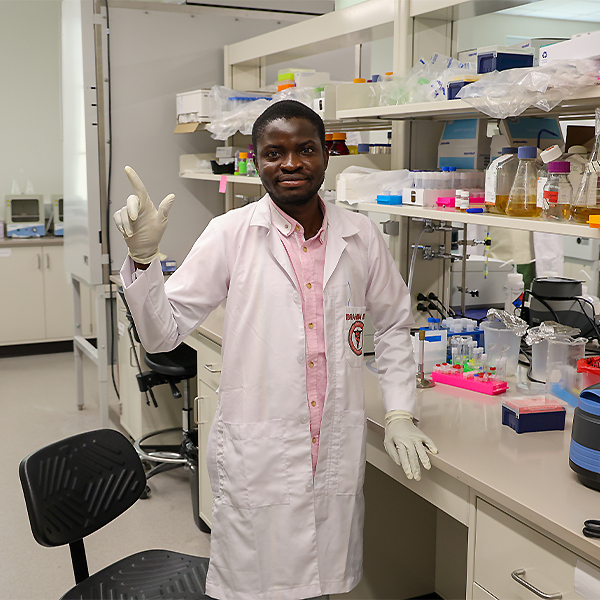
A childhood curiosity led this graduate student to Amarillo to pursue his passion for One Health research.
Long before Ibrahim Idris ever stepped foot into a research lab as a graduate student in Texas Tech University’s School of Veterinary Medicine’s innovative Ph.D. in One Health Sciences program, he was already drawn to the fascinating world of disease ecology and the vital role it plays in human, animal and ecosystem health.
Growing up in Birnin Gwari, a rural community in northwestern Nigeria, Idris spent his childhood raising pigeons and watching how the rainy season brought swarms of insects and with them, countless questions about animal health. Those early moments of curiosity and observation sparked a sincere passion for discovery and a lifelong commitment to improving the health of people, animals and the ecosystem.
“Even before I knew what ‘research’ meant, those early observations and questions laid the foundation for the scientist I am becoming today,” Idris said.
Idris never imagined he would one day find himself in Amarillo, Texas, but this past August he began his journey as a doctorate student in the One Health Sciences program. Now, he is doing what he loves most: working with innovative technology and brilliant minds to explore ways to prevent diseases and better control them across humans, animals and ecosystems.
Let’s learn more about Idris and his research through a series of questions.
What are you passionate about in research and One Health? 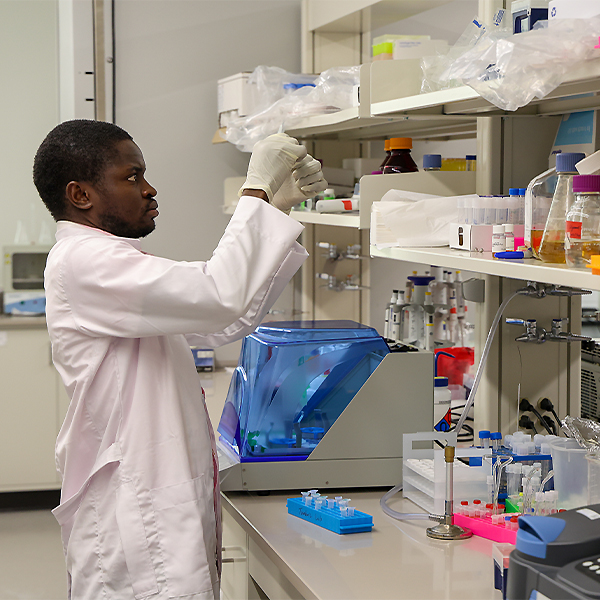
I am deeply passionate about the One Health approach because it reflects the reality, I grew up witnessing—human, animal and ecosystem health are interconnected at every level. My strongest interests lie in vector-borne and zoonotic diseases, and I am particularly drawn to understanding how these diseases emerge, persist and spread within complex ecosystems. One Health allows me to explore these questions from multiple perspectives, whether ecological, molecular or environmental, giving me a holistic view of disease systems. I am fascinated by research that uncovers the hidden interactions between vectors, pathogens, hosts and their surroundings. What inspires me most is the chance to generate knowledge that can benefit both people and animals, especially in communities vulnerable to disease threats. For me, One Health is far more than a discipline—it is a meaningful commitment to solving problems that truly matter.
What inspired you to pursue research?
My inspiration for research began with my childhood fascination with birds, insects and the endless questions I asked about the natural world. As I grew older and entered veterinary school, that early curiosity matured into a deeper scientific interest in vectors, parasites and wildlife-associated diseases. My veterinary training exposed me to the biological complexity of disease systems and strengthened my desire to understand how they work at a molecular, ecological and environmental level. I became particularly intrigued by how pathogens interact with their vectors and hosts, and how environmental conditions shape these dynamics. Research provides the opportunity to explore these mechanisms, uncover new knowledge and contribute meaningful solutions to real-world health challenges. That combination of curiosity, lived experience and purpose is what ultimately inspired me to pursue a career in research.
What is your research?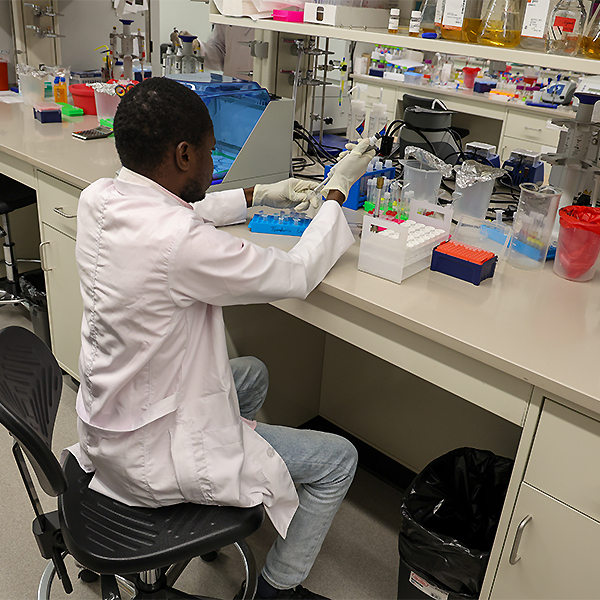
My research focuses on the ecology and epidemiology of parasites and vector-borne diseases within the One Health framework. I am working under Dr. Chad Cross, professor in One Health, in the PARAVEC Lab, where our work integrates quantitative ecology, applied biostatistics, medical and veterinary entomology and disease ecology. Our projects combine field investigations, molecular approaches and computational techniques to understand how pathogens circulate across humans, animals and the environment. Some of our current efforts include applying environmental DNA to explore West Nile Virus activity and examining ecological drivers of Chagas disease. My goal is to investigate the molecular mechanisms and ecological processes that shape pathogen transmission. Through this research, I hope to contribute deeper insight into how vector-borne diseases behave in real-world settings.
What opportunities have helped you advance your research?
Mentorship has played a critical role in shaping my development as a researcher, especially the guidance I have received from faculty who are genuinely committed to student growth. Because of my curiosity and passion for understanding disease systems, I was exposed to research early during my veterinary training, where I first engaged with scientific inquiry and evidence-based approaches. This foundation made it easier for me to take advantage of the opportunities available in my current program. Access to collaborative research groups and well-equipped facilities has enabled me to explore molecular methods, ecological studies and vector-focused investigations. Working on interdisciplinary projects has strengthened my understanding of how biological, environmental and quantitative factors intersect within One Health frameworks. Through internships and hands-on laboratory experiences, I have expanded my technical skill set while gaining exposure to diverse scientific perspectives.
Learning within an environment that values innovation, teamwork and scientific curiosity has helped refine both my confidence and competence. Collectively, these opportunities have strengthened my commitment to pursuing high-quality research in One Health Sciences and vector-borne disease systems.
Why did you choose Texas Tech to pursue your Ph.D. in One Health Sciences?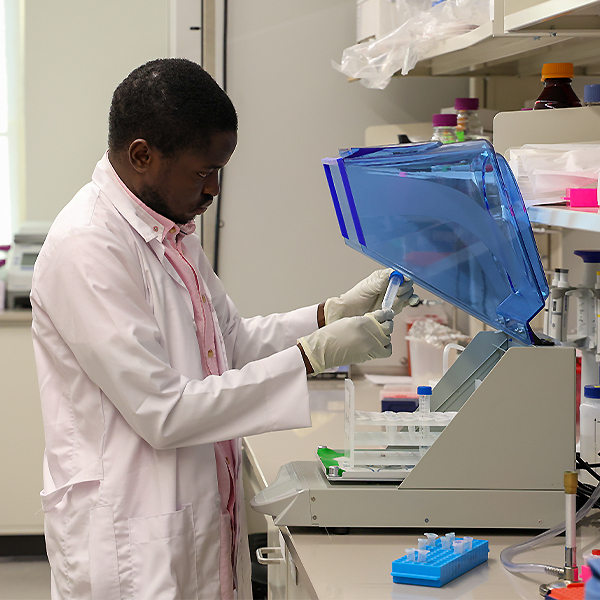
I chose Texas Tech because it is the only university in the United States that offers a Ph.D. specifically in One Health Sciences, which aligns perfectly with my long-standing interests in vector-borne diseases and interconnected health systems. The program’s interdisciplinary foundation spans infectious diseases, metabolic diseases, cancer, One Health communication and zoonotic diseases—reflecting the full breadth of modern One Health challenges. I was also drawn to the collaborative culture and the opportunity to work with faculty whose expertise matches my research goals. This Ph.D. in One Health Sciences program provides the ideal environment to explore complex disease systems while developing both scientific and professional skills. For me, it was the perfect match between passion, purpose and opportunity.
What do you like most about the One Health Sciences program?
What I value most about the program is its competency-based approach, which allows students to build real, demonstrable skills that prepare us for diverse career paths. Students are encouraged to develop strong technical abilities, scientific reasoning and critical thinking—all essential for understanding complex health problems. The program’s interdisciplinary nature creates a rich learning environment where ideas from different fields come together to strengthen our research. Faculty support and mentorship ensure that each student grows both academically and professionally. I also appreciate how the program emphasizes creative problem-solving and practical application. It’s a place where curiosity is encouraged and innovation is expected. Moreover, I appreciate how the One Health Sciences program faculty, staff and fellow graduate students are always willing to support one another. From my first day here, I felt welcomed, guided and encouraged, which made the program feel like a community and a home. The collaborative spirit creates an environment where you can ask questions, learn from others and grow without feeling alone in the process. Beyond academics, the serene atmosphere in Amarillo provides a peaceful and focused environment for study and research.
How has the school helped you become a better researcher?
The School of Veterinary Medicine has given me meaningful opportunities to grow as a researcher from the very beginning of my program. In my first few months, I was trained in advanced molecular biology techniques, which strengthened my technical foundation and boosted my confidence in laboratory work. I have also grown significantly through frequent presentations that helped me communicate science clearly and confidently. Additionally, the emphasis on scientific writing has improved my ability to organize ideas, interpret research and present findings effectively. Mentorship from faculty and collaboration with peers have expanded my perspectives and sharpened my scientific reasoning. These experiences together have helped me develop into a more skilled, confident and independent researcher.
What do you hope to do after graduating?
After graduating, I hope to contribute to research on vector-borne and zoonotic diseases, focusing on molecular mechanisms, pathogen ecology and the environmental drivers of transmission. I see myself working as a research scientist in the biomedical industry, or within academic or research organizations, where I can develop and apply innovative approaches to understand complex disease systems. My long-term goal is to use the One Health framework to strengthen disease prevention strategies and improve health resilience, particularly in underserved communities. I am also passionate about mentoring the next generation of scientists and supporting global research capacity. I aim to make meaningful contributions that advance human, animal and environmental health worldwide.