
 |
 |
 |
 |
 |
 |
 |
Go to Step 4 (Position Title Glossary)
Career Streams
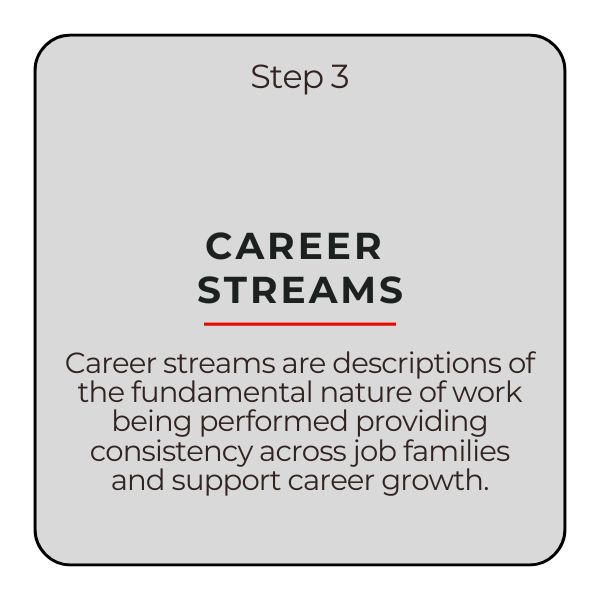
Career streams are descriptions of the fundamental nature of work being performed providing consistency across job families and support career growth. Use the information below as a guide to determine the appropriate career stream and job complexity level for your position based on how the work is performed and the level of independence and responsibility.
Job Complexity
Using the information provided, select the job complexity based on the job’s scope, effective knowledge, impact, communication and collaboration, problem solving, autonomy, leadership, and required education and experience.
Tip:
- Start your job leveling with the beginning complexity level and then work your way up. Depending on your department size and position function, it is possible that not all levels will be used in each career stream.
Operational Contributor
Employees in this career stream serve in support, operational, administrative, or technical functions and typically do not require a college degree. May attended trade school and/or completed apprenticeships. Typically paid hourly and receive overtime.
OC1 - Entry
- Education and Experience
- High School education
- 0-3 years of experience
- Effective Knowledge
- Demonstrates baseline working knowledge of routine work processes and tools.
- Impact
- Works to achieve day-to-day objectives with direct impact within the area. Work consists of tasks that are typically routine with some deviation from standard practice. Will not be evaluated based on ability to influence outcomes. Since the position largely follows set principles and guidelines, decisions mainly impact only the position itself or immediate colleagues.
- Communication and Collaboration
- Practices baseline principles of listening, and clear written/verbal communication. Communicates information that requires little explanation or interpretation. Communicates with contacts within the department or unit on matters that typically involve obtaining or providing information requiring some explanation or interpretation to reach agreement.
- Problem Solving
- Performs functions that are routine in nature and follows standard procedures. Recognizes and escalates unusual situations or problems. Work generally follows defined schedules and protocols.
- Autonomy
- Follows standard principles and guidelines with little to no latitude for personal decision making. Has responsibility for checking data and information for minor changes. Work is closely supervised.
- Leadership
- Not Applicable
OC2 - Experienced
- Education and Experience
- High School education
- 3-5 years of experience
- Effective Knowledge
- Demonstrates proficient working knowledge of routine work processes and tools, and intermediate knowledge of concepts, practices, and procedures of own job family.
- Impact
- Works to achieve day-to-day objectives with direct impact within the area. Work consists of tasks that are typically routine with some deviation from standard practice. May seek advice of more senior personnel in the same area.
- Communication and Collaboration
- Communicates information that requires explanation or interpretation. Communicates with contacts within the department or unit on matters that typically involve obtaining or providing information requiring some explanation or interpretation to reach agreement.
- Problem Solving
- Problems are typically of a routine nature but may at times require interpretation or deviation from standard procedures. Position may need to modify work appropriately in response to new information.
- Autonomy
- Checks and makes minor adjustments to work methods to solve problems that are routine and typically exist in current work processes and systems. May be required to highlight areas of concerns/problems and puts forth solutions to supervisor in own work area. Works under moderate supervision.
- Leadership
- Not Applicable
OC3 - Lead
- Education and Experience
- High School education
- 5+ years of experience
- Effective Knowledge
- Demonstrates advanced working knowledge of routine work processes and tools, and intermediate knowledge of concepts, practices, and procedures of own job family.
- Impact
- Works to achieve day-to-day objectives with significant impact within the area. Work consists of tasks that are typically not routine. May be required to apply discretion within established operational boundaries and procedures. Responsible for assisting and training lower-level support employees.
- Communication and Collaboration
- Explains practices, procedures and policies to reach agreement with others outside of the work area. Communicates with contacts within and outside the department on matters that typically involve obtaining or providing information on matters of moderate importance to the organization. May act as liaison with other Operations roles across the institution to solve issues related directly to position’s job content.
- Problem Solving
- Problems are typically not routine and require analysis to understand. Makes minor adjustments to working methods and independently develops solutions to problems.
- Autonomy
- Has responsibility for making minor changes in activities and processes to solve problems or improve effectiveness of area. Expected to independently develop solutions to problems for manager review. Works under limited supervision for routine situations.
- Leadership
- May act as lead position within job function and title grouping, providing operational guidance to team members with same or similar work. May act as an escalation point for less experienced team members. May serve as time approver.
Professional Contributor
Employees in this career stream serve in knowledge-based roles requiring more independent judgement in each successive job level. Typically requires an associate's degree or above.
PC1 - Entry
- Education and Experience
- AA/BA
- 0-2 years of experience
- Effective Knowledge
- Performs duties with baseline working knowledge of routine work processes and tools.
- Impact
- Focus of performance is stated individual objectives. Will not be evaluated based on ability to influence outcomes. Since the position largely follows set principles and guidelines, decisions mainly impact only the position itself or immediate colleagues.
- Communication and Collaboration
- Exchanges standard information with colleagues and immediate supervisor. Practices baseline principles of listening, and clear written/verbal communication.
- Problem Solving
- Recognizes and escalates unusual situations or problems. Identifies opportunities to improve daily work outcomes. Work generally follows defined schedules, routines, and protocols. Position may need to modify work appropriately in response to new information.
- Autonomy
- Follows standard principles and guidelines with minimal latitude for personal decision making. Works under general supervision.
- Leadership
- Not Applicable
PC2 - Experienced
- Education and Experience
- AA/BA
- 3-5 years of experience
- Effective Knowledge
- Performs duties with intermediate knowledge of concepts, practices, and procedures in a particular job sub-family.
- Impact
- Focus of performance is stated individual objectives. Will not be evaluated based on abilities to influence outcomes. Decisions primarily impact own job sub-family but may impact the job family level.
- Communication and Collaboration
- Builds productive internal/external relationships to resolve mutual problems via collaboration. Focuses on providing standard professional advice and creating initial reports or analysis for review by experienced team professionals.
- Problem Solving
- Diagnoses causes of problems; proposes potential solutions within the goals of the job sub-family; applies broad knowledge of concepts and procedures to perform moderately complex tasks. Work may be vague at times and require some ability to make minor changes to existing techniques and concepts.
- Autonomy
- Follows standard principles and guidelines with some latitude for personal decision making. Any personal decision making is expected to utilize existing standards and procedures. Operates largely independently and may perform some tasks autonomously.
- Leadership
- Not Applicable
PC3 - Senior
- Education and Experience
- BA (may require MA/PhD)
- 7-10 years of experience
- Effective Knowledge
- Performs duties with advanced knowledge of concepts, practices, and procedures in a job sub-family; may be seen as a specialist within the job sub-family.
- Impact
- Focus of performance is both stated individual objectives and ability to achieve outcomes within scope of work. Decisions may have significant impact within own job sub-family and may impact own job family or minimally impact another job family; may be able to influence short-term goals.
- Communication and Collaboration
- Grows relationships and networks with senior level partners outside of their department who are not familiar with the subject matter. Works to influence others and adapts communication style depending on audience. Advises others on difficult matters.
- Problem Solving
- Applies broad knowledge of concepts and procedures to perform complex tasks; identifies problems and solutions independently; identifies and resolves missing information; improves existing processes. Performs varying assignments simultaneously with a high level of quality and timeliness. May be able to apply variations of existing techniques and concepts.
- Autonomy
- Mainly works independently and has latitude with decision making with regard to matters of significance. May receive general instruction and clarification on complex problems. Operates independently with occasional supervision and performs tasks autonomously.
- Leadership
- May supervise individuals who provide tactical / operational support. Typically directs
the work efforts of individual contributors. Responsible for task assignment and coordination.
Applies institutional policies and practices; provides input into performance reviews.
- May supervise individuals who provide tactical / operational support. Typically directs
the work efforts of individual contributors. Responsible for task assignment and coordination.
Applies institutional policies and practices; provides input into performance reviews.
PC4 - Expert
- Education and Experience
- BA (may require MA/PhD)
- 7-10 years of experience
- Effective Knowledge
- Performs duties with expert knowledge of concepts, practices, and procedures in a particular job sub-family; applies a broad perspective to improve existing procedures within the job sub-family and, in some cases, the job family.
- Impact
- Focus of performance is both stated individual objectives and ability to move the sub-family forward in its strategic goals. Decisions may have significant impact across job family and, in some cases, other job families or the entire institution; may be able to influence long-term strategic goals. May provide general guidance, mentorship, or indirect supervision to colleagues.
- Communication and Collaboration
- Conveys information and works to influence diverse stakeholders/audiences to accept practices, new concepts, and approaches. Typically requires communication with leadership regarding matters of significant importance to the institution.
- Problem Solving
- Develops new procedures and policies to apply to complex issues; proactively recognizes business needs and impact of issue at hand; identifies and implements new, creative solutions (both short-term and long-term) that may extend beyond assigned job sub-family. Develops new techniques and concepts. May establish new strategies for assigned job sub-family and, in some cases, assigned job family.
- Autonomy
- Often has complete autonomy in decision making for daily activities; frequently has ability to implement new procedures at own discretion. Operates independently with occasional supervision; may be able to pursue strategic initiatives with dialogue with management.
- Leadership
- May supervise individuals who provide tactical / operational support. Typically directs the work efforts of individual contributors. Responsible for task assignment and coordination. Applies institutional policies and practices; provides input into performance reviews.
PC5 - Principal
- Education and Experience
- BA (may require MA/PhD)
- 7-10 years of experience
- Effective Knowledge
- Performs duties with broad and substantive knowledge and expertise of principles, practices and theories of multiple related disciplines.
- Impact
- Focus of performance is both stated individual objectives and the ability to advance long-term goals and objectives. Decisions may have significant impact across job families or the entire institution. Typically provides general guidance, mentorship, or indirect supervision to colleagues.
- Communication and Collaboration
- Creates formal networks involving coordination among groups. Focuses on providing thought leadership and works on broader organization projects. Requires conveying of advanced information and persuading several diverse stakeholders.
- Problem Solving
- Issues faced are often highly complex and uniquely challenging, requiring extensive consideration of variables with impact outside of the job area. Is expected to make improvements to existing professional standards or protocols, and create new professional standards or innovations that benefit the institution.
- Autonomy
- Often has complete autonomy in decision making for unit processes and issues. Assignments are often self-initiated. Operates independently with limited supervision; may be able to pursue strategic initiatives without supervision.
- Leadership
- May supervise individuals who provide tactical / operational support. Typically directs the work efforts of individual contributors. Responsible for task assignment and coordination. Applies institutional policies and practices; provides input into performance reviews.
Managerial Contributor
In addition to their functional duties, employees in this career stream are responsible for managing the activities, training, and performance of other employees. Typically requires a bachelor's degree or above.
M1 - Oversees daily team tasks
- Education and Experience
- BA (facilities positions may be an exception)
- 2-4 years in job area
- Effective Knowledge
- Applies baseline planning, organizing, coordinating, and facilitating skills. Applies baseline knowledge of employee regulations, policies, and procedures. Demonstrated working knowledge of routine work applications. Demonstrated organizational skills.
- Impact
- Focus of performance is stated individual/team objectives. Monitors and reports on work completion according to short-term goals. Makes day-to-day decisions regarding work priorities. Provides input into employment performance feedback. Typically does not have budget accountability but may manage day-to-day elements of the budget (e.g., overtime for staff, expense monitoring).
- Communication and Collaboration
- Communicates, written and verbally, with direct reports and internal stakeholders. Communicates instructions and procedures to direct reports. Explains policies, standards and processes of the job area to others within and outside of the work unit. Provides information in clear, accurate manner to train others.
- Problem Solving
- Issues and problems may be varied, solutions are typically guided by policies and practices. Sets goals and objectives for team members for achievement of operational results.
- Autonomy
- Applies institutional standards, policies, and guidelines. Follows recommended approach to assigned work, supervises others within defined processes and procedures. Adheres to these established practices while appropriately escalating complex decisions or exceptions. Typically reports to a Manager 2 or 3.
- Leadership
- Typically directs the work efforts of individual contributors. Responsible for task assignment and coordination. Applies institutional policies and practices; provides input into performance reviews.
M2 - Manages teams and operations
- Education and Experience
- BA (facilities positions may be an exception)
- 4-6 years in job area
- Effective Knowledge
- Applies baseline planning, organizing, coordinating, and facilitating skills. Applies baseline knowledge of employee regulations, policies, and procedures. Demonstrated working knowledge of routine work applications. Demonstrated team leadership strongly preferred.
- Impact
- Focus of performance is the outputs and performance of individual/team objectives. Monitors and reports on work completion, performance, and employee relations. Oversees some aspects of the operations of their program or functional area. Decisions often have direct impact on operations of a program or functional area. Conducts employment performance feedback. Typically does not have budget accountability but may manage day-to-day elements of the budget (e.g., overtime for staff, expense monitoring).
- Communication and Collaboration
- Communicates, written and verbally, directly with staff, internal and external stakeholders and other management positions within job family. Communicates direction from leadership and articulates impact on staff work objectives. Requires ability to influence others within job area on policies, practices and procedures. May work to justify and gain cooperation of other parties on practices, policies and procedures.
- Problem Solving
- Identifies and resolves issues that may not be readily apparent. Focus is on day-to-day operations and continuity of a job sub-family. Develops, implements, and maintains operational plans, programs, and systems.
- Autonomy
- Applies institutional standards, policies, and guidelines. Follows recommended approach to assigned work, with the ability to exercise some autonomy to interpret local strategies and standards, and in decision-making to implement new day-to-day processes and procedures. Adheres to these established practices while appropriately escalating complex decisions or exceptions. Typically reports to a Manager 3.
- Leadership
- Typically supervises a team of individual contributors and potentially Manager 1s. Responsible for task assignment and coordination. Ensures staff are trained to be effective and compliant in their work. Monitors employee interactions and promotes a productive, inclusive work environment. Identifies potential performance and employee relations issues. Applies institutional policies and practices; conducts performance reviews.
M3 - Leads functions; aligns strategy
- Education and Experience
- BA
- 6-8 years in job area
- Management Experience: 2-4 years
- Effective Knowledge
- Applies intermediate planning, organizing, directing, and facilitating skills. Applies intermediate knowledge of employee regulations, policies, and procedure, including delivering formal feedback, planning work, motivating employees, resolving conflicts, and addressing performance issues. Applies subject matter expertise across multiple job sub-families.
- Impact
- Focus of performance is outputs across multiple job sub-families and performance of people management responsibilities. Reviews individuals’ and team’s work to promote quality. Responsible for reviewing the effectiveness of programs, projects, or systems within own group and creatively determining solutions. Accountable for planning and directing all aspects of the operations of a major program or functional area. Decisions have direct impact on operations of a program or functional area, and often have indirect impact on related areas. Provides input to employment decisions. Has significant influence over performance and rewards decisions. Makes/approves decisions within assigned parameters (e.g., assigned budget).
- Communication and Collaboration
- Communicates, written and verbally, directly with staff, internal and external stakeholders and other management positions within and across job family. Serves as a communication conduit, sharing direction from leadership and articulates impact on staff work objectives. Influences others outside of own area regarding policies, practices and procedure. Uses information exchange, influence, and active persuasion to gain cooperation of others to support college, division or department objectives.
- Problem Solving
- Solves problems that may not be readily apparent in nature and may extend beyond single job sub-family or across longer periods of time. Focus is on tactical and operational plans with short to mid-term focus (e.g., 1-2 years). Develops, implements, and maintains operational plans, programs, and systems requiring creativity, and integration.
- Autonomy
- Applies institutional standards, policies, and guidelines. Exercises autonomy to interpret local strategies and standards, and in decision-making to implement new day-to-day processes and procedures. Escalates issues and decisions that have impact across the job family or across the multiple job families. Typically reports to a Manager 4 or 5.
- Leadership
- Typically directs small to medium teams which would typically consist of professionals and potentially Manager 1s and 2s. Responsible for task assignment and coordination. Ensures staff are trained to be effective and compliant in their work. Monitors employee interactions and promotes a productive, inclusive work environment. Identifies potential performance and employee relations issues. Applies policies and practices; conducts performance reviews.
M4 - Sets direction for departments
- Education and Experience
- BA (may require MA/PhD)
- 8-12 years in job area
- Management Experience: 4-6 years
- Effective Knowledge
- Applies proficient ability in work design, project management, financial planning, and goal development. Applies proficient knowledge of common management tactics, such as providing formal performance reviews and final employment decisions, to effectively lead a large team. Applies awareness of trends and changes. Has advanced knowledge and skills across multiple job sub-families.
- Impact
- Focus of performance is outcomes within the job family and utilization of sound people management practices. Reviews achievement of individual and team objectives to promote performance over time. Responsible for budget management and control. Has significant influence over employment decisions; provides substantial input for performance and rewards decisions. Allocates resources across functional areas. Approves resource use decisions.
- Communication and Collaboration
- Communicates, written and verbally, directly with staff, stakeholders and other management/leadership positions within and across job family. Communicates university initiatives and translates them to objectives, policies, and plans for the area of responsibility with senior functional, college, division or university leaders. Persuades others to accept practices and approaches, and influences executive leadership. Uses diplomacy and advanced communication skills in unstructured contexts. Works to influence others in the university to accept new practices, concepts, and approaches in a major college or division functional area.
- Problem Solving
- Solves complex problems through the use of analysis and the ability to draw on past experience. Solutions require innovation. Strategizes, implements, and maintains operational plans, programs, and systems requiring a high degree of innovation, creativity, and integration.
- Autonomy
- Interprets and seeks guidance on institutional standards, policies, and guidelines and establishes local strategies and standards. Exercises autonomy to provide direction and modify guidelines within University standards. Approves exceptions to local strategies and standards within the job sub-family. Typically reports to a Manager 5.
- Leadership
- Typically leads a team that includes multiple levels of managers, and may oversee a job family. Coaches, mentors, and motivates staff. Defines work goals and standards. Evaluate individual and team performance on difficult work assignments. Reviews completed work to verify technical soundness, in particular with complex or novel solutions.
M5 - Drives organizational strategy
- Education and Experience
- BA (may require MA/PhD)
- 12+ years in job area
- Management Experience: 6-8 years; 4+ years leading crossfunctionally
- Effective Knowledge
- Applies advanced skills in financial planning, business development, negotiation, and facilitation of work critical to job family success. Applies broad management leadership capability to lead a job family. Applies and prioritizes awareness of broad issues and management trends. Applies advanced knowledge and skills across the job family.
- Impact
- Focus of performance is achievement of goals related to institutional-level outcomes. Establishes shared vision and engages others to achieve that vision. Monitors individual and team performance and is accountable for job family adherence to institutional compliance and standards. Ultimately responsible for forecasting, and budgeting job family resource needs. Creates detailed plans for changes in overall direction of job family direction. Has employment decision authority; provides input to how performance and rewards are determined across the job family. Has ultimate decision authority for unit budget/resource matters.
- Communication and Collaboration
- Serves as the communication liaison between University executive leadership and staff. Fosters collaboration between job families. Requires ability to negotiate and compromise with multiple levels of stakeholders across the institution to influence decisions impacting the college or division. Applies high level of diplomacy and persuasion to engage internal and/or external stakeholders. Engages in written and verbal communication that reaches a university-wide or broad external audience.
- Problem Solving
- Provides guidance on highly complex, controversial or unusual situations without clear precedent and extend across multiple job families or across the institution. Strategizes, and oversees operational plans and long-term initiatives, programs, and systems requiring a high degree of innovation, creativity, and integration.
- Autonomy
- Creates environment for institutional policy compliance within assigned job family. Establishes strategies and goals for the job family. Exercises autonomy to facilitate decision-making process for matters of institution-level impact. Typically reports to an Executive 1.
- Leadership
- Typically oversees a job family, which may include multiple levels of managers or senior-level individual contributors. Leads through coaching and development. Maintains effective leadership culture at all levels. Monitor outputs and outcomes of completed work of others to ensure soundness of approach and effectiveness. Delegates complex tasks to others.
Executive Contributor
Employees in this career stream are responsible for long-term strategic planning, establishing unit goals, and executing on the institution's mission, vision, and values.
E1 - Vice President
- Education and Experience
- BA (may require MA/PhD)
- 10+ years in job area
- Management Experience: 7+ years; 5+ years leading crossfunctionally
- Effective Knowledge
- Applies advanced skills in risk management, strategic planning, and determining work critical to success in division/functional area. Broad knowledge of the functions of the organization and how the area operates within the structure. Manages budget and forecast for area of oversight. Applies advanced knowledge and skills to make decisions for division/functional area.
- Impact
- Focus of performance is outputs across division/functional area and performance of individual objectives. Oversees recruitment, retention, and performance management. Develops and implements policies and procedures to ensure effective operations. Decisions have major and measurable long-term impact on division/functional area, and often the institution as a whole.
- Communication and Collaboration
- Serves as a principal spokesperson for division/functional area on highly significant matters. May serve on President's executive committee.
- Problem Solving
- Provides solutions for very complex, controversial, or unusual situations without clear precedent, often extend across/beyond area of oversight. Develops strategies and systems requiring a high degree of innovation, creativity, and integration. Develops plans to foresee risks and prevent major issues, often requiring deep expertise and cross functional collaboration.
- Autonomy
- Responsible for leading the development of division/functional area strategy and implementing strategic plans. Decisions are guided by institution policies, objectives, and long-term goals. Typically reports to an Executive 2 or 3.
- Leadership
- Through subordinate management, responsible for leading a division or functional area of the institution. Direct reports may include high-level managers and professional contributors.
E2 - Executive Vice President
- Education and Experience
- BA (may require MA/PhD)
- 15+ years in job area
- Management Experience: 10+ years; 6+ years leading crossfunctionally
- Effective Knowledge
- Applies advanced skills in risk management, strategic planning, and determining work critical to success in division/functional area. Detailed knowledge of the functions of the organization and how the area operates within the structure. Manages budget and forecast for area of oversight. Applies expert knowledge and skills to make decisions for division/functional area.
- Impact
- Focus of performance is outputs across large division/functional area(s) and performance of individual objectives. Oversees talent strategy for area of oversight. Decisions drive the long-term success or failure of large division/functional area(s), and often the institution as a whole.
- Communication and Collaboration
- Serves as principal spokesperson for large division/functional area(s) on highly significant matters. Interacts with President to execute decisions, manage risk, and influence activities that impact long-term viability. May serve on President's executive committee.
- Problem Solving
- Provides solutions for highly complex, controversial, or unusual situations without clear precedent and extend across/beyond area of oversight. Develops strategies and systems requiring a high degree of innovation, creativity, and integration. Develops plans to foresee risks and prevent major issues requiring deep expertise and cross functional collaboration.
- Autonomy
- Responsible for setting large division/functional area(s) strategy in collaboration with the President. Exercises autonomy in determining the direction of their area of oversight. Advises on institution policies, objectives, and long-term goals. Typically reports to an Executive 3.
- Leadership
- Through subordinate management, responsible for leading a large division or functional area, or multiple divisions or functional areas of the institution. Direct reports may include other executives.
E3 - President/Chancellor
- Education and Experience
- BA (may require MA/PhD)
- 20+ years in higher education
- Management Experience: 15+ years; 7+ years leading crossfunctionally
- Effective Knowledge
- Applies expert administrative and financial acumen, business development skills, and political deftness. Possesses strong background in higher education. Intricate knowledge of the functions of the organization and how the area operates within the structure. Applies adaptable leadership capability to manage a changing environment. Diplomatically navigates pressures from institution, community, and legislative bodies.
- Impact
- Focus of performance is outputs across institution and performance of individual objectives. Most or all objectives are directly tied to overall institutional performance. Decisions drive the long-term success or failure of the institution.
- Communication and Collaboration
- Represents the institution externally concerning matters of critical interest and significance. Collaborates with the Board of Directors to determine direction and priorities. Collaborates with academic leadership to foster program growth. Builds relationships and negotiates with external stakeholders, including government officials, donors, and community leaders to further institutional priorities.
- Problem Solving
- Provides final authority on the most complex, controversial, or unusual situations without clear precedent that impact the institution, community, and other external stakeholders. Develops precedent-setting strategies for overcoming challenges. Develops plans to foresee risks and prevent the highest risk issues requiring deep expertise and cross functional collaboration.
- Autonomy
- Responsible for leading the development of institutional strategy and long-term goals. Typically reports to the Board of Directors.
- Leadership
- Through subordinate management, responsible for leading the institution. Direct reports include other executives. Serves as the President or Chancellor.
 |
 |
Go to Step 4 (Position Title Glossary)
Human Resources
-
Address
Texas Tech University, 2518 15th Street, Lubbock, TX 79409 -
Phone
8067423851 -
Email
webmaster.hr@ttu.edu