

 |
 |
 |
 |
 |
 |
 |
Staff Appointments and Compensation Policies
- OP 70.06: Employee Working Hours
- OP 70.08: Nepotism
- OP 70.11: Appointment of Staff Employees
- OP 70.14: Compensation Policy
- OP 70.15: Multiple and Other Employment
- OP 70.16: Compensation in Excess of Base Salary
- OP 70.17: Overtime
- OP 70.25: Longevity and Hazardous Duty Pay
- OP 70.35: Drug and Alcohol Testing for Safety- and Security-sensitive Positions
- OP 32.10: Additional Compensation for Faculty/Staff through the Office of the Provost
Staff Compensation Philosophy
The staff compensation philosophy strives to attract, retain, and motivate exceptional talent in alignment with our mission to advance knowledge through innovative and creative teaching, research, and scholarship. We are committed to fostering a workplace where employees thrive and are empowered to make meaningful contributions to student success, impactful research, and the development of our communities.
Balancing market competitiveness and financial stewardship, we are committed to consistency and fairness in determining pay, recognizing job differentiation based on clearly defined work dimensions and market benchmarks to align with the new compensation culture. We are committed to maintaining a work environment free of discrimination and encourages all employees to strive to reach their full potential.
Position Title Glossaries
The Staff Position Title Glossary lists the University’s staff position titles and specific information about each position to include the position title, a brief explanation of its role and responsibilities, and required qualifications.
The purpose of this glossary is to ensure clarity and consistency in how roles are understood and communicated across the University. It supports human resources functions such as recruitment, onboarding, performance management, and career development, while also helping to standardize job titles in internal communications and organizational planning.
Position Description
Please use the Position Description form to outline the essential job functions, responsibilities, qualifications, and expectations for the job.
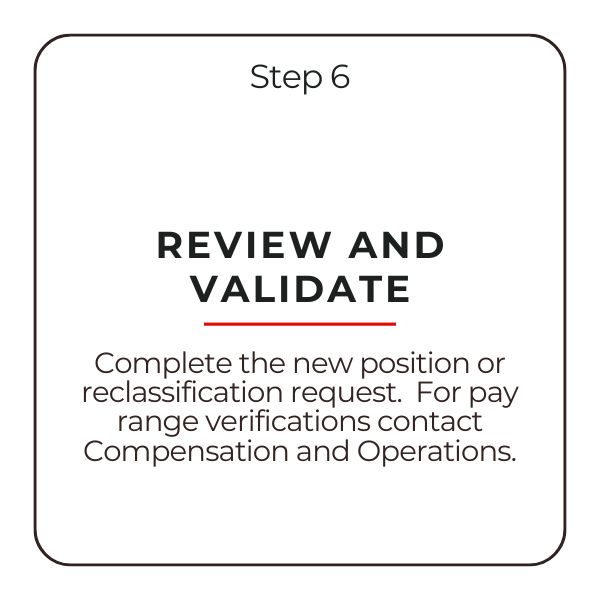
New Position and Reclassification Request
Human Resources partners with department managers and administrators to evaluate and classify both new and existing positions. This collaborative process supports informed decision-making when adjusting organizational structures.
When a new position is proposed or an existing role is being reclassified, Human Resources and the department collaboratively assess the position’s responsibilities, scope, required qualifications, and reporting relationships. Positions should be defined based on the actual work to be performed, rather than tailored to fit the background of a specific individual or group.
Fair Labor Standards Act (FLSA)
The Fair Labor Standards Act (FLSA) is a federal law administered by the Department of Labor (DOL) that regulates employment rules such as minimum wage, the rules for determining eligibility for overtime and how overtime is paid. Under the FLSA, employees are entitled to pay at the rate of one and a half times the employee's regular hourly wage for all hours worked in excess of 40 in a given workweek, unless that employee falls within one or more of the white collar exemption statuses.
- Exemption worksheets:
- FLSA
Pay Ranges for Positions in the Staff Position Title Glossary
Competitive and fair pay is one component of the University’s staff compensation program. After matching a job to a market benchmark, the salary structure below is used to assign a pay range that aligns the job to market standards intended to attract, retain, and reward top talent.
Pay Positioning Guidelines
Use the Pay Positioning Guidelines to help determine the appropriate pay within the pay range while considering factors such as experience, performance, and time in the position.
Job Complexity Level Worksheets
Use the Job Complexity Worksheets to analyze each position by evaluating the scope of the position, effective knowledge, impact, communication and collaboration, problem solving, autonomy, leadership, and required education and experience.
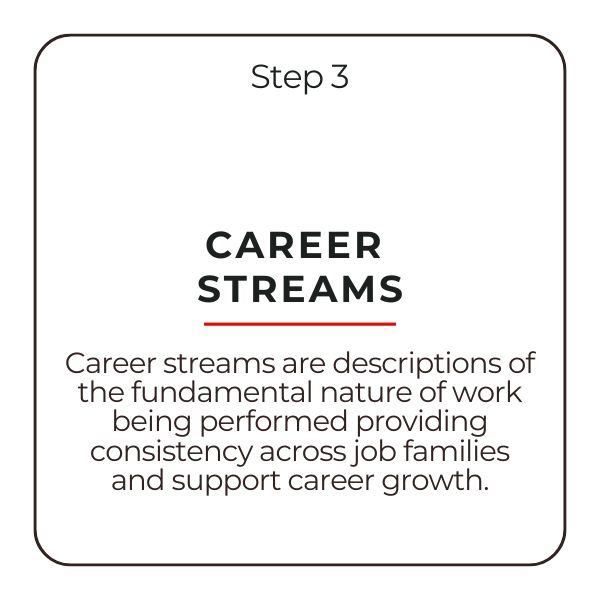
- Operational Contributor
- Employees in this career stream serve in support, operational, administrative, or technical functions and typically do not require a college degree. May attended trade school and/or completed apprenticeships. Typically paid hourly and receive overtime.
- Professional Contributor
- Employees in this career stream serve in knowledge-based roles requiring more independent judgement in each successive job level. Typically requires an associate's degree or above.
- Managerial Contributor
- In addition to their functional duties, employees in this career stream are responsible for managing the activities, training, and performance of other employees. Typically requires a bachelor's degree or above.
- Executive Contributor
- Employees in this career stream are responsible for long-term strategic planning, establishing unit goals, and executing on the institution's mission, vision, and values.
Human Resources
-
Address
Texas Tech University, 2518 15th Street, Lubbock, TX 79409 -
Phone
8067423851 -
Email
webmaster.hr@ttu.edu