
School of Music
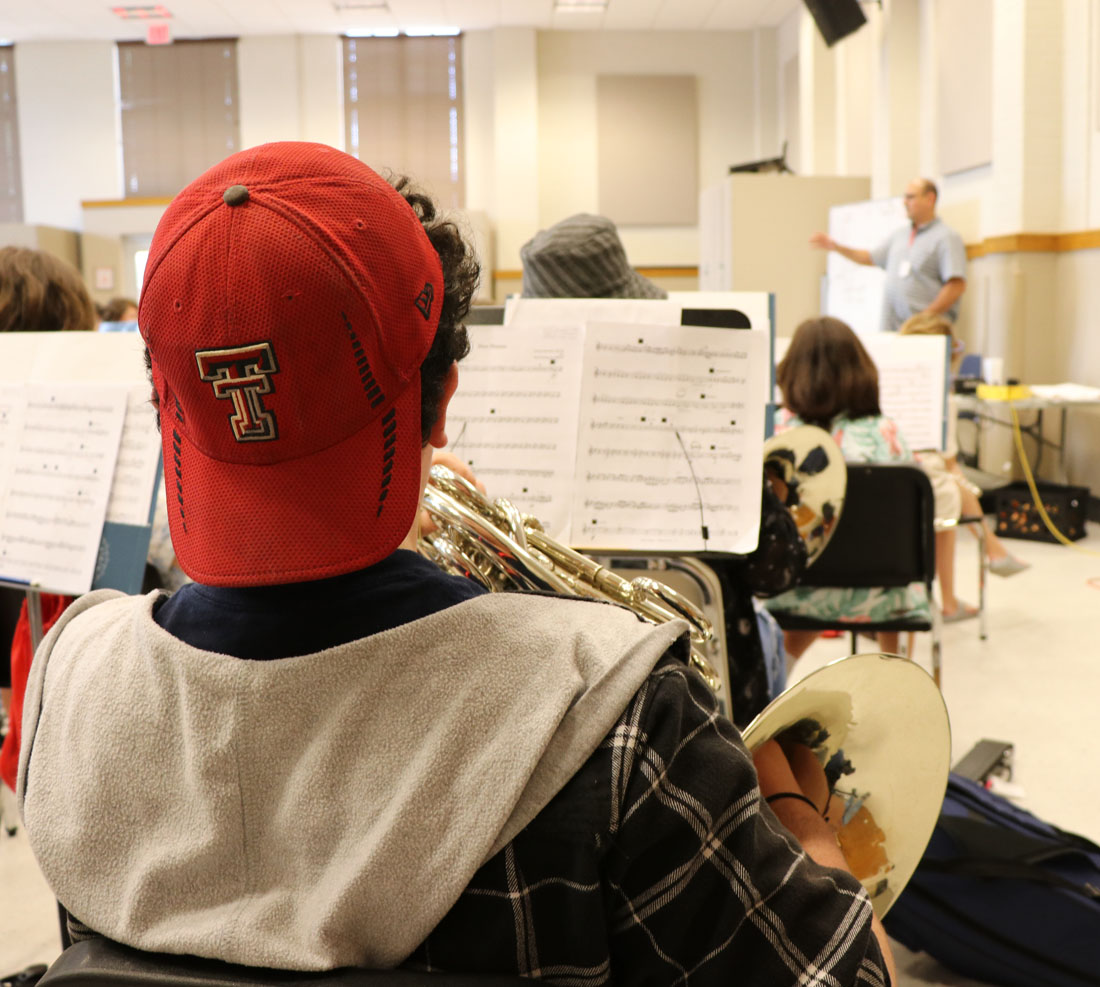
TTU Band & Orchestra Camp
Camp Information
Camp Information
Schedule
Final Day of Camp
8:30 AM Band 7
9:15 AM Band 6
9:45 AM Band 5
10:30 AM Band 4
11:15 AM Orchestra 2
12:15 PM Full Orchestra 1
1:00 PM Band 3
1:45 PM Band 2
2:30 PM Band 1
General Day Schedule for Camper
M-F classes will run from approximately 8 am - 5 pm, depending on the student's ensemble and elective choices. The evening activities begin at 6:30 pm. Students will get their personalized schedules on the Sunday evening after audition results are posted.
Concerts
Final Day of Camp
8:30 AM Band 7
9:15 AM Band 6
9:45 AM Band 5
10:30 AM Band 4
11:15 AM Orchestra 2
12:15 PM Full Orchestra 1
1:00 PM Band 3
1:45 PM Band 2
2:30 PM Band 1
All concerts will take place in Hemmle Recital Hall unless otherwise noted.
Many of the electives will have a small ensemble concert on Friday. The
students will be informed near the end of the week if their group will be performing
and the details of those concerts. These will take place around the SUB and Music
Building.
Electives
Sign Up Process
Campers will be signing up for electives AT CAMP. After the audition results are posted, students will choose from the classes that fit into their final schedule, rather than being assigned by the camp staff.
Electives that require an audition, such as Orchestra Winds/Percussion and Chamber Music for Strings, will take place during the regular audition. Students will indicate to their judges that they would like to be considered and results for those electives will be posted with the regular ensemble results.
Jazz Band is the only elective that will require a separate audition at camp.
About
In addition to their regular schedule of rehearsals and sectionals, students take either 1 or 2 elective classes, listed below, that they attend every day. This allows campers to explore different areas of interest or play in new types of ensembles.
We offer classes for all levels of playing ability; however, some electives are limited to advanced players or have other requirements as listed in the description.
Classes
*Classes that require an audition or placement test
*CHAMBER MUSIC FOR STRINGS
Small ensembles of strings. For Advanced Students Only. Placement in this class will be determined during your regular audition.
CONDUCTING - Learn the basic beat patterns of directing.
DRUM MAJOR - To learn either the fundamentals or advanced concepts of conducting, teaching, & leadership.
IMPROVISATION (Jazz) - Open to all student levels and instruments.
INSTRUMENT CHOIRSBRASS CHOIR - Small ensemble of trumpets, horns, trombones, baritones & tubas - May also audition for orchestra
CLARINET CHOIR - Small ensemble of Bb, alto, bass and contra alto/bass clarinets
FLUTE CHOIR - Small ensemble of flutes
HORN CHOIR - Small ensemble of horns
PERCUSSION ENSEMBLE - Small ensemble of percussion instruments. You may also audition for orchestra or jazz band. For Advanced Students Only
SAX CHOIR - Small ensemble of alto, tenor & bari saxes
STRING BASS ENSEMBLE - Chamber ensemble for string bass students
TROMBONE CHOIR - Small ensemble of trombones
TRUMPET CHOIR - Small ensemble of trumpets
TUBA/EUPHONIUM ENSEMBLE - Small ensemble of tubas & euphoniums
*JAZZ BAND - Saxophone, trumpet, trombone, rhythm & percussion students. Placement in the Middle School or High School jazz band will be by audition only. The jazz audition is separate from the ensemble audition and will accrue on the Sunday during Check-In.
LEADERSHIP - Class to learn the skills necessary for positions such as officer & section leader.
MUSIC IN FILM - For anyone who loves the music of movies! Students will dive into the world of film music and discover what role it plays in making the action on-screen come alive using films like The Nightmare Before Christmas, The Incredibles, Star Wars, and more.
*ORCHESTRA/WINDS & PERCUSSION - For ADVANCED wind & percussion students interested in performing with a full orchestra. BY AUDITION ONLY. Students that make this ensemble can also take jazz band or any of the other nonplaying electives.
PIANO, (Introduction to) - An introduction to piano basics. This class will cover beginning concepts such as identifying keys on a keyboard and correct hand placement.
REED MAKING FOR BASSOON AND OBOE - Class limited to bassoonists and oboists who wish to learn to make & adjust reeds. Suggested for 9th grade & above. Warning: Sharp utensils will be used in this class. It is advisable for students to provide their own tools if possible. **Please note, this class requires an additional $15 fee for materials**
MUSIC OF THE BEATLES- Students will learn and explore the rich history of the music of the Beatles and how they have impacted the popular music of today.
*THEORY - To learn either the fundamentals of theory including scales, key signatures, intervals, chord structure, & simple melodic dictation, or the more advanced aspects of complicated chord structures, key schemes, intervals, & melodic dictation. All Theory students will be required to take a placement exam on registration day.
UKULELE CLASS – More info coming soon!
Audition Music
Each camper is required to perform the audition material for their instrument on site the first day of camp. Material is selected by the Texas Tech University instrument faculty. Results of the audition will be posted on the camper's schedule on the day of Check-In. Audition material is available by section and instrument below.
Electives Requiring Audition
At the start of your Audition please state if you are interested in any of the electives below.
Chamber Music for Strings (string players only)
Orchestra Winds & Percussion (Full Orchestra Instruments Only)
Jazz Band (saxophones, trumpets, trombones, guitar, piano, bass, and drums): You may use TMEA All-State Etudes and/or an excerpt from your school jazz program, or another jazz excerpt of your choice (etude, transcription, etc).. You have the option to improvise on Bb blues (backing track provided). Auditions will be held in Room 125 (jazz lab) after your regular BOC ensemble audition.
Please email Kevin Whalen with jazz-specific questions: kevin.whalen@ttu.edu
Instruments
Strings/Winds/Brass/Percussion
Level 1 - Beginning Students who have completed their first year of music instruction.
Level 2 - Middle School level material for students interested in the top middle school ensemble.
Level 3/4 - High school level (entering 9th grade and above). NOTE: To be considered for the Wind Ensemble, Band 1 or Band 2, you must audition with level 4 music.
Students should select the level that they feel comfortable playing and best represents their ability level.
Woodwinds
FLUTE
Level 1: Two scales of your choice demonstrating your comfortable lowest to highest range
+ one short etude of your choice (please consult your director for assistance in selecting
an appropriate etude)
Level 2: Chromatic scale demonstrating your comfortable lowest to highest range + two major scales of your choice + one short etude of your choice (please consult your director for assistance in selecting an appropriate etude)
Level 3/4: Three-octave chromatic scale (full range) + all major scales + one technical etude and one lyrical etude from Flute Etudes Book by Mary Karen Clardy or other standard etude collection.
OBOE
Level 1: Two scales showcasing the lowest to highest that you can comfortably play + a short etude of your choosing (please consult your private teacher or band director for assistance in choosing)
Level 2: Chromatic scale from the lowest to the highest that you can comfortably play + a short etude or solo showing lyrical and technical ability.
Level 3/4: Chromatic scale from the low Bb to high F + two octave Eb scale and E major scale. Choose any etude from Ferling 48 Studies, 24 Etudes for Oboe by Luft, or Selected Studies for Oboe by Voxman.
(Not sure what to play??? Send me an email and I’m happy to help! Mrockett@ttu.edu)
CLARINET
Level 1: 3 or 4 lines of a Rose etude of your choosing (please consult your director for assistance
in choosing)
Level 2: A Rose Etude of your choosing. Recent all-region etudes are allowed
Level 3/4: Any Rose Etude of your choosing that has NOT been used for TMEA or ATSSB all-region auditions in the last two years.
BASSOON
Level 1: Two scales showcasing the lowest to highest that you can comfortably play + a short
etude of your choosing (please consult your director for assistance in choosing)
Level 2: Chromatic scale from the lowest to the highest that you can comfortably play + a short excerpt(s) showing lyrical and technical ability
Level 3/4: Chromatic scale from the lowest to the highest that you can comfortably play + two major/minor scales + two suggested etudes from standard pedagogical texts
SAXOPHONE
Level 1: Two scales showcasing the lowest to highest that you can comfortably play + a short
etude of your choosing (please consult your director for assistance in choosing)
Level 2: Chromatic scale from the lowest to the highest that you can comfortably play + a short excerpt(s) showing lyrical and technical ability
Level 3/4: Chromatic scale from the lowest to the highest that you can comfortably play + two major/minor scales + two suggested etudes from standard pedagogical texts
Brass
TRUMPET
Level 1: A one-octave concert B-flat major scale + a short etude of your choosing (Getchell, etc. - please consult your director for assistance in choosing)
Level 2: A one-octave concert B-flat major scale and a one or two octave concert F major scale + a short etude or excerpt(s) showing lyrical and technical ability (Ost Early Etudes, Concone, Wurm, Getchell, etc.)
Level 3/4: A two-octave concert B-flat major and natural minor scale + two contrasting etudes of choice (recommended: Charlier, Brandt, Vannetelbosch, Wurm, etc.)
HORN
Level 1: Two scales showcasing the lowest to highest that you can comfortably play + a short etude of your choosing (please consult your director for assistance in choosing)
Level 2: Chromatic scale from the lowest to the highest that you can comfortably play + two short excerpts showing lyrical and technical ability.
Level 3/4: Chromatic scale from the lowest to the highest that you can comfortably play + two major scales and two minor scales (can be natural, harmonic, or melodic) + two etudes showing lyrical and technical ability, chosen from the TMEA All State Etude books.
-335 Selected Melodious, Progressive, & Technical Studies for French Horn, Book 1 (Pottag / Andraud, Southern Music Co.), 40 Characteristic Etudes by Henri Kling (ed. Sansone, Southern Music Co.). 60 Selected Studies by Kopprasch (Kalmus).
TROMBONE
Level 1: Two scales showcasing the lowest to highest that you can comfortably play + a short etude of your choosing (please consult your director for assistance in choosing)
Level 2: Chromatic scale from the lowest to the highest that you can comfortably play, a Bb or Eb Major Scale + a short excerpt(s) showing lyrical and technical ability
Level 3/4: Chromatic scale from the lowest to the highest that you can comfortably play, a C, F, Eb or Ab Major Scale, one short lyrical excerpt, and one short technical excerpt showing your current technical ability.
EUPHONIUM
Level 1: play a B flat major scale and another scale of your choice one octave. Also play a short etude of your choosing (please consult your director for assistance in choosing)
Level 2: Chromatic scale from the lowest to the highest that you can comfortably play and a short excerpt(s) showing lyrical and technical ability
Level 3/4: One two-octave major scale and one two-octave minor scale. Select an etude from any all-state list (TMEA, ATSSB, etc). Sight reading will also be required.
TUBA
Level 1: play a B flat major scale and another scale of your choice one octave. Also play a short etude of your choosing (please consult your director for assistance in choosing)
Level 2: Chromatic scale from the lowest to the highest that you can comfortably play and a short excerpt(s) showing lyrical and technical ability
Level 3/4: One two-octave major scale and one two-octave minor scale. Sight reading will also
be required. Select an etude from any of the following books:
1. Phil Snedecor: Low Etudes for Tuba
2. Vladislav Blazhevich: 70 Studies for Bb Tuba, Book 1 or Book 2
3. Boris Grigoriev: 78 Studies for Tuba
Percussion
PERCUSSION
Level 1/2: Please prepare a short snare drum etude. Then, you will be asked to sight-read a short etude on keyboard percussion representative of Level 1/2 keyboard percussion repertoire.
Level 3/4: Please prepare a short snare drum etude (e. g, All-Region Etude or an etude
from the Cirone, Peters, or Delecluse books would be appropriate). Then, you will
be asked to sight-read a short etude on keyboard percussion representative of Level
3/4 keyboard percussion repertoire.
Strings
Level 1:
1. One scale showing the lowest to highest notes that you can comfortably play (any
tempo or bowing).
2. One 2-minute excerpt from a solo, orchestral excerpt, or etude of your choice,
representing your highest playing ability. (Please consult your orchestra
director and/or private teacher for assistance in choosing).
Level 2:
1. One two-octave scale (any tempo or bowing)
2. One 2-minute excerpt from a solo, orchestral excerpt, or etude of your choice,
representing your highest playing ability. (Please consult your orchestra director
and/or private teacher for assistance in choosing).
Level 3/4:
1. One thee-octave scale major scale and one three octave minor scale (any tempo or
bowing)
2. Two contrasting excerpts (lyrical and technical) from a solo, orchestral excerpt,
or etude of your choice, representing your highest playing ability. (The All-State
audition etudes are encouraged.)
Questions
Contact Us
boc@ttu.edu
806.742.2225
School of Music
-
Address
2624 18th Street | Box 42033 | Lubbock, TX 79409-2033 -
Phone
806.742.2274 -
Email
schoolofmusic@ttu.edu