

I came in knowing nothing, but I noticed very early on it's quite impressive when you can take scholarly language and translate that for a novice or the general public. Alanna [Hirshman] has been very supportive in making sure that I was understanding the research process and the opportunities in academia.

The Rawls Undergraduate Research Program is a wonderful opportunity that allows faculty to propose a paper idea and find a student interested in that idea. It's an opportunity to help an undergraduate student interested in research develop and hone their research skills. You can show them what life in graduate school, and potentially as an academic, can look like.
Rawls Undergraduate Research Program
The Rawls Undergraduate Research Program provides undergraduate students with a unique opportunity to participate in faculty-mentored research at Rawls College. Applications for the Fall 2026-Spring 2027 are now closed. If you submitted an application, expect to hear back from the program administrators with a decision by September 1st.
Undergraduate Research Mentees
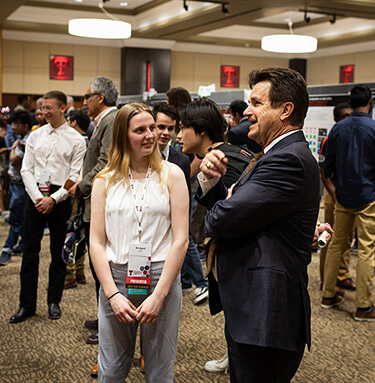
As an Undergraduate Research Mentee, student researchers will have opportunities to conduct research, analyze data, present research results, network with students who have similar research interests, and develop working relationships with Rawls College faculty mentors.
Conducting undergraduate research can play an important role in your college experience through benefits such as:
- Establishing 1:1 connections with faculty experts allowing you to gain an understanding of research methodology.
- Developing transferable skills, including critical thinking, problem solving, communication, collaboration, and independence through hands-on learning.
- Providing effective career preparation while paving a pathway to graduate school.
- Building a community with peers, faculty and organizations on- and off-campus.

Become an Undergraduate Research Mentee
Each summer, Rawls College accepts applications for the Rawls Undergraduate Research Program which runs September through May. Although the program is designed for Rawls College undergraduate students in their junior or senior year with a GPA of 3.0 or higher, exceptional students from other classes may be considered on a case-by-case basis.
For the 2026-2027 cycle, the Rawls College of Business seeks to gather a cadre of mentees who will commit to the following duties:
- Dedicate at least 3-4 hours per week to work on their project during the fall and spring semesters.
- Meet with assigned research mentor at least once per week.
- Attend at least one research skill-building workshop each semester. Qualifying workshops such as the Responsible Conduct of Research and Scholarship training, Endnote, R, SPSS, research methodology, coding languages, data management, and data visualization are typically offered through TTU Library Services.
- Present their research at the spring TTU Undergraduate Research Conference.
- Submit a 10-page final project report.
Completion of the RURP program
Each mentee completing the program in both the fall and spring semesters will get assigned a Pass/Fail grade. A Pass grade will allow the mentee to receive a Business Research Micro-credential. A mentee also has the option of converting this RURP experience into a 3-credit business class to satisfy their degree requirements, per O.P. 30.10 “Conversion of Alternative Non-credit Activity to Semester Credit Hours.” If choosing this option, mentees will be responsible for the tuition associated with the registration of said class.
In addition, the top three performing mentees will receive the following awards:
- 1st Prize: $5,000 for the mentee plus a plaque titled “Rawls Undergraduate Research Award” to commemorate and celebrate the efforts of the student in developing their research skills.
- 2nd & 3rd Prizes: $2,500 for each undergraduate mentee awardee.
Faculty Research Mentors
Undergraduate research is one of the keys to growing Rawls College as a leading, research-based business school, and its success depends on the support of our world-class faculty. Developing the research skills of undergraduate mentees by partnering with them on a genuine research project supports one of the most important aspects of our mission to advance knowledge through impactful research.
Faculty can engage undergraduate students in guided research activities such as coding, transcription, focus group and survey development, data visualization and data analysis. The assigned research activities should be designed so that they can be completed by the mentee during one program cycle (September-May) and support scholarly or creative projects, a pilot project, a specific part of a larger project or be designed to provide preliminary data for future research.
Apply to Become an Undergraduate Research Mentor
Faculty research mentors take on the responsibility of teaching students important research skills, but will also benefit as students often bring fresh insight and inquiry to their area of study.
Research Mentor GuidelinesFor the 2026-2027 cycle, the Rawls College of Business seeks to gather a cadre of mentors who will commit to the following duties:
- Meet with their assigned research mentee at least once a week. Students report much more positive experiences when they have regular contact with their research mentors.
- Orient their assigned mentee to their selected project and establish clear expectations for the mentee's assigned research project activities, associated tasks and their importance to the project.
- Establishing clear policies concerning schedules, a timeline of assigned research activities, communications, progress performance reviews, and expected deliverables.
- Become available to the student researcher throughout the entire undergraduate research process - i.e. availability before the research begins (to assist with project design and proposal writing), during, and after the research has been completed (to assist with analysis of final results and presentation of research at the TTU Undergraduate Research Conference).
- Report a Pass/Fail grade for the assigned mentee at the end of the program. A pass grade allows the mentee to receive a Business Research Micro-credential. The student will also have the option of converting the RURP Micro-credential to non-credit activity to Semester Credit Hours per O.P. 30.10. If choosing this option, mentees will be responsible for the tuition associated with the registration of said class.
Past Projects
Faculty Mentor: Deidre Popovich
Key Words: consumer vulnerability; medical gaslighting; service failure; trust; marketplace exclusion; psychological trauma; women's health
Project Activities: Assisting with scraping and organizing data from online platforms such as Reddit.
- Conducting preliminary coding and thematic analysis of qualitative data.
- Supporting recruitment and preparation for interviews or focus groups.
- Helping with transcription, memo-ing, and qualitative data management.
- Contributing to literature reviews on consumer vulnerability, women’s health, and medical decision-making.
- Participating in regular research meetings to discuss findings, refine methods, and co-develop research outputs.
Faculty Mentor: Ankit Anand
Key Words: Automated Scanning Robots (ASR), Buy-Online-Pickup-in-Store (BOPIS), service failures, grocery retail
Project Activities: This study uses a matched store comparison with a before-and-after design to evaluate the impact of ASR implementation on BOPIS failure rates. This approach compares changes in BOPIS failure rates over time between stores with ASR implementation and similar stores without ASR.
Faculty Mentor: Claudio Muller
Key Words: intergenerational succession, ranching business, West Texas
Project Activities:
Phase 1: Literature Review & Contextualization
1 Guided Literature Search and Annotation
2. West Texas Contextual Information Gathering
Phase 2: Data Collection Preparation & Support
1. Survey Instrument Review and Piloting
2. Interview Protocol Familiarization & Transcription Practice
3. Stakeholder Mapping & Contact Information Compilation
Phase 3: Data Organization
1. Data Entry and Cleaning (Quantitative Data)
2. Qualitative Data Organization
3. Basic Descriptive Statistics & Visualization (Quantitative Data)
Phase 4: Research Dissemination Support
Faculty Mentor: Himali Patil
Key Words: Additive Manufacturing, Localized Manufacturing, short lead times, Supply Chain
Project Activities: Survey development, Building survey in Qualtrics, Data collection, Pilot Analysis, Results and discussion
Faculty Mentor: Christine Nittrouer
Key Words: Relational Dynamics, academia couples, hiring process, disclosure of personal information, academic recruitment
Project Activities: Independent coding, visualizations or ways to think creatively about presenting the data analysis, deep coding of approximately 1500 articles.
Faculty Mentor: Deidre Popovich
Key Words: Artificial intelligence (AI), healthcare, medical chatbots, human medical providers
Project Activities:
- Literature Review: Helping identify relevant articles on AI in healthcare, consumer trust, stereotype threat, and chatbot design.
- Study Design: Assisting in creating chatbot scripts that reflect “warm/empathetic” vs. “objective/neutral” styles.
- Survey Programming: Learning to build and edit experimental studies in Qualtrics and pilot test them with small samples.
- Data Collection: Helping recruit participants (via online platforms such as Prolific) and monitoring study progress.
- Data Analysis: Gaining experience with SPSS or JASP for analyzing experimental data (training provided).
- Research Dissemination: Assisting with creating figures, summaries, and presentations for conference submissions.
Faculty Mentor: Andrew Blake
Key Words: entrepreneur pitch, machine vision, emotion
Project Activities: manage lab data collection efforts including participant recruitment, survey research, and providing instructions to lab participants
Faculty Mentor: Bobby Merriman
Key Words: macro/micro economic data, prediction, search, queries
Project Activities: write code to run regressions, conduct a literature review on research using Google search, use latex to compile graphs and tables
Faculty Mentor: Christine Nittrouer
Key Words: STEM disciplines, diversity, majority social identities
Project Activities: design field settings, perform basic statistical analysis, perform basic survey design, and draft result reports
Faculty Mentor: Alanna Hirshman
Key Words: corporate social responsibility, stakeholder perceptions
Project Activities: data collection, coding, data scrapes
Faculty Mentor: Darima Fotheringham
Key Words: customer preferences, perceptions, and decision-making
Project Activities: Manipulation design, data analysis and presentation, literature review
Faculty Mentor: Dr. Alejandra Marin
Key Words: social media engagement, ethnic identification, contextualization
Project Activities: literature review, data collection, cleaning, and preliminary analysis.
Rawls College of Business
-
Address
Rawls College of Business, Box 42101, 703 Flint Avenue, Lubbock, TX 79409 -
Phone
806.742.3188 -
Email
ba_webmaster@ttu.edu