
Laser Safety Manual
SECTION I: MANAGEMENT OF LASER LICENSE D1 LASER SAFETY PROGRAM
D1 LASER SAFETY PROGRAM
Introduction
The purpose of this manual is to inform users and non-users of laser equipment about
the policies and procedures concerning laser use at Texas Tech University and state
regulations, 25 Texas Administrative Code (TAC) §289.301 are covered. Policies and
procedures set forth in this guide have a primary goal to protect Texas Tech University
faculty, staff, students, and visitors against unnecessary and potentially harmful
laser radiation exposure. This manual includes the procedure for permitting lasers
at TTU and the requirements to obtain a sublicense permit for laser usage from the
Radiation and Laser Safety Committee.
D1.1
Objective
This program is designed to protect the faculty, staff, employees, and students of
Texas Tech University (TTU); to protect members of the general public; and to comply
with 25 TAC
§289.301 [Texas Regulations for Control of Laser Radiation Hazards (TRCLRH)].
D1.2
Method
Texas Tech University (TTU) has established this Laser Safety Manual (LrSM) to provide
safety guidance to its faculty, staff, and students when working with lasers. The
Radiation Laser Safety Committee (RLSC) and Laser Safety Officer (LSO) are also, available
for additional assistance.
D1.3
Date of Implementation
September 1, 2002, upon approval by the RLSC.
D1.4
Review
This program will be reviewed on an annual basis no later than the anniversary month
of its inception.
D1.5
Program Elements
D1.5.1
Purchase, Transfer, Shipping, and Delivery Notification: Laser purchase, transfer,
shipping, and delivery procedures are specified in D.13.1.
D1.5.2
Access Controls for Laser Areas: Access to the laser areas is controlled by D.13.4
of the LrSM. In addition, certain elements of administrative and engineering controls
regarding storage, use, and maintenance/service procedures contain steps which specifically
address access controls.
D1.5.3
Posting of Areas and Rooms: D.13.3 of the LrSM provides for posting of the appropriate
signage respective of the class(s) of the laser.
D1.5.4
Training: D.13.5 of the LrSM addresses the required training for laboratory personnel.
D1.5.5
Management of Required Records: Records management procedures are addressed in
D.13.11 of the LrSM.
D1.5.6
Personal Protective Equipment: D.13.6 provides procedures for providing for the necessary
protection respective of the class(s) of the laser.
D1.5.7
Reports of Incidents and Accidents: All TTU personnel are responsible for reporting
incidents and accidents to the LSO - immediately. The specific procedures are found
in Section IV of the LrSM.
D2 RADIATION LASER SAFETY COMMITTEE
D2.1
Purpose and Structure
The RLSC is composed of a group of administrators, faculty, and staff appointed by
the Executive Vice President and Provost to establish policies and regulations governing
the use of ionizing and non-ionizing radiation. The RLSC is primarily responsible
for the administration, implementation, and enforcement of the laser radiation safety
program at TTU.
D2.2
Duties (RLSC Authority)
The RLSC will:
D2.2.1
establish policies and procedures, as well as provide administrative advice regarding
laser radiation safety;
D2.2.2
approve or disapprove all applications, amendments, and renewals relating to the use
of laser equipment;
D2.2.3
receive and review reports from the LSO on monitoring, surveillance, and exposure;
D2.2.4
monitor procurement, use, and transfer procedures;
D2.2.5
take appropriate corrective action on laser incidents, including administrative guidance
and license suspension or revocation;
D2.2.6
provide a representative to the University Safety Committee; and
D2.2.7
serve as an avenue of appeal in cases of dispute and exception to actions by the LSO.
D2.3
Membership
The members of the committee will be appointed by the Executive Vice President and
Provost. Members of the committee, other than those specified by virtue of their position,
will be nominated by the committee chairperson and the Associate Vice President for
Operations. Each member will serve a term of three years except when lesser terms
may be required to maintain balanced membership and continuity of committee operations.
Re-appointments are permissible. The RLSC shall be composed of:
D2.3.1
three faculty members who regularly use radioactive materials;
D2.3.2
two faculty members who regularly use lasers;
D2.3.3
at least one faculty member who regularly uses radiation producing equipment;
D2.3.4
at least two faculty/staff members who are non-users of radioactive materials, lasers,
or radiation producing equipment;
D2.3.5
RSO (Ex-Officio);
D2.3.6
LSO (Ex-Officio);
D2.3.7
Associate Vice President for Operations, (Ex-Officio)
D2.4
Operating Procedures
The RLSC shall observe the following:
D2.4.1
the RLSC shall schedule a regular meeting for each month of the year. Additional meetings
may be called as necessary. The LSO will prepare and distribute a written agenda to
committee members at least one day before each scheduled meeting;
D2.4.2
a quorum, at least one-half of the voting members, is required to conduct official
business;
D2.4.3
sub or ad hoc committees may be appointed by the Chairperson as needed;
D2.4.4
if a committee member is unable to continue serving on the committee for any reason,
the member shall notify the Chairperson so that a replacement may be appointed promptly;
and
D2.4.5
if a committee member fails to attend three consecutive meetings or one-half of the
called meetings in a twelve-month period, without just cause, the Chairperson will
contact that member to determine if that person should be replaced. If so, the Chairperson
will ask the Associate Vice President for Operations to arrange for a replacement
under the appointment procedures of the committee.
D2.5
RLSC Responsibilities
The RLSC shall:
D2.5.1
establish policies regarding laser radiation and laser safety;
D2.5.2
provide administrative advice to the LSO on matters regarding laser radiation and
laser safety;
D2.5.3
regulate type of training needed by laser users to meet applicable statutory and administrative
requirements;
D2.5.4
receive, review, and act on all applications and any amendments for the use of laser
equipment in any areas used by TTU personnel;
D2.5.5
receive and review periodic reports from the LSO on records, surveys, and inspections
and require compliance with applicable record keeping standards;
D2.5.6
periodically review the overall use of laser equipment at TTU from the standpoint
of operational hazards and potential secondary hazards;
D2.5.7
receive and review all reports from the LSO concerning laser radiation and laser incidents
at TTU;
D2.5.8
conduct necessary investigations, hearings, and/or appropriate corrective action to
be taken if a sublicensee or authorized laser personnel fail to operate the licensed
laser equipment according to the criteria specified in this policies and procedures
manual at TTU;
D2.5.9
meet regularly during the academic year;
D2.5.10
perform an annual audit of the Laser Safety Program; and
D2.5.11
upon committee action, issue sublicenses which will be duly signed and approved by
the Chairperson of the RLSC.
D3 LASER SAFETY OFFICER
D3.1
Duties
D3.1.1
The LSO is a member of the Radiation Safety Office who is trained in the areas of
laser operation and laser safety and registered with the Bureau of Radiation Control.
The LSO is the University official primarily responsible for compliance with applicable
safety policies and regulations. The LSO also provides various technical services
necessary for achieving such compliance.
D3.2
Responsibilities
The LSO shall:
D3.2.1
suspend immediately or restrict operation of a laser system when, in the view of LSO,
the sublicensee or authorized laser personnel working with laser system or other personnel
in the vicinity of the laser are in danger;
D3.2.2
instruct laser users and others affected in proper procedures and policies concerning
laser equipment use, including teaching laser safety training classes. The LSO shall
also provide consulting services to TTU personnel for aspects concerning laser safety;
D3.2.3
assure that appropriate primary control measures are in effect and to recommend alternate
control measures as back up if primary measures become infeasible or inappropriate;
D3.2.4
generate reports, receive and review records from sublicensees, and maintain all material
concerning laser equipment, personnel working in laser areas, and any other information
required by the Texas Regulations for the Control of Laser Radiation Hazards (TRCLRH).
This shall include, but not be limited to: laser eye protection inspections, incident/accident
reports, LSO laser lab inspections, registration, inventory forms, and medical surveillance
records;
D3.2.5
periodically inspect laser sublicensees to ensure proper record keeping, verify inventories,
inspect appropriate laser control measures, and ensure compliance with other laser
safety aspects as detailed in this manual. The LSO shall also inspect all new and
existing laser facilities and laser equipment prior to their installation or modification
to ensure proper compliance. The results of these inspections shall be periodically
presented to the RLSC;
D3.2.6
investigate all actual and suspected incidents resulting from operation of a laser
system by personnel at TTU. The LSO shall prepare reports to applicable agencies and
the RLSC shall approve such reports and initiate appropriate action concerning the
incident;
D3.2.7
provide each sublicensee with a copy (and updates) of the TTU Policies and Procedures
Manual for Laser Safety.
D4 INSPECTIONS
D4.1
The LSO performs routine monitoring and inspections of all laser sublicensees and
the results are then presented to the RLSC for their evaluation. Through this process,
the Laser Safety Program at TTU can keep abreast of past, present, and future concerns
with laser safety.
D4.2
The entire laser safety program is periodically inspected by a Regional Inspector from the Bureau of Radiation Control for compliance with the Texas Regulations for the Control of Laser Radiation Hazards. The results of these inspections are presented to the Director of Environmental Health and Safety, the Laser Safety Officer, the Radiation Safety Manager, and the Radiation Laser Safety Committee.
D4.3
General Monitoring
D4.3.1
The LSO may visit laboratories to ensure laser operations are according to procedures
set forth in this manual and sublicensee’s SOPs.
D4.3.2
The LSO will immediately report any major violation to the sublicensee and RLSC.
D4.3.3
The LSO will report minor violations to the sublicensee and RLSC.
D4.4
Formal Inspections
D4.4.1
Laser inspections will be performed semiannually by the LSO.
D4.4.2
Inspection results will be presented to the RLSC.
D4.4.3
Violations found will be brought to the attention of the sublicensee.
D4.4.4
Inspections results and reports will be sent to the sublicensee.
D4.5
Violation Levels
D4.5.1
Violations by a sublicensee are classified as either major or minor. All violations
will be presented to the RLSC at the next regularly scheduled meeting. A copy of the
most current monitoring and inspection criteria and the type of violation may be obtained
from the LSO
D4.5.2
Major Violations
Include but are not limited to:
D4.5.2.1
Unauthorized personnel in laser area when laser is in use (authorized personnel are
listed on the laser sublicense);
D4.5.2.2
Operation of laser equipment in a manner which could cause injury to personnel outside
the laser area;
D4.5.2.3
Operation of laser equipment in a manner other than that specified in the approved
standard operating procedures;
D4.5.2.4
Personnel in a laser area not utilizing proper personal protective equipment when
the laser is in use;
D4.5.2.5
Operation of laser equipment without prior authorization from the RLSC and LSO; or
D4.5.2.6
Any combination of D4.5.2.1 to D4.5.2.5.
D4.5.2.7
Any major violation may warrant the immediate deactivation of laser operation, and
will remain so until safety concerns are addressed.
D4.5.3
Minor Violations
Include but are not limited to:
D4.5.3.1
Improper posting of a laser area;
D4.5.3.2
Improper labeling of laser equipment;
D4.5.3.3
Usage log books not filled out as required;
D4.5.3.4
Monthly surveys and interlock checks not performed;
D4.5.3.5
Standard operating procedures and laser equipment manuals not in vicinity of laser
equipment;
D4.5.3.6
Expiration of a laser sublicense; or
D4.5.3.7
Information on laser sublicense out of date.
D4.5.3.8
Any minor violation will be reported to the Sublicensee for correction and results
discussed in the RLSC meeting.
D4.6
Inspection Procedures
D4.6.1
The LSO shall inspect all laser usage facilities for compliance with all applicable
regulations - state, federal, and local.
D4.6.2
The LSO shall make a record of each inspection and keep those on file in the Radiation
Safety office.
D4.6.3
The LSO will forward a formal report of inspection (Form LS-1) to each sublicensee
within two weeks of final evaluation of his/her inspection results, noting corrective
action needed.
D4.6.4
Each sublicensee will revise or correct his/her individual program as noted in the
report under "Corrective Actions". Questions or problems should be addressed to the
LSO or the RLSC.
D4.6.5
The LSO will request a written response to some of the “Corrective Actions” from the
sublicensee within 30 days.
D4.6.6
The LSO will report all major violations as well as any instance of non-compliance
for a sublicensee to the RLSC.
D4.6.7
The LSO shall make follow-up inspections of all sublicensees having deficiencies deemed
serious by the RLSC within 15 days of report.
D4.6.8
All inspection statistics should be evaluated by the RLSC.
D4.6.9
Sublicensees having repeated violations (same violation during two consecutive inspections)
will be reported to the RLSC and the RLSC for appropriate action.
D4.6.10
A Sublicensee who commits the same violation during three consecutive inspections
will be reported to the RLSC. The RLSC will issue a written notice and require the
sublicensee to meet with the committee during the next scheduled RLSC meeting to explain
their violation.
D4.6.11
The RLSC may terminate a sublicense if major violations are continued.
SECTION II: SUBLICENSE PROGRAM
This section details the procedures and requirements for obtaining a sublicense for
laser equipment. Also included, will be procedures for renewals and amendments.
D5 DEFINITIONS
D5.1
Laser License – the specific laser license issued to TTU by the Bureau of Radiation Control of the Texas Department of Health. This license authorizes all laser use programs to be conducted at the discretion of the RLSC.
D5.2
Sublicense – an authorization issued by the RLSC to use laser equipment.
D5.3
Sublicensees – authorized laser personnel, full-time faculty members, whose training and experience are such that they have been sublicensed by the RLSC to use lasers in their research and educational activities. The RLSC will determine the extent of required training respective of the laser classification involved.
D5.4
Authorized Laser Personnel – faculty, students and other professionals, usually research or laboratory assistants or workers which may be engaged in education, laboratory research, and research support activities. These personnel may work with lasers but only after completing the required safety training programs and the Sublicensee amending his/her Sublicense to include them on it.
D5.5
Non-Authorized Personnel – faculty, students, and other professionals and non-TTU personnel which have not had TTU Laser Safety Training nor listed on the researcher’s Sublicense.
D5.6
Operation – the normal mode of the laser or laser system over the full range of its intended functions. It does not include maintenance.
D5.7
Maintenance – tasks specified in the maintenance instructions provided by the manufacturer which are to be performed by the user to ensure the intended performance of the product. It does not include operation.
D5.8
Service – procedures or adjustments described in the manufacturer’s service instruction which are to be performed by a “licensed” manufacturer serviceman which is performed infrequently. It does not include maintenance or operation.
D6 SUBLICENSE APPLICATION PROCEDURES
D6.1
Qualifications for a Sublicense
D6.1.1
The applicant must have sufficient training and experience in the use of the laser(s)
requested to ensure that proposed work is conducted and/or supervised in a safe manner.
D6.1.2
The applicant must be a TTU faculty member.
D6.1.3
The applicant must submit a completed application form for a laser usage sublicense,
and a resume of use and experience within the area of interest shown by the application.
This resume may include papers referencing the use of an instrument, and/or any formal
training courses or continued education.
D6.1.4
The applicant must specify on the application all types and numbers of lasers to be
licensed as well as the procedures involved.
D6.1.5
The RLSC will authorize issuance of the sublicense if it determines that all requirements
have been met.
D6.1.6
The RLSC will require all applicants to attend the TTU Laser Safety Training and/or
obtain experience by working under an active sublicensee for a specified period.
D6.1.7
The RLSC will require additional, “specific” training for individuals utilizing any
class IIIB and IV laser users.
D6.2
Requirements for Individuals Working Under a Sublicense
D6.2.1
All workers must document, prior to approval, completion of computer-based Laser Safety
Training.
D6.2.2
All workers will document, prior to approval, completion of required training for
class IIIB and IV lasers.
D6.3
Procedures for Obtaining a Sublicense
D6.3.1
The LSO will first review all applications.
D6.3.2
If an licensing amendment is properly completed by an authorized laser Sublicensee
and a qualifying inspection or a recent inspection of the laboratory by the TTU LSO
shows that the laboratory is in compliance with state and local regulations, interim
approval not to exceed 30 days may be granted by the LSO.
D6.3.3
A diagram of the proposed work area in the laboratory must accompany the application,
indicating laser work areas, and non-laser work areas, and equipment location(s).
D6.3.4
Final approval is required of all applications by the TTU RLSC.
D6.3.5
To be considered for final approval all applications, amendments and renewals must
be submitted at least two working days before a regularly scheduled RLSC meeting.
D6.3.6
All applications must be completed and signed by the applicant. Incomplete applications
will be returned to the applicant for re-submission.
D6.4
Sublicense Renewal and Amendment
D6.4.1
Term
Texas Tech University sublicenses remain in effect for two years from date of issue.
D6.4.2
Renewal
Although the Radiation Safety Office will remind sublicensees of a pending expiration,
it is the sole responsibility of the sublicensee to submit a timely renewal application
to avoid expiration of a sublicense. If a sublicense expires, authorized use of laser
equipment ends and may be continued again, only after a new application is processed
and approved by the RLSC.
D6.4.3
Conditions
Any one of the following changes in the conditions of the sublicense requires an amendment
to the sublicense:
D6.4.3.1
a change in personnel (additions and deletions);
D6.4.3.2
a change in the authorized locations of laser use (addition or deletion of rooms);
D6.4.3.3
a change in the laser inventory (new laser equipment, transfer or disposal of laser
equipment, storage or reactivation of laser equipment);
D6.4.3.4
a change in the standard operation procedures;
D6.4.3.5
any change on the laser equipment.
D6.4.4
All modifications need to be reported to the LSO. Application forms for license renewal
or amendment are available from the Radiation Safety Office or may be found in this
manual.
D7 ABSENCE OF SUBLICENSEE FROM CAMPUS
D7.1
If a sublicensee expects to be absent from the campus for more than 30 days, the LSO
shall be notified and the sublicensee shall:
D7.1.1
Deactivate all laser equipment on the sublicense during the absence (appropriate forms
must be filled out to deactivate and subsequently reactivate laser equipment); or
notify the LSO as to the responsible individual (another sublicensee) who will take
over supervision of the use of the laser equipment to be used. This sublicensee must
be competent in the use and regulations concerning the lasers to be used.
D7.1.2
Should arrangements as specified above in C.1 not be made, the RLSC Chairman and LSO,
shall revoke and terminate the sublicense. The LSO will terminate all laser use in
the affected laboratories.
D7.2
It is the sole responsibility of a sublicensee to notify the LSO during a period of his/her absence and to take appropriate action as outlined above.
D8 TERMINATION OF SUBLICENSE
The following procedure shall be used to terminate a laser equipment sublicense.
D8.1
A letter of intent to terminate the sublicense will be submitted to the LSO.This letter
will include:
D8.1.1
The date of termination.
D8.1.2
The listing of the sublicensee's authorized laser inventory and laboratories, including
storage areas. A diagram of all these areas should accompany this letter of intent.
D8.1.3
A statement that all lasers active and/or stored will be transferred either to the
LSO for storage or disposal, or to another sublicensee authorized to possess the lasers
under consideration.
D8.1.4
Upon receipt of the letter of intent, the LSO will conduct a visual inspection of
the laboratory and laser equipment. All signs and labels indicating laser use will
be removed.
D8.1.5
The LSO will label all laser equipment with a "Security Seal" to prevent use until
the laser equipment is transferred or disposed. Laser equipment transferred to another
TTU sublicensee will continue to bear the "Security Seal" until the recipient sublicensee
has his sublicense adjusted accordingly and the laser equipment to be disposed will
continue to bear the "Security Seal" until the laser is rendered incapable of emitting
laser radiation.
D8.1.6
AT THIS POINT, FURTHER USE OF LASER EQUIPMENT BY THE SUBLICENSEE AND INDIVIDUAL WORKERS
OF THAT SUBLICENSE IS STRICTLY PROHIBITED.
D8.1.7
Based on a review of the letter of intent, the results of the close-out survey, and
the disposition of the laser equipment, the LSO will make recommendations to the RLSC
regarding the request to terminate the sublicense.
D8.1.8
Until the RLSC and the LSO formally terminates the sublicense, the department chairperson
will be responsible for all laser equipment until these termination procedures are
complete until such time that the equipment is transferred to another sublicense.
D8.1.9
Once a sublicense has been terminated due to negligence, the sublicensee cannot apply
for another laser sublicense for a period of one year from the date of his/her laser
sublicense termination.
D9 DEACTIVATION/REACTIVATION OF SUBLICENSE
D9.1
Should a sublicensee foresee a period of time in which they do not plan to use laser
equipment the affected laboratory may be deactivated, by meeting the following criteria:
D9.1.1
A letter of intent to deactivate the sublicense will be submitted to the LSO. This
letter will include:
D9.1.1.1
The date of deactivation.
D9.1.1.2
The listing of the sublicensee's authorized laser inventory and laboratories, including
storage areas. A diagram of all these areas should accompany this letter of intent.
D9.1.1.3
A statement that all lasers used and/or stored in the affected laboratory will be
secured against any use.
D9.1.1.4
A statement that all associated laser hazards are secure and contained to ensure compliance
with regulations.
D9.1.1.5
Upon receipt of the letter of intent, the LSO will perform an inspection of the laboratory
and laser equipment.
D9.1.1.6
Based on a review of the letter of intent, the results of the inspection, the LSO
will make his recommendations to the RLSC who, in turn, will authorize deactivation
of the laboratory.
D9.1.1.7
Upon deactivation, all signs and labels, indicating where laser use was authorized
for use shall be removed.
D9.1.1.8
AT THIS POINT, FURTHER USE OF LASER EQUIPMENT BY THE SUBLICENSEE AND INDIVIDUAL WORKERS
OF THAT SUBLICENSE IS STRICTLY PROHIBITED.
D9.1.1.9
The LSO will label all laser equipment with a "Security Seal" to prevent any further
use. These security seals will only be removed at the expressed approval of the LSO.
D9.1.1.10
The term of deactivation of an authorized laser use area will be a MINIMUM OF FIFTEEN
DAYS AND A MAXIMUM OF UP TO TWO YEARS (or until the sublicense is due for renewal).
At the end of a deactivation period the sublicense may request, in writing, to renew
the deactivated status of the laboratory(s) for another term.
D9.1.1.11
During the period in which a laser use area is deactivated, the sublicense will remain
in an active status. If there are still active laboratories on the sublicense, all
current rules, regulations and policies governing that sublicense (relative to the
active laboratories) remain in
effect. Since deactivated laboratories are no longer considered laser use areas, the
requirements for inspections no longer applies. However, the sublicensee is still
responsible for the retention of ALL records and files which were generated for that
laboratory.
D9.1.2
A sublicensee may REACTIVATE a sublicense at any time AFTER the initial fifteen day
period if the following criteria are met:
D9.1.2.1
A TTU Form LS-2, Laser Amendment Application, must be filled out and delivered to
the LSO.
D9.1.2.2
Any and all changes in work areas, storage areas, etc. must be reflected on the amendment
application and accompanied with a diagram.
D9.1.2.3
The LSO will review the request and inspect the laboratory area(s) and make his recommendations
to the Chairperson of the RLSC.
D9.1.2.4
After the Chairperson has approved the reactivation of the laser laboratory, it will,
again, be subject to the posting, required records, safety procedures, and survey/safety
check requirements as stipulated by local, state, federal, and TTU regulations and
policies.
D9.1.2.5
At this time, the laser equipment may again be used and stored in that laboratory(s).
However, the laser equipment will be subject to a survey conducted by the LSO to ensure
the laser(s) meet all state and local requirements.
D10 DEACTIVATION/REACTIVATION OF EQUIPMENT
D10.1
Should a sublicensee foresee a period of time in which they do not plan to use specific
laser equipment, the laser may be deactivated, by meeting the following criteria:
D10.1.1
TTU form LS-2 Laser Amendment Application will be submitted to the LSO to deactivate
and a letter of intent that will include:
D10.1.1.1
A statement that the laser deactivated will be stored and secured against any use.
D10.1.1.2
A statement that all associated laser hazards are secure and contained to ensure compliance
with regulations.
D10.1.1.3
Upon receipt of the amendment application and letter of intent, the LSO will confirm
deactivation of the laser equipment and its storage area.
D10.1.1.4
Based on a review of the amendment application, the results of the confirmation, the
LSO will make his recommendations to the Chairperson of the RLSC who, in turn, will
authorize deactivation of the laser.
D10.1.1.5
Upon deactivation, all signs and labels, indicating where the laser was authorized
for use shall be removed.
D10.1.1.6
AT THIS POINT, FURTHER USE OF THE LASER EQUIPMENT BY THE SUBLICENSEE AND INDIVIDUAL
WORKERS OF THAT LASER EQUIPMENT IS STRICTLY PROHIBITED.
D10.1.1.7
The LSO will label the laser equipment with a "Security Seal" to prevent any further
use. These security seals will only be removed at the expressed approval of the LSO.
D10.1.1.8
The term of deactivation of authorized laser equipment will be a minimum of sixty
days.
D10.1.1.9
During this period in which the laser is deactivated, the sublicense will remain in
an active status. If there are still active lasers on the sublicense, all current
rules, regulations, and policies governing that sublicense (relative to the active
lasers) remain in effect. Since the deactivated laser is no longer considered active,
the requirements for inspections no longer apply. However, the sublicensee is still
responsible for the retention of ALL records and files which were generated for that
laser.
D10.2
A sublicensee may REACTIVATE a laser at any time AFTER the initial sixty-day period
if the following criteria are met:
D10.2.1
TTU Form LS-2, Laser Amendment Application, must be made to the LSO.
D10.2.2
Any changes in work areas, storage areas, etc. must be reflected on the amendment
application.
D10.2.3
The LSO will review the request and inspect the laboratory and make recommendations
to the Chairperson of the RLSC.
D10.2.4
After the Chairperson has approved the reactivation of the laser equipment, it will,
again be subject to the posting, required records, safety procedures, and survey/safety
check requirements as stipulated by federal, state, and local TTU regulations and
polices.
D10.2.5
At this time, the laser equipment may be used and stored in that particular laboratory.
However, the laser will be subject to a inspection conducted by the LSO to ensure
the unit(s) meet all state and local requirements.
D11 RESPONSIBILITIES OF THE SUBLICENSEE
D11.1
The sublicensee has the following obligations:
D11.1.1
To assure the safe operation of the licensed laser(s) by authorized laser personnel
and account for any misuse, accidents, or injuries to persons or property;
D11.1.2
To submit an application for a laser sublicense or necessary amendments to update
the information in the latest sublicense before any work with lasers. There shall
be no use of lasers without first obtaining a sublicense or appropriate amendment
from the RLSC and approval for laser operation from the LSO;
D11.1.3
To ensure registration of all laser(s) under their authority, with the LSO (each laser(s)
purchased, donated, received, or otherwise constructed);
D11.1.4
To maintain records in accordance with national, state, and local regulations. This
shall include, but is not be limited to: laser eye protection inspections, incident/accident
reports, LSO laser lab inspections, registration, inventory forms, and other records
concerning the laser(s) under his/her control;
D11.1.5
To ensure that laser users have general laser safety training, specific hazard laser
training, and SOP training for class IIIB and IV lasers. The sublicensee will provide
the SOP training;
D11.1.6
To receive approval for operation of a laser system before the installation of a laser
and after modifications have been made. All new or modified (i.e. installation setups
that are different from approved application) lasers must first be approved by the
LSO before any operating of the particular laser unit commences;
D11.1.7
To report any actual or suspected incidents resulting from a laser operated under
his/her authority to the LSO. If necessary, the sublicensee shall immediately obtain
appropriate medical attention for any worker involved in a laser accident;
D11.1.8
To provide to the LSO and maintain standard operating procedures (SOP) for all laser
equipment under their authority;
D11.1.9
To prohibit operation of the laser when adequate control of laser hazards are not
met or when personnel are not properly trained;
D11.1.10
To report to the LSO any inoperative lasers due to disassembly or destruction;
D11.1.11
To provide all lab personnel with the appropriate personal protection equipment (PPE)
required;
D11.1.12
To provide all lab personnel with the appropriate training and emergency procedures
specific to the laser being used;
D11.1.13
To correctly post work areas and all laser-producing equipment;
D11.1.14
To report possible incidents and actual exposures to the LSO;
D11.1.15
To report all lasers being transferred, sold, or decommissioned.
D12 RESPONSIBILITIES OF USERS AND OPERATORS
D12.1
To comply with all applicable safety rules and laser program requirements and those specified by the RLSC/LSO and to be familiar with all standard operating procedures and emergency procedures for the laser equipment under his/her control.
D12.2
To use and operate only those laser(s) which are listed on the sublicense.
D12.3
To maintain documentation of training with dates and signature.
D12.4
To report any departures from established SOPS to the sublicensee and LSO.
D12.5
To report all possible incidents and actual exposures to the LSO.
D13 PROGRAM REQUIREMENTS
D13.1
Purchase, Transfer, Shipping and/or Delivery
D13.1.1
Ordering lasers or laser equipment
D13.1.1.1
Requestor will contact the LSO via email.
D13.1.1.2
The Requestor will provide the following information:
Sublicensee
Description of item
Manufacturer/Vendor
Model and Serial Number
Quantity
Purpose
Location of intended use
D13.1.1.3
The LSO will:
Verify status of sublicense;
Document information received;
Contact Purchasing and grant approval.
D13.1.2
Transfer of laser equipment
D13.1.2.1
Requestor will contact the LSO and Property/Surplus Manager
D13.1.2.2
Requestor will provide the following information:
Laser specifications;
To whom the equipment will be transferred;
Time frame for the transfer.
D13.1.2.3
The LSO will:
Verify status and document information, and
Contact Property/Surplus Manager and grant approval
D13.1.3
Shipping and Delivery
D13.1.3.1
Requestor will contact the LSO
D13.1.3.2
The LSO will:
Verify status of sublicense and paperwork;
Document information received;
Contact Central Warehouse and grant approval.
D13.2
Facilities (25 TAC §289.301(v)(3))
D13.2.1
Laser work areas(s) will have restricted access from non-authorized personnel.
D13.2.2
Laboratories will have heat-chemical resistant materials in the beam paths (when applicable).
D13.2.3
Laser work areas and lab entrances will be posted with the correct warning signs.
(signs available from Laser Safety)
D13.2.4
All signage (sublicense, emergency numbers, etc.) shall be posted in prominent view.
D13.2.5
Laboratories will have all windows covered with appropriate materials.
D13.2.6
Laser dye, solvent, and gas laboratories will have ventilation, fume hoods, and gas
cabinets capable of handling and storing the chemicals being utilized in order to
comply with regulatory limits.
D13.3
Signage (25 TAC §289.301(v)(3))
D13.3.1
Laser equipment will be labeled with manufacturer and class designation.
D13.3.2
Laser equipment will have labels with warning, output, duration, medium, and wavelength.
D13.3.3
Laser protective housing and enclosures will be labeled during normal and servicing
operations.
D13.3.4
Labels will be specific to the hazards of the laser determined by the LSO.
D13.3.5
Signage must be posted during maintenance and servicing operations and as stated in
the Standard Operating Procedures, SOP’s.
D13.4
Control Area and Access
D13.4.1
Laser work areas(s) will have restricted access from non-authorized personnel.
D13.4.2
Class IIIB and Class IV laser laboratories will have safety interlocks or alternate
control methods approved by the LSO.
D13.4.3
All costs for installations and materials will be assumed by the sublicensee or their
department.
D13.5
Training
D13.5.1
Training is available in 3 levels:
D13.5.1.1
Basic Level 1 – Fundamentals of laser principles;
D13.5.1.2
Administrative Level 2 – State regulations, TTU policies, and a brief review;
D13.5.1.3
Hazard Level 3 – Any additional training required by RLSC and LSO.
D13.5.2
Researchers are required to take Laser Training Levels 1 and 2 if they meet the following
stipulations:
D13.5.2.1
No training or experience;
D13.5.2.2
No documentation of training within the last five years.
D13.5.3
Researchers and Post-Doctorates are required to take Laser Training Level 2 if they
meet the follow stipulations:
D13.5.3.1
Have extensive training or experience;
D13.5.3.2
Have LSO approval.
D13.5.4
Students and Other Personnel are required to take Laser Training Level 1 if they meet
the following stipulations:
D13.5.4.1
No training or experience;
D13.5.4.2
No documentation of training within the last five years.
D13.6
Personal Protective Equipment (PPE)
D13.6.1
All laboratory personnel will be trained on the proper use of the following by Environmental
Health & Safety personnel:
D13.6.1.1
Laser eyewear
It will be in good condition and comfortable;
It will be labeled with wavelength and optical density; and
It will be inspected every year.
D13.6.1.2
Protective clothing
It will be tightly woven material.
It will be long sleeved.
D13.6.1.3
Chemical resistant gloves for handling of dyes and solvents.
D13.6.1.4
Various forms of shielding appropriate for the hazard.
D13.6.1.5
Hearing protection if work environment exceeds regulatory limits.
D13.7
Instrumentation
D13.7.1
Laser equipment will have protective housing.
D13.7.2
Laser safety interlocks for all class IIIB and IV.
D13.7.3
Laser equipment will have either a key switch or a computer code.
D13.7.4
Laser laboratories will have optical attenuators
D13.7.5
Laser equipment will have operational lights, alarms, and devices to notify others
that the laser is in “on.”
D13.8
Standard Operating Procedures
D13.8.1
The items listed are recommended to be included in the SOP’s for each laser. The information
can be revised in part to reflect major modifications that affect the laser’s performance
and operation.
D13.8.1.1
General Information:
Information of the laser owner;
Inventory control (TTU ID Number).
D13.8.1.2
System Information:
Description;
Location;
Class.
D13.8.1.3
Hazards Summary:
Beam information;
Non-Beam information.
D13.8.1.4
Required Control Measures:
Access Controls;
System Controls;
Personnel Controls.
D13.8.1.5
Alignment Procedures:
By whom;
Conditions;
Can be general for research purposes with the RLSC approval;
Buddy Policy required for Class IIIB and IV laser laboratories.
D13.8.1.6
Emergency Instructions
D13.8.1.7
All laser operators must sign the TTU form, LS-8 SOP Training Acknowledgement, to
document that they have been trained on the SOP of the laser.
D13.9
Modification
D13.9.1
A laser or laser system that requires modification that significantly changes the
SOP and performance shall not be operated until approved by the LSO.
D13.9.2
Modifications not reported to the LSO are in violation of the SOP approved by the
RLSC and terms of the sublicense.
D13.10
Usage Logs
D13.10.1
The usage logs must be dated and initialed by operator each time the laser equipment
is operated. This log should include notes of adjustments, operation conditions, maintenance,
servicing, and problems.
D13.11
Record Keeping
D13.11.1
The laser sublicensee should keep the following for documentation and inspection purposes
in one notebook. The records shall be available during routine monitoring of the lab
by Laser Safety personnel and/or regulatory agencies.
D13.11.1.1
Standard Operating Procedures (SOP)
D13.11.1.2
Signatures of SOP and PPE Training
D13.11.1.3
Usage Log
D13.11.1.4
Sublicensee Information
Sublicense – All Sublicensees should have a current copy.
Amendments/Renewals – All copies of personnel / laser changes.
Past Inspection Reports – All inspection reports sent from the LSO.
LSO Memos – All memos from the LSO are available to personnel.
Laser Inventory – All current laser inventories for inspections.
D13.12
General Services
D13.12.1
All laser activity must be suspended until these services have been performed:
D13.12.1.1
All laboratories must be surveyed (visual inspection) for any possible hazards within
24 hours of the scheduled cleaning or other services. The lab shall remain in order
until after the services, and it is the responsibility of the sublicensee to ensure
this. Records of the visual surveys must be kept.
D13.12.1.2
Exposure of general service personnel to preventable hazards will result in the suspension
of general services and a probationary period, at which time the status of the sublicense
will be determined by the RLSC.
D13.13
Custodial Services
D13.13.1
All laser activity must be suspended until these services have been performed:
D13.13.1.1
To obtain special custodial service (i.e., scrubbing, stripping, and finishing floors),
call Custodial Services (744-1866).
D13.13.1.2
Prior to scheduling the cleaning, the following preparations must be made:
The floor must be cleared of all obstacles such as boxes, books, containers, and chemical-labeled
items. This must be done by authorized personnel. Visual surveys of the lab must be
performed within 24 hours;
Custodial Services will schedule the work and call to confirm the date with the requestor;
The custodians will leave a checklist in the laboratory. The checklist must be completed
and signed by the lab personnel;
Laser laboratories requesting cleaning service will be furnished with a Request for
Custodial Service door card. The door card must be signed by the sublicensee or LSO,
and left on the outside of the door on the day the work is to be accomplished;
The sublicensee or a worker on that sublicense is required to be in the lab during
the cleaning of all Class IIIB and IV laser laboratories.
D13.13.1.3
To obtain routine custodial service, call Custodial Services (744-1866) to receive
a door card. Routine custodial service includes only sweeping floors, empty trash
containers, and replace paper in paper dispensers.
The Sublicensee will complete, sign and date a door card.
Place the card on the outside of the laboratory door before 6:00 PM on the day of
the routine cleaning. These cards are only good for one day. These cards assure the
custodians that there are no laser hazards.
The sublicensee or a worker IS NOT required to be in the lab during the routine cleaning.
Routine cleaning will probably be scheduled between 6:30 PM and 8:00 PM.
D13.14
Building, Maintenance, and Construction (BM&C Service)
D13.14.1
All laser activity must be suspended until these services have been performed:
D13.14.1.1
The LSO or sublicensee can give clearance for BM&C to perform work in an authorized
laser use/storage area. The laboratory must be surveyed within 24 hours of the scheduled
work.
D13.14.1.2
The sublicensee or a worker IS required to be in the lab during the BM&C services
of all Class IIIB and IV laser laboratories.
D13.15
Other Services
D13.15.1
All laser activity is suspended until these services have been performed.
D13.15.1.1
Departmental technicians may enter and perform routine duties provided they have the
required laser training requirements, and are granted permission by both the sublicensee
and the LSO.
D13.15.1.2
Company technicians and servicemen servicing or checking items on any laser equipment
must have the permission of the LSO. The Sublicensee will be required to have the
lab surveyed within 24 hours prior to their visit. All laser hazards should be rechecked
which would be unfamiliar to the technicians and servicemen. Records of these surveys
must be kept.
D13.15.1.3
The sublicensee or a worker is required to be in the lab during the services.
D14 LAB PERSONNEL
D14.1
Authorized Personnel
D14.1.1
Personnel such as faculty, students and other professionals, usually research or laboratory
assistants or workers that may be engaged in education, laboratory research, and research
support activities may work with lasers but only after completing the required safety
training programs and the express approval of the RLSC.
D14.1.1.1
The names of authorized personnel will be listed on the sublicense. Individuals not
listed on the sublicense are not authorized personnel.
D14.2
Non-Authorized Personnel
D14.2.1
Faculty, students, and other professionals and non -TTU personnel which have not had
TTU Laser Safety Training nor the express approval of the RLSC or whose names do not
appear on a given laser sublicense.
SECTION C-III: LASERS
D15 BASIC LASER CHARACTERISTICS
D15.1
Lasers
D15.1.1
Laser is an acronym for Light Amplification by the Stimulated Emission of Radiation.
The major components of a laser are: the excitation mechanism, active medium, and
an optical cavity. In general, there are four major laser types: solid state, semi-conductor,
gas and liquid (dye). The laser light emits non-ionizing electromagnetic radiation
that is ultraviolet, visible, or infrared light.
D15.1.1.1
Pulsed Lasers – a laser that delivers energy in the form of a single pulse or train
of pulses which is delivered in less than .25 seconds. Pulsed Lasers are expressed
as the total energy per pulse (joules).
D15.1.1.2
Continuous Wave Lasers – a laser whose output is operated in a continuous mode for
at least a period of .25 seconds. Continuous Wave Lasers are expressed as the average
power (watts).
D15.2
Intensity Terms
These are important laser terms that describe degrees of intensity which a particular
laser is capable of and are also, used in regulatory standards.
Radiance – The laser energy per unit area of the beam. Irradiance – The laser power
per unit area of the beam
D15.3
Classification
D15.3.1
ANSI and LIA Classification
D15.3.1.1
The American National Standards Institute (ANSI 2000) has developed four categories
of hazard potential. The classification scheme is based on the ability of optical
emissions from a laser system to produce injury to personnel. The higher the classification
number, the greater the hazard potential.
The Laser Institute of American (LIA) Laser Safety Guide describes each class as follows:
D15.3.2
Class I – Lasers or laser systems that do not, under normal operating conditions,
pose a hazard.
D15.3.3
Class II – Low-power visible light lasers or laser systems that, because of the normal
human aversion response (i.e. blinking, eye movement, etc.), do not normally present
a hazard, but may present some potential for hazard if viewed directly for extended
periods of time (similar to many conventional light sources).
D15.3.4
Class IIIA – Lasers or laser systems that normally would not injure the eye if viewed
for only momentary periods (within the aversion response period) with the unaided
eye, but may present a greater hazard if viewed using collection optics.
D15.3.4.1
Class IIIA lasers must carry a caution label. Another group of Class IIIA lasers have
DANGER labels and are capable of exceeding permissible exposure levels for the eye
in 0.25 seconds and still pose a low risk of injury.
D15.3.5
Class IIIB – Lasers or laser systems that will produce eye damage if viewed directly.
This includes intrabeam viewing of specular reflections. Normally, Class IIIB lasers
will not produce a hazardous diffuse reflection.
D15.3.6
Class IV – Lasers or laser systems that produce retinal damage from direct or specular
reflections, but may also produce hazardous diffuse reflections. Such lasers may produce
significant eye and skin radiation hazards as well as fire hazards.
D15.4
Hazards
D15.4.1
Beam Hazards
D15.4.1.1
Beam
Direct beam viewing is dependent on the laser classification. The hazard increases
beginning with Class II as minimal to Class IV as very dangerous.
D15.4.1.2
Beam Reflections
These types of reflections can sometimes occur when modifications are made to Class
I through Class III; however it is highly dependent on the laser environment. For
this reason, the LSO should always be consulted. Class IIIB and IV hazards include
specular and diffuse reflections which are dependent on the materials, objects, and
lenses in the laser area as well as the wavelengths of the beam. The determinations
of these are:
Specular Reflection – The reflection is mirror-like due to smooth surfaces being less
than the incident wavelength.
Diffuse Reflection – This type of reflection is much more scattered due to the irregularities
of the surface.
D15.4.2
Non-Beam Hazards
These hazards vary widely and are specific to the materials and the experiments involved
with the laser system.
D15.4.2.1
Physical – Factors that contribute to injury are: fire, explosions and electrocutions
from arc and filament lamps, capacitors, wiring, power supply’s, circuits, solvents,
and gases.
D15.4.2.2
Chemical – Various chemical agents include dyes, solvents, gases, and laser-generated
airborne contaminants (dusts, mists, fumes, and smokes).
D15.4.2.3
Radiation – The types of radiation’s vary from infrared, ultraviolet, x-ray, and visible
which the laser produces. The radiation is dependent on the wavelength of the laser
in the electromagnetic spectrum.
D15.5
Biological Effects
Biological effects are dependent on the laser beam properties and vary with duration,
wavelength, photon energy, target tissue, and tissue condition. Therefore, all effects
have to be weighed on a case by case basis. Safety and prevention are the best protection
against personal injury.
D15.5.1
Eye
D15.5.1.1
Injuries to the eye are primarily due to two main types of biological effects which
may or may not occur separately. Biological effects to the eye are dependent on exposure
conditions, wavelength, and irradiation levels. The main tissue types of the eye which
suffer these biological effects are the cornea, lens and retina.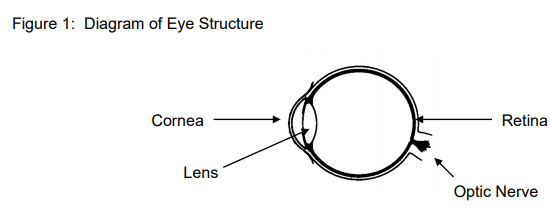
D15.5.1.2
Photochemical – High energy laser light photons may interact with molecules in the
eye tissue causing chemical bonds to be broken. The injury depends on the tissue of
the eye affected.
D15.5.1.3
Thermal – Heat dissipation is a major factor in causing to the eye. Heat flow could
travel horizontally along the same tissue or vertically through different depths of
underlying tissues.
D15.5.1.4
Summary – Types of eye damage from laser radiation are
Cornea >>> Corneal Burn
Lens >>> Cataracts
Retina >>> Decreased Vision/ Vision Loss
Optic Nerve >>> Blindness
D15.5.1.5
Electromagnetic Radiation to the Eye
D15.5.2
Skin
Skin tissue is at risk from laser exposure. The effects to the skin are considered
secondary; the higher the power of the laser - the greater the risk to the skin.
D15.5.2.1
Thermal – It is an actual burn to the skin; the severity of the burn is dependent
upon the penetration of the skin tissue.
D15.5.2.2
Ultraviolet – Due to the intense ultraviolet beam exposure, the skin will be affected.
Typically, this affect is equivalent to a sunburn.
D15.5.2.3
Photosensitivity – This effect may occur when laser personnel are currently on medications
that would cause sensitivity to light. If medications warn against avoiding sunlight,
then laser use should also be avoided.
D15.5.2.4
Summary – Types of skin damage from laser radiation are
Sunburn
skin burns
skin cancer, and
skin aging
D15.5.3
D16 SPECIFIC LASER REQUIREMENTS
D16.1
Class IIIB and IV Lasers D16.1.1
All Class IIIB and IV lasers require the following five items to be in full compliance
of 25 TAC
§289.301. Exemptions will be determined by substituting engineering and administrative
controls reviewed by the RLSC and the LSO.
D16.1.1.1
Maximum Permissible Exposure (MPE) – The level of laser radiation to which a person
may be exposed without hazardous effect or adverse biological changes in the eye or
skin. Parameters that determine the MPE are wavelength, duration, exposure conditions
(point or extended source, cw or pulsed, pulse width, pulse repetition frequency).
MPE are given in units of radiant exposure (J/cm 2).
D16.1.1.2
Nominal Hazards Zone (NHZ) – The space within which the level of direct, reflected,
or scattered radiation during operation exceeds the applicable MPE. Exposure levels
beyond the boundary of the NHZ are below the applicable MPE level. 
D16.1.1.3
Accessible Emission Limits (AEL) – The maximum accessible emission level permitted
within a particular laser class. AEL is in units of uW’s.
AEL = MPE x (area of limiting aperture)
D16.1.1.4
Optical Density (OD) – The logarithm to the base ten of the reciprocal of the transmittance.
The OD will be labeled on the eyewear for each laser.

OD = log Ei = incident beam irradiance in W cm 2
D16.1.1.5
Interlock – A switch that, when activated, will interrupt normal operation of a laser
by closing a shutter or de-energizing the system.
D16.2
Infrared Lasers
D16.2.1
Fire resistant materials are to be used in and around the laser work area.
D16.3
Fiber Optic Lasers
D16.3.1
The use of a tool shall be required for the disconnection of a connector of the laser
fiber optic cable for servicing and maintenance purposes, if the connector is not
within a secured enclosure. All connectors shall bear the appropriate label.
D16.4
Constructed Lasers
D16.4.1
All “constructed lasers” built from separate components must comply with the 21 Code
of Federal Regulations (CFR) Part 1040, Federal Laser Product Performance Standard.
Contact the LSO for more specific information.
SECTION IV: EMERGENCY PROCEDURES
INTRODUCTION
This section outlines basic emergency procedures. An emergency situation or accident
can arise from the use, the misuse, or abuse of laser equipment. This section is intended
to enhance a sublicensee’s and worker's ability to react properly to laser accidents.
Due to the broad scope of possible accidents at TTU, a comprehensive listing of all
steps to be followed for each type of accident is impracticable. Instead, a researcher
must use the following basic procedures and apply them to his/her individual situation.
The best advice for protection against laser accidents is to prepare for them.
It is the responsibility of each sublicensee to develop and ensure that personnel
working under their supervision have reviewed a practical emergency plan. This plan
is to include all required telephone numbers and is to be posted in each laser work
area. (Reference TTU - Operating Procedure 78.01 Vol.III)
D17 GENERAL INFORMATION
D17.1
A laser incident* at TTU is defined as any accident, single exposure, or suspected
exposure as set forth in 25 TAC §289.301.
D17.1.1
Users will report all laser incidents.
D18 ORGANIZATION AND AUTHORITY
D18.1
The LSO is responsible for investigating any laser incident at TTU.
D18.1.1
The LSO will promptly report all investigation findings to the RLSC and to the Texas
Bureau of Radiation [reference 25 TAC §289.301(xx)] for direction and action.
D18.1.2
If preliminary findings of an incident presented to the RLSC indicate there is probable
cause of neglect or violation of state, federal, or local regulations or policies,
the sublicensee involved will attend the next RLSC meeting to present his/her account
of the incident.
D18.1.3
In the event of a major emergency situation the LSO shall have the authority to bring
the situation under control.
D18.5
The LSO has the responsibility to see that each laser sublicensee/worker:
Recognizes a laser emergency;
Has the training to prevent or confine a laser accident;
Has the training to recognize possible risks of exposure.
D18.6
Each sublicensee is responsible to assist the LSO in controlling and/or investigating a laser accident. Furthermore, the sublicensee is responsible to assist the laser exposure victim(s) in getting timely medical attention.
D19 FIRES, EXPLOSIONS, OR MAJOR EMERGENCIES
D19.1
The laser sublicensee should:
Notify all persons in the area to leave at once and turn off all electrical laser
equipment.
Notify the Lubbock Fire Department, UPD, TTU Fire Marshall, the LSO and other supervisory
personnel. Give them the address and the location of the fire.
Caution firemen about the current situation in the area. Be ready to advise them on
the location of laser(s) and other equipment or chemicals, and provide any other information
that may be needed to avoid hazardous exposure of personnel
Be available to evaluate or help evaluate the extent of damage to materials and equipment.
D19.1.2
All sublicensees and workers will be required to file an incident report with the
LSO.
D19.1.3
If the fire is minor (individual decision) and there are no chemical hazards involved,
a sublicensee or worker may attempt to put out the fire with approved firefighting
equipment.
D20 INCIDENTS: POSSIBLE EXPOSURE OR INJURY
D20.1
The laser sublicensee should:
Immediately remove affected person(s) from the area and notify the LSO.
Secure the area.
Accompany the affected persons(s) to the nearest emergency center immediately for
clinical observation. Inform the attending medical personnel that injuries occurred
as the result of a laser accident. Be prepared to answer any questions concerning
the accident or type of laser involved.
D20.1.1
Assist the LSO in obtaining all details of the incident.
D20.2
Persons involved in the incident will not be permitted to work with the laser equipment until exposure results have been received and the LSO has determined that exposure limits are not exceeded.
D20.3
The LSO will provide reports to the RLSC and regulatory agencies.
D21 LOSS OR THEFT
D21.1
Any loss or theft of laser(s) equipment shall be immediately reported to the LSO and TTU police.
D21.2
The LSO will provide required notification to the Bureau of Radiation Control.
D21.3
Laser equipment involved in an accident, fire, flood, etc. MAY NOT BE USED until tested by the LSO and found to be in proper and safe operating condition. The LSO will determine the extent of damage and analyze the recovery plan.
D22 EMERGENCY PHONE NUMBERS
TTU RADIATION SAFETY OFFICE 742-3876 LSO (HOME) 298-4621 CHAIRMAN, RADIATION LASER
SAFETY COMMITTEE (HOME) 828-5787
LUBBOCK FIRE DEPARTMENT 765-5757
TTU FIRE MARSHAL (HOME) 799-1701
TTU POLICE DEPARTMENT 742-3931
CAMPUS EMERGENCY DIAL 9911
TEXAS BUREAU OF RADIATION CONTROL (BRC) ( 512) 835-7000
IF TTU RADIATION EMERGENCY PERSONNELCANNOT BE CONTACTED CALL:
BRC 24 HOUR EMERGENCY PHONE NUMBER (512) 458-7460
BRC-REGION II RADIATION CONTROL (CANYON) (806) 655-7151
Environmental Health & Safety
-
Address
Texas Tech University, 407 Flint Ave, Lubbock, TX 79409 (Mail Stop 1090) -
Phone
806.742.3876 -
Email
safety@ttu.edu