
Texas Tech University
Join the Dust Coast Winds

School of Music
Ensembles
dust coast winds

dust coast winds

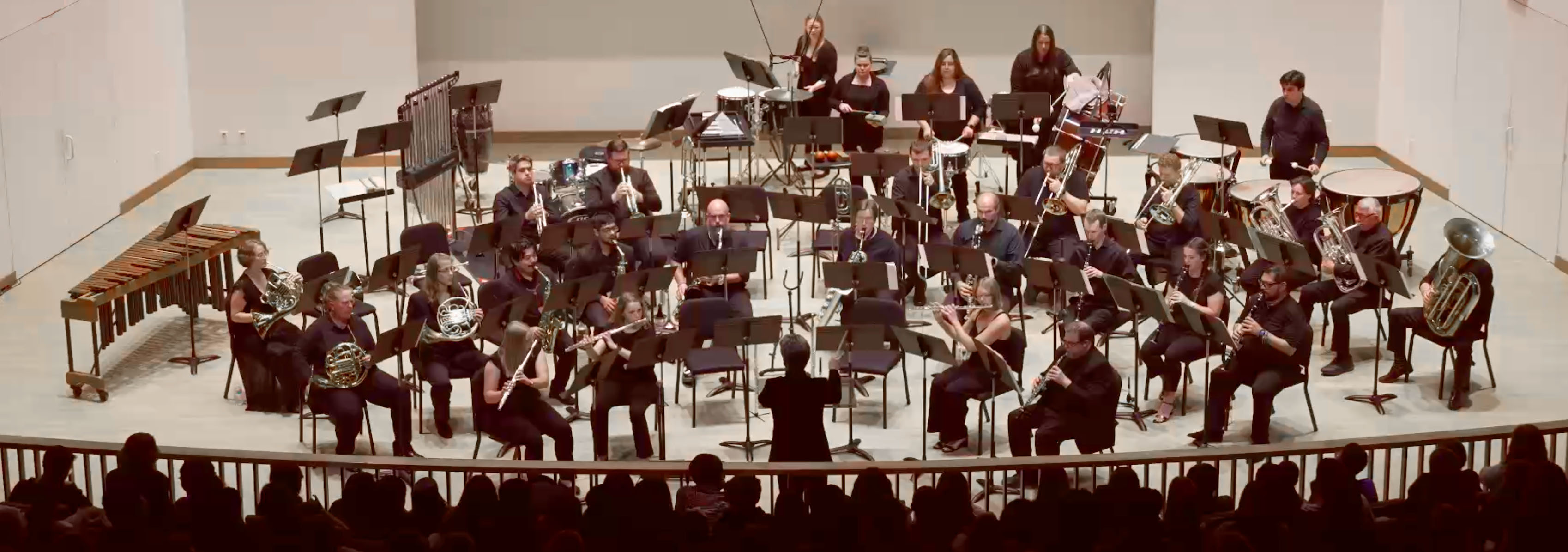
The Dust Coast Winds is an audition-based community ensemble housed at the TTU School of Music. We perform repertoire that will challenge and expand musical boundaries, and our audiences will hear the wide array of sounds that a wind ensemble can offer.

Please fill out the interest form if you want to participate in the ensemble in either the fall of 2026 or spring of 2027 and see the FAQ below for more information.

Dust Coast Winds performing on-stage

You can follow us @Dustcoastwinds on Facebook and Instagram, where we will also be sharing 2026-2027 audition information soon!

EXAMPLE PROGRAM

See an example Program from Spring 2026, with Program Notes by TTU SoM Lecturer of Music Humanities and Dust Coast Winds member, Amelia McElveen:

Music Director’s Note

I wanted to pick something very “Lubbock-esque” as a theme for the Dust Coast Wind’s first concert, and all I had to think about was my first drive into town!

Tumbleweeds, like the Wind Band, can act as a great connector as they spread seeds (elements) of music’s role in society. Each piece on this program, while interesting enough as a “wind work,” also contains some other characteristic in it. These can be poetry, folk songs, popular idioms, or small fragments like chamber ensembles. I encourage you to read Dr. Amelia McElven’s wonderful program notes to see what other “seeds” these pieces carry. We hope you leave this concert curious about learning more about us and the wonderful world of wind music.

Seth Davis  

David Maslanka: Mother Earth

David Maslanka (1943-2017) was an American composer known for his wind ensemble compositions. Maslanka composed Mother Earth in 2003 for a commission by the South Dearborn High School Band. This piece is a short fanfare that celebrates Earth while also serving as a call to action. Maslanka wrote in his own program note that Thích Nhất Hạnh, Vietnamese Buddhist monk and activist, was a major inspiration for this composition due to his philosophy of music as a means of opening our minds. The composer also provides this text, by St. Francis of Assisi, as inspiration:

Praised by You, my Lord, for our sister, MOTHER EARTH, 
Who nourishes us and teaches us, 
Bringing forth all kinds of fruits and colored flowers and herbs.

J.S. Bach: Little Fugue in G Minor, arranged by Mordechai Rechtman

J.S. Bach (1685-1750) was a German Baroque-era composer who wrote complex contrapuntal music. One of his most celebrated genres that features this counterpoint is the fugue. A fugue is a genre and form that always begins with a short subject (melody), after which a second voice answers the subject in a new key while the original voice continues with a countersubject. This subject, or sometimes multiple subjects, is passed across all voices using different contrapuntal techniques such as overlapping entrances, augmentation, and diminution. Bach wrote numerous collections of fugues throughout his life.

Little Fugue in G Minor was composed between 1703-1707 in Arnstadt, Germany, as a four-voice fugue written for organ. Due to its popularity, several composers have composed orchestral and wind arrangements of this work. This specific version was arranged by Mordechai Rechtman (1926-2023), an Israeli composer, arranger, bassoonist, and conductor. In this wind ensemble version, the first iteration of the subject is played by a trio of woodwinds. As each new instrument or instruments enters with either the subject, answer, or countersubject(s), the piece grows in complexity. 

Danielle Fisher: Willows Weeping

Danielle Fisher (1986-) is an Austin-based band director and composer, who studied composition with David Maslanka, Martha Horst, and David Feurzeig. Willows Weeping is a chamber wind composition written for a 2023 commission for Fisher’s close friend, Lisa Preston, and the Normal West Chamber Winds. The piece is written for two flutes, one oboe, two clarinets, one alto saxophone, one tenor saxophone, and one bassoon, with soloistic writing for each of the instruments. Listen closely to the lyrical virtuosity and resolving dissonance between the different voices. The difficulty of this work is in emphasizing the reflective nature of the piece and ensemble balance.

Fisher wrote a poem alongside this piece, included below: 

Willow Trees  

mean many things to many people.

For some,
It's a place where you talk to those you can’t see
or touch anymore.
It's where you seek shelter
under a storm.

They have to be moved by some outside force
for the next layer to be seen.
It's why you grow your hair so long.
You can lift one piece and discover a whole new being.

It was your mother’s favorite.
If ever I were a tree,
I'd be a willow.

I sort of already am.

Gustav Holst: Second Suite in F

Gustav Holst (1874-1934) was an English composer, teacher, and arranger. Holst is most known for his The Planets orchestral suite. His major compositional influences were Richard Wagner and Richard Strauss, which is indicated by his Romantic-era writing. Holst was also influenced by the English folksong movement and Hindu philosophy.

Holst composed Second Suite in F in 1911, and it is the sister suite and a more difficult piece than the more-often played First Suite in E♭. Three of the four movements are based on different English folk tunes. The first movement, titled “March: Morris Dance,” features three distinct folk tunes; the second movement, titled “Song Without Words, I’ll Love My Love,” is based on the folk song “I’ll Love My Love;” the third movement, titled “Song of the Blacksmith,” is based on the tune “A Blacksmith Courted Me;” and the fourth movement, titled “Fantasia on the Dargason,” is not based on a folk tune and is instead based on two melodies from The Dancing Master (1651), a collection of country dances.

Alfred Reed: Two Bagatelles for Brass

Alfred Reed (1921-2005) was a Neoclassical American composer with an extensive wind ensemble, orchestral, and choral opus. His career crossed between several conducting positions, including the 529th Air Force Band, and staff composer positions for both NBC and ABC netwokrs. He also taught theory and composition from 1966-1993 at the University of Miami.

Two Bagatelles for Brass was first published in 1983 as a trombone quartet, but Reed later arranged it for brass choir and wind ensemble. This edition is for brass choir and percussion. The first bagatelle, “Cantando” is in a moderate 3/4 tempo, while the second bagatelle, “Scherzando,” is a contrasting brisk tempo.

Victoriano Valencia: “Chande,” “Bambuco” and “Porro” from Ritmos de la Tierra

Victoriano Valencia (1970-) is a Colombian composer and arranger who is acclaimed for his symphonic band music. He is currently a professor in the Department of Music at Pontificia Universidad Javeriana and teaches a range of courses in composition, jazz studies, and music education. 


“Chande,” “Bambuco,” and “Porro” are three pieces from the composition titled Ritmos de la Tierra, published in 2013. Each movement of the work is based on a form, genre, or style of Latin American music. “Chande” is a coastal Colombian rhythm and is a traditional dance of the Barranquilla Carnival. “Bambuco” is a Colombian genre found in the Andean region, and “Porro” is a musical rhythm associated with Colombian coastal wind band music. This performance features multiple instrumentalists in soloistic sections throughout each movement. 


Marie Douglas: Big City Lights

Marie Douglas (1987-) is an Atlanta-based composer, and her musical upbringing stems partly from her childhood in the inner city of Atlanta. Douglas earned her Doctor of Musical Arts in composition and conducting from the University of Memphis in May 2024. Her compositional style borrows from African diaspora musical idioms and American popular music such as hip-hop and R&B.

Big City Lights (2021) is a wind ensemble composition that borrows heavily from the hip-hop genre, specifically the subgenre “trap music.” This subgenre originates from the American South, specifically Atlanta, and is associated with extensive hi-hat patterns, complex percussion, and layered melodies.

FREQUENTLY ASKED QUESTIONS (FAQS)

TTU Double-T Logo

WHAT DO I NEED TO PARTICIPATE?  

You need your instrument and its equipment, as well as the ability to prepare and perform a grade 4-6 band program. There is a small fee to participate if you are not affiliated with TTU that covers purchasing of sheet music and reservation of parking.  

TTU Double-T Logo

WHEN DOES DCW MEET AND PERFORM?  

We meet on Tuesday nights from 6-7:30pm at Hemmle Recital Hall or a nearby location, starting when the fall semester begins on campus and have a concert usually on the Tuesday of finals week or sometime near then.  

TTU Double-T Logo

WHAT ARE THE EXPECTATIONS?

Members will sign an agreement upon joining the group that commits them to attend a certain number of rehearsals based on the semester. Additionally, as the time window for rehearsals are tight, please only commit to the ensemble if you can attend rehearsals on time. 

TTU Double-T Logo

WHAT IS THE ENSEMBLE PERFORMING THIS YEAR?

We will be playing works by Percy Grainger, Margaret Bonds, Paul Hindemith, Marie Douglas, Eric Whitacre, and many others. The Fall program will be a little shorter and follow more of a narrative format while the Spring concert will be more traditional experience. 

dust coast winds Faculty